
Meta Patent Reveals AR Glasses That Translate Text Before You Read It
Meta has filed a patent for AR glasses that translate foreign-language text in your surroundings before you consciously decide to read it, then display the translation the moment your eyes settle on it.
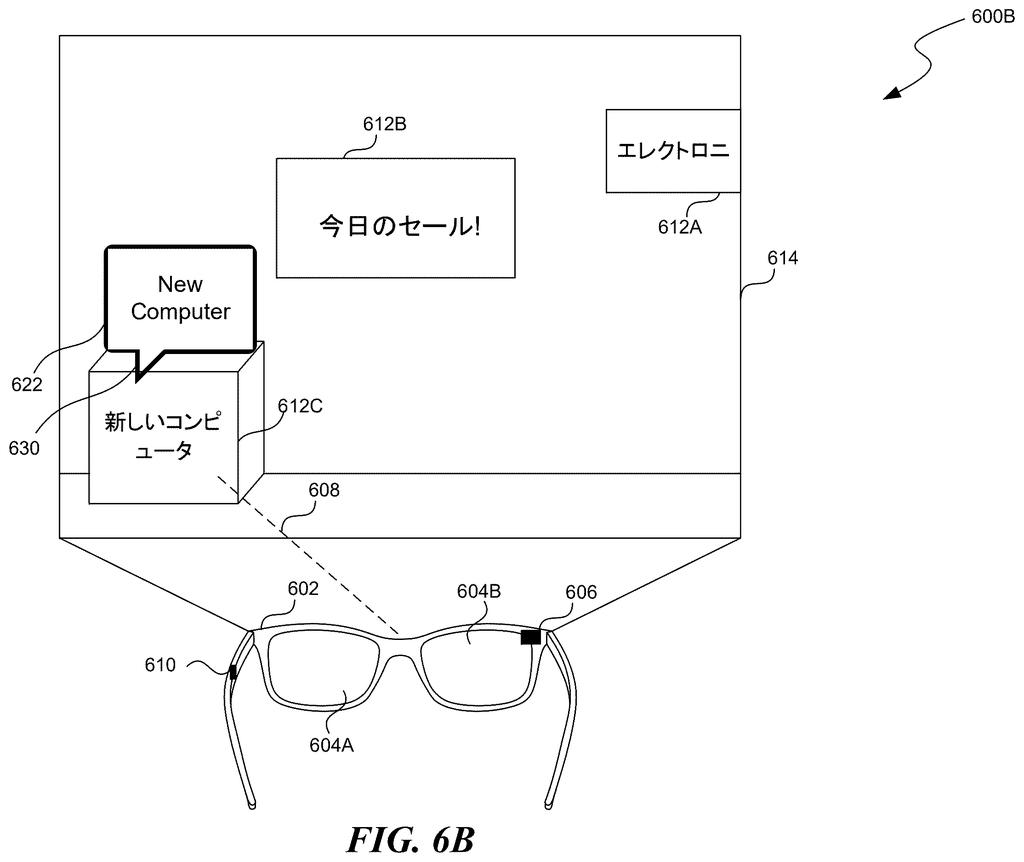
How Meta's AR glasses handle foreign text for you
You're walking through a foreign city and every sign, menu, and storefront is in a language you don't speak. You could pull out your phone, open a translation app, and point it at each thing one at a time. Meta's patent describes a way to skip all of that.
The idea is that the glasses are already scanning everything in front of you in the background. The moment the cameras spot text that isn't in your native language, the system translates it automatically, even before you've looked at it. A second set of cameras, pointing inward at your face, watches where your eyes go. Once you look at a sign for long enough (a brief, deliberate stare the system calls a "gaze dwell"), the translated text appears on the lens right over the original.
The result is a translation experience that feels less like using a tool and more like a natural part of seeing. You just walk around, look at things, and the words make sense.
detecting, by an artificial reality system, one or more text segments, in the first language, in a field-of-view of the artificial reality system in a real-world environment; automatically translating the one or more text segments from the first language to the second language …
Translation: The glasses constantly scan your surroundings to find foreign words and translate them into your preferred language.
How gaze detection triggers the translation overlay
The system runs two parallel processes continuously. The outward-facing cameras on the AR glasses scan the visible environment in real time, identifying any text in the user's field of view. If that text is in a language other than the user's configured base language, the system sends it through a translation pipeline immediately, in the background, without waiting for any user action.
At the same time, inward-facing cameras monitor the user's eyes. The key concept here is gaze dwell: the system measures how long and how deliberately the user's gaze rests on a particular piece of text. A brief glance while walking past doesn't trigger the overlay; a longer, focused look signals intent to read.
When the system detects that intent, it pulls the pre-computed translation for that specific text segment from its internal buffer and renders it on the AR display, overlaid on or near the original text. Because translation already happened in the background, there's little or no visible delay between the user deciding to read and the translated text appearing.
- Outward cameras: continuously detect and extract text from the environment
- Background translation engine: translates non-native text proactively
- Inward eye-tracking cameras: measure gaze dwell to infer reading intent
- AR overlay renderer: displays the translation on the lens when intent is confirmed
Inward-facing cameras can detect the user's gaze and determine whether the user has an intent to read the text, e.g., based on a gaze dwell on the text. If the system determines that the user has the requisite intent, the system can seamlessly display the translated text to the user …
Translation: Internal cameras track your eyes to see if you are staring at a sign, then show you the translation only when you look.
What this means for AR as a language barrier tool
For anyone who has spent time in a country where they don't speak the language, the friction of translation apps is real. You stop, open the app, frame the shot, wait. This patent describes a system where that friction disappears, turning the glasses into a quiet, always-on interpreter that only surfaces when you actually need it. The gaze-dwell trigger is a thoughtful design choice: it means you aren't bombarded with translation overlays for every bit of background text you walk past.
The hardware requirements here are not trivial. This needs outward cameras capable of live text recognition, inward eye-tracking cameras, enough on-device processing power to run translation in real time, and a display that can layer text naturally over the real world. Meta already has eye-tracking in some of its headsets and has been building toward lighter AR glasses for years. The plain-English patent summaries Patentlyze covers in the AR space consistently show Meta pushing gaze-aware interaction as a core design pattern, and this filing fits squarely in that line of work.
The gap between this patent and a shipping product comes down to the hardware. The software pipeline, background translation plus gaze-intent detection, is plausible with current AI capabilities, and translation models are already fast enough for near-real-time use on capable chips. What Meta doesn't yet have publicly is a pair of true AR glasses (with a see-through display and the full camera array described here) light enough for all-day wear. The likeliest route is a capability that ships first in a heavier mixed-reality headset, then migrates down to lighter hardware as the component supply chain matures; the AI is ready before the form factor is.
There are more where this came from
We read every patent application Big Tech publishes and send you the ones worth knowing. Plain English, free, every week.
The drawings
11 drawing sheets from US 2026/0237161 A1 · click any drawing to enlarge


Want this weekly breakdown for a company we don't cover? Patentlyze Pro →
Be the first to weigh in