
Samsung Patents a Speaker Built Into a Sliding Phone's Inner Rail
Samsung is exploring a way to fit a speaker directly inside the structural rail that lets a phone's screen slide open, freeing up precious space without cutting sound hardware.
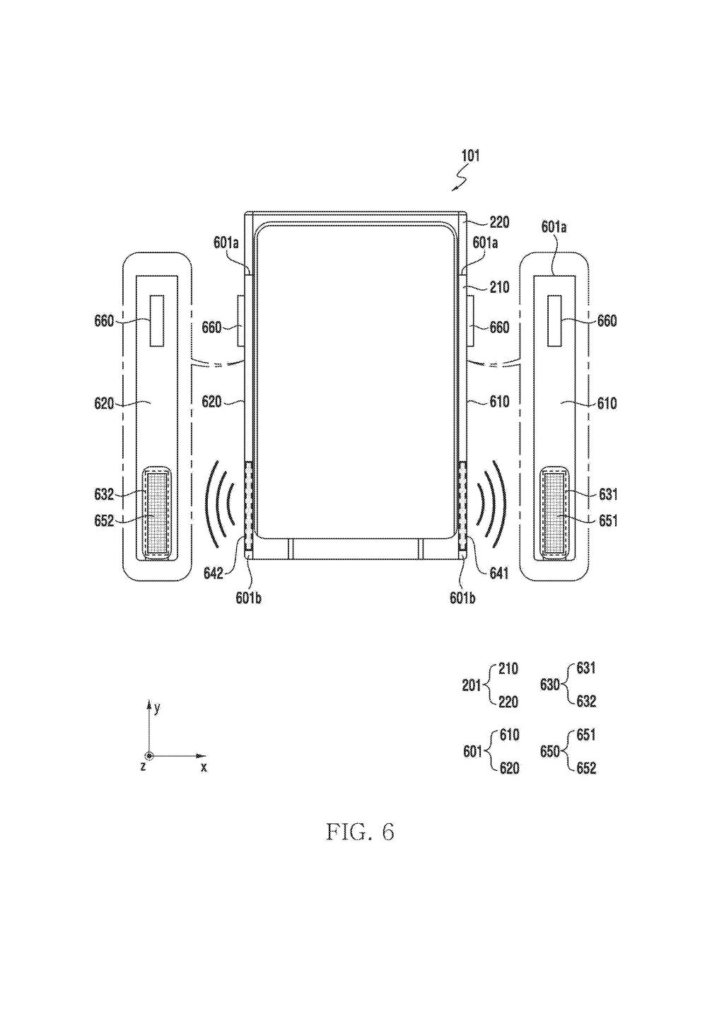
How Samsung hides a speaker inside a sliding phone's frame
A phone slides open on a hot summer day, and its owner winces knowing that every millimeter of space inside that expanding body is already spoken for. You have a battery, a display, antennas, and a frame that has to slide smoothly, all crammed together.
Samsung's patent addresses exactly that squeeze. Instead of carving out a separate chamber for the speaker somewhere in the phone's body, the design tucks the speaker module into the sliding guide rail itself, the track that lets one half of the phone glide over the other. A small opening in the side of the housing lines up with the speaker's vibrating cone, letting sound out without requiring extra real estate.
The result is a phone that doesn't have to choose between a sturdy sliding mechanism and decent speakers. Both live in the same structural piece.
… a speaker module including: a speaker including a diaphragm, and an enclosure surrounding at least portion of the speaker, wherein the speaker module is at least partially disposed in a recess formed at the first guide part and an opening formed at a side of the first housing part …
Translation: The speaker is tucked into a small gap inside the phone's sliding rail mechanism and faces an opening on the side of the device.
How the diaphragm lines up with the housing opening
The patent describes a sliding phone made of two housing parts that move relative to each other, like a classic slide phone but potentially for a screen-extending device. Inside runs a guide member, a two-part track that keeps the halves aligned as they move.
The key move: the speaker module sits in a recess carved into the first guide part (the stationary half of the track) rather than in a standalone cavity inside the housing. The module includes both the speaker driver and an enclosure (a sealed or semi-sealed box that surrounds the driver to shape the sound).
A small opening on the side of the housing aligns with the speaker's diaphragm (the thin vibrating membrane that produces sound). The patent specifies that at least part of the diaphragm must overlap with that opening, ensuring an acoustic path to the outside world.
- The guide rail does double duty: structural track and speaker housing.
- The enclosure is integrated into the rail's recess, not bolted on separately.
- The side-firing opening keeps the speaker port away from the main display face.
An electronic device according to one embodiment comprises a housing including a first housing part and a second housing part, a guide member including a first guide part and a second guide part movably coupled to the first guide part, and a speaker module of which at least a portion is disposed in a recess …
Translation: This phone uses a sliding rail system to move two housing parts, with a speaker module built directly into the sliding track.
What this means for thin, sliding-screen phone design
Sliding and extending phones are among the hardest devices to engineer because every component has to coexist with a moving frame. Speakers are usually victims of that constraint, either shrunken to the point of sounding thin or positioned awkwardly. Folding the speaker into the guide rail is a space-accounting trick: one part does two jobs, which means the saved volume can go to battery or cooling.
The obvious cost is acoustic. A speaker enclosure built into a structural rail will have irregular geometry and limited volume, both of which affect bass response and overall loudness. Whether Samsung's engineers can tune around those limits is the real question this patent leaves open. Filings like this one sit alongside the newest Big Tech patents reshaping how phone makers approach sliding and foldable form factors, a category where every cubic millimeter of internal space is contested.
Samsung's 56th filing we've tracked since May in our foldable phone patents follows work like the two-layer adhesive screen and the tri-fold touch fix.
Putting a speaker inside a sliding rail is a real engineering compromise. The rail is shaped for sliding, not for sound, so the speaker chamber is awkward from the start. Shallow, oddly shaped speaker chambers usually hurt bass and overall volume.
Samsung is betting that the space saved elsewhere in the phone makes that trade worth it. For a thin sliding phone where every millimeter counts, that is a reasonable call.
Whether the sound actually suffers enough for users to notice depends on how well Samsung builds it. The patent gives no clues on that.
Get our take in your Top Stories
Liked this breakdown? Add Patentlyze as a preferred source on Google, and our plain-English take shows up more often in your Top Stories the next time Samsung patent news breaks.
There are more where this came from
We read every patent application Big Tech publishes and send you the ones worth knowing. Plain English, free, every week.
The drawings
24 drawing sheets from US 2026/0246864 A1 · click any drawing to enlarge


Want this weekly breakdown for a company we don't cover? Patentlyze Pro →
Be the first to weigh in