Samsung
Samsung · Display · Filed Apr 10, 2026 · USPTO published Aug 20, 2026 · Aug 20 release
Samsung Patents a Tri-Fold Phone That Cancels Accidental Touches When You Open It
Tri-fold phones have a unique problem: if you tap something on one panel and then open another panel a split second later, which input wins? Samsung's new patent answers that directly.
- Publication number
- US 2026/0246861 A1(US20260246861A1)
- Applicant
- Samsung Electronics Co., Ltd.
- Filed · Published
- Apr 10, 2026 · Aug 20, 2026
- Inventors
- Kwangtaek WOO, Sangheon KIM, Yonggil HAN
- Status when we published
- Waiting for an examiner
- Document
- 20 claims
- US classification
- 455/566
- Parent application
- Continuation of PCT/KR2024/017261 (filed Nov 5, 2024)(PCTKR2024017261)
How Samsung's tri-fold handles touches mid-unfold
Today's foldable phones already make it tricky to know which part of the screen is "live" at any given moment. A phone with three separate folding panels multiplies that confusion considerably, because a user might touch one section of the screen while simultaneously beginning to unfold a different hinge.
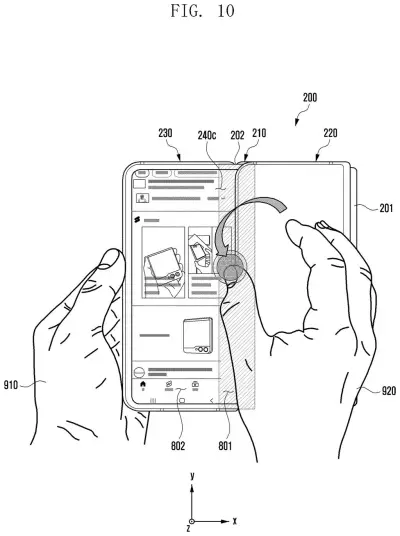
Samsung's patent describes a specific fix for that scenario. On a three-panel phone where two panels are already open and a third is still folded, the device watches for the moment you start unfolding that third hinge. If it catches a hinge movement starting right after you've tapped something, it cancels that tap rather than acting on it. The logic is that the opening motion likely means you didn't intend the tap in the first place.
The result is that accidental touches during unfolding don't trigger unwanted actions, like launching an app or deleting a message, just because your fingers were resting on the screen while you opened the device.
… detect an unfolding movement of the first hinge assembly, and based on the unfolding movement of the first hinge assembly, deactivate the touch input on the first portion of the third display area.
Translation: It notices when you open the hinge and ignores any accidental touches happening on the screen while you do it.
How the hinge sensor kills the stale touch input
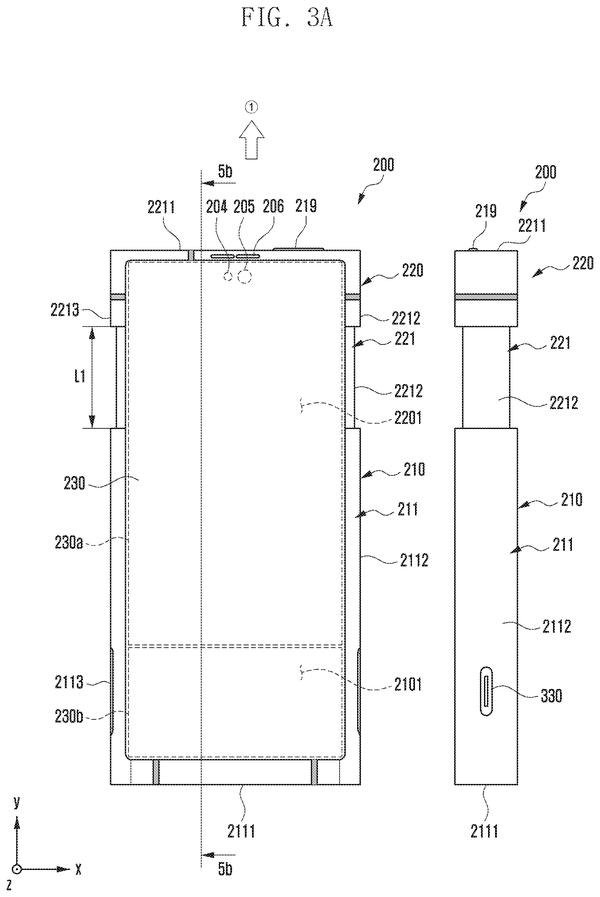
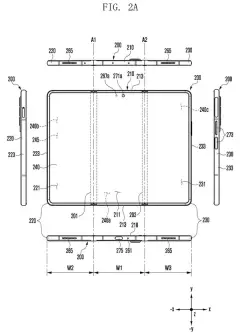
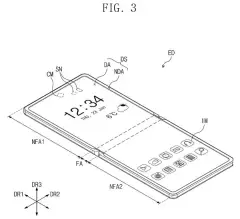
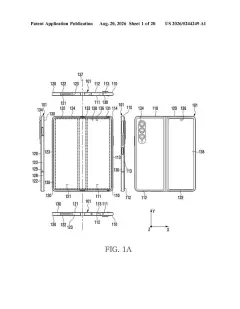
The patent describes a phone with three physical housings, each carrying a section of one continuous flexible display. Two hinges connect them: one between the first and second housing, another between the first and third. The device can be in various fold states at once, for example, the third panel open flat while the second panel is still folded closed.
The core claim covers a specific sequence of events:
- The device receives a touch input on the display area of the third (open) panel.
- After that touch lands, the device's sensors detect that the other hinge (the one connecting panels one and two) has started to move toward the open position.
- Based on that hinge motion, the device deactivates the earlier touch input, treating it as unintentional.
Each housing contains its own sensor, and those sensors feed into a processor that monitors hinge state in real time. The key insight is that hinge-opening movement is used as a signal to retroactively discard a touch, rather than simply ignoring future touches while the hinge moves. That retroactive cancellation is what the independent claim specifically protects.
A multi-foldable electronic device is provided. The multi-foldable electronic device includes a first housing including a first sensor, a second housing foldably coupled to a first side of the first housing and including a second sensor, a third housing foldably coupled to a second side of the first housing and including a third sensor …
Translation: The patent describes a device built with three connected sections that track their positions using built in sensors.
What this means for multi-fold phone usability
For anyone who has accidentally triggered something on a foldable phone just by gripping it while opening it, this is a practical quality-of-life fix applied to a more complicated device than any currently on sale. Tri-fold hardware is coming, and the interaction problems multiply with each added hinge. Getting touch arbitration right before the hardware ships matters more than it might seem.
The broader context is that Samsung is building out the software behavior layer for multi-fold devices at the same time as the physical engineering, and this kind of hinge-aware touch logic is part of that foundation. Other folding-phone patents covering similar display-management territory are among this week's Big Tech patents tracking how manufacturers are defining the rules for a new device category.
Samsung's latest application is the 54th we've tracked in our foldable phone patents watchlist since May, adding to earlier work like a corner magnet seal and a foam screen buffer.
Source: US 2026/0246861 A1 at the USPTO (PDF). Full patent text and figures are in the official publication.
Get our take in your Top Stories
Liked this breakdown? Add Patentlyze as a preferred source on Google, and our plain-English take shows up more often in your Top Stories the next time Samsung patent news breaks.
Add Patentlyze on Google
One click.
There are more where this came from
We read the new patents from Big Tech, carmakers and more and send you the ones worth knowing. Plain English, free, every week.
The drawings · 16 sheets
16 drawing sheets from US 2026/0246861 A1 · click any drawing to enlarge


Show the other 8 sheets


More from Samsung
All 1,662 Samsung patents →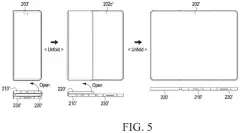
More in Cell phone
All 496 Cell phone patents →
Samsung
Samsung Patents a Corner Magnet Design to Keep Foldable Phones Sealed
Samsung
Samsung Patents a Two-Layer Adhesive System for Foldable Phone Screens
Samsung
Samsung Patents a Spring-Loaded Gear Hinge for Its Foldable Phones
Samsung