Samsung
Samsung · Display · Filed Apr 16, 2026 · USPTO published Aug 27, 2026 · Aug 27 release
Samsung Patents a Camera Placement System for Phones That Fold Twice
Samsung is solving one of the hardest puzzles in foldable phone design: where do you put a front-facing camera when your screen folds in three separate places?
- Publication number
- US 2026/0254891 A1(US20260254891A1)
- Applicant
- Samsung Electronics Co., Ltd.
- Filed · Published
- Apr 16, 2026 · Aug 27, 2026
- Inventors
- Soli JUNG, Jeongho KANG, Namwoo KIM, Minho KIM, Changi PARK, Jaeuk AHN, Yeonggyu YOON, Junyoung CHOI, Hyunchul HONG, Byounguk YOON
- Status when we published
- Waiting for an examiner
- Document
- 15 claims
- US classification
- 455/575.3
- Parent application
- Continuation of PCT/KR2024/013623 (filed Sep 9, 2024)(PCTKR2024013623)
What Samsung's triple-fold camera layout actually does
A phone folds in half on a crowded subway and the selfie camera ends up pressed against the hinge, unusable. That problem gets multiplied when your phone has two hinges instead of one, and you suddenly have three separate screen panels to think about.
Samsung's patent tackles this by assigning each panel a specific job. The outer panel gets the front camera, so it's always accessible no matter how the phone is folded. The other outer panel houses the electronics that actually power the display. The middle panel is left clean, acting as the anchor between the other two.
This isn't a cosmetic choice. Where you put the camera and where you put the display-driving chip affects heat, battery life, and how thin each panel can be. Samsung is essentially working out the floor plan of a phone that doesn't quite exist in the market yet.
a foldable housing comprising a first housing, a second housing, and a third housing; a first hinge assembly disposed between the first housing and the second housing; a second hinge assembly disposed between the first housing and the third housing …
Translation: The phone uses three connected sections and two hinges to fold up.
How Samsung splits the camera and display driver across panels
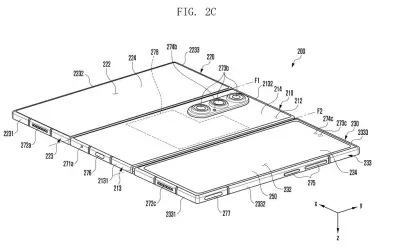
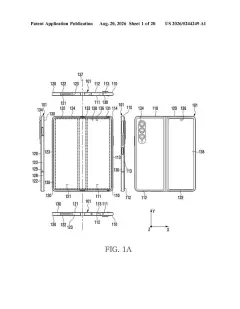
The patent describes a portable device with three housing sections connected by two separate hinge assemblies. Think of it like a tri-fold brochure: a center panel, and two wings that fold inward or outward independently.
Stretched across all three panels is a single flexible display, but the patent treats each panel's screen area as distinct. The key decisions are:
- The front camera sits in the third housing's display area, meaning the outermost wing on one side.
- The display driving circuit (the chip that tells every pixel what color to show) lives in the second housing's display area, the opposite outer wing.
- The center panel holds neither, keeping its profile as slim as possible.
By separating the camera from the display driver and putting each on a different outer panel, Samsung avoids stacking bulky components in the same place. The display driving circuit is explicitly called out in the claim because on a flexible screen that bends repeatedly, where that chip sits affects signal routing, heat distribution, and whether the bending zones stay thin enough to actually fold.
… a flexible display including a first display area supported by the first housing, a second display area supported by the second housing, and a third display area supported by the third housing, and a first front camera disposed in the third display area of the third housing.
Translation: One continuous screen spans all three sections, with a camera hidden in the third part.
What this means for foldable phone design trade-offs
For anyone who has used a current foldable phone, the camera placement problem is real: Samsung's existing Galaxy Z Fold puts the selfie camera in a punch-hole cut-out in the inner screen, which limits how much of that screen you can use. A three-panel device makes that trade-off even sharper because there are now two fold lines to avoid. Dedicating one outer wing to the camera and the other to the display electronics is a practical attempt to stop those components from competing for the same limited real estate.
This filing sits at the early-blueprint stage. Real, mass-produced tri-fold hardware would need display materials that survive two separate daily bend points without degrading, hinge mechanisms precise enough to keep a single flexible panel aligned across three sections, and thermal management for a chip sitting in a panel that bends. Samsung's Galaxy Z Fold lineup shows the company is committed to the foldable category, but a triple-fold device at consumer scale is still a meaningful engineering distance away, and filings like this one are part of a broader wave of interesting tech patents mapping out where foldable display engineering is heading.
Samsung's 62nd filing we've tracked in our foldable phone patents watchlist since May builds on work like one on preventing screen cracks and one on sliding-screen audio.
Source: US 2026/0254891 A1 at the USPTO (PDF). Full patent text and figures are in the official publication.
Get our take in your Top Stories
Liked this breakdown? Add Patentlyze as a preferred source on Google, and our plain-English take shows up more often in your Top Stories the next time Samsung patent news breaks.
Add Patentlyze on Google
One click.
There are more where this came from
We read the new patents from Big Tech, carmakers and more and send you the ones worth knowing. Plain English, free, every week.
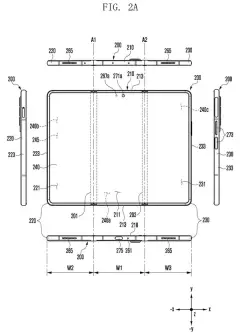
The drawings · 36 sheets
36 drawing sheets from US 2026/0254891 A1 · click any drawing to enlarge


Show the other 28 sheets


More from Samsung
All 1,662 Samsung patents →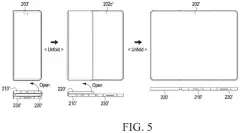
More in Cell phone
All 496 Cell phone patents →
Samsung
Samsung Patents a Corner Magnet Design to Keep Foldable Phones Sealed
Samsung
Samsung Patents a Tri-Fold Phone That Cancels Accidental Touches When You Open It
Samsung
Samsung Patents a Two-Layer Adhesive System for Foldable Phone Screens
Samsung