
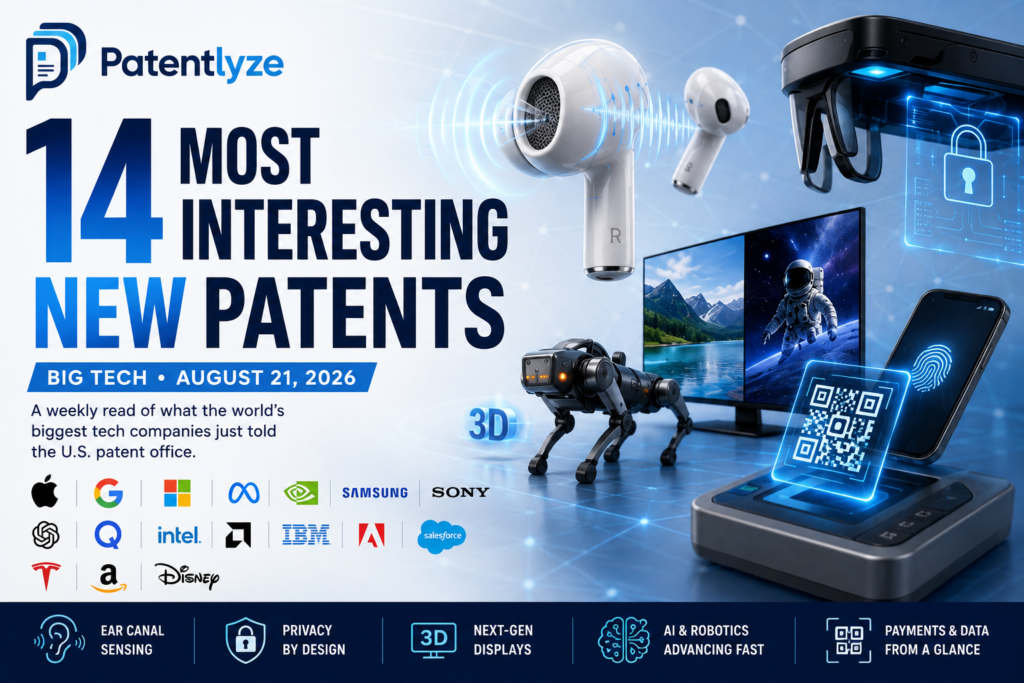
A weekly read of what the world’s biggest technology companies just told the U.S. patent office.
Another heavy week: we wrote up 231 filings, with Samsung out front at 50, then Sony with 34, Qualcomm with 25, and Google with 23. The full run lives under this week’s Big Tech patents; these fourteen stood out.
1. Google Patents Earbuds That Listen to Your Ear Canal to Catch Chewing, Sleep, and Teeth Grinding
Your fitness tracker knows your steps. Nothing you own knows whether you grind your teeth at night. Google has filed for earbuds that bounce sound off your ear canal and read the echoes to figure out what your body is doing.
The earbud plays a signal into your ear and listens to what comes back. Chewing, jaw tension, and sleep each change the echo in their own way, so the software can tell them apart. A tiny sonar system, pointed inward.
The clever part is the layering. Once the system decides you are asleep, it uses that fact to sharpen its guess about whether you are also grinding your teeth, so each detection helps the next instead of running blind.
The catch: every ear canal is different, and the same ear changes with earbud fit, earwax, and temperature. One small microphone carries the whole system, and for health features a wrong guess has real consequences.
2. Meta Patents a Mute Switch That No App, Hack, or Update Can Override
Every mute button you own is a software promise. Software can be patched, hacked, or silently updated. Meta has filed for a chip-level mute switch that code cannot touch.
A small dedicated circuit sits apart from the main processor, and its only job is to hold the mute state and enforce it on the microphones and cameras. It answers to one thing: a physical signal, like a real button. No app can reach it.
The switch flips all at once, with no halfway state for an attacker to exploit. Even if every layer of software on the device is compromised, the sensors stay off.
This is built for AR glasses, which sit on your face all day with a camera pointed at people who never agreed to be filmed. Last week Apple filed alert tones that cannot be faked; this week Meta files the off switch. Privacy is moving out of software and into the metal.
3. Sony Patents a Screen That Shows Two People Two Completely Different Pictures
Two people, one TV, one compromise. Sony has filed for a screen that shows each viewer something entirely different at the same time, and gives one of them 3D without glasses.
Two thin optical layers sit on the screen. The first routes some pixels toward one viewer and other pixels toward the second. The other layer splits the first viewer’s picture into a left-eye and right-eye feed, which is what makes 3D work without glasses.
A sensor tracks where the 3D viewer is sitting, and the processor rebuilds the picture for that exact spot. The layers never move; the content does the adjusting.
Glasses-free 3D has always died the moment you leave the sweet spot, and tracking the viewer attacks that head-on. What the filing cannot prove is whether one viewer’s picture bleeds into the other’s in a real living room.
4. Nvidia Patents “Teleportation”: Your Real Room, Rebuilt in VR for a Remote Guest
A video call shows a flat rectangle of someone else’s world. Nvidia has filed for what it calls teleportation: a system that rebuilds your real room in VR so a remote guest can walk through it.
The host wears sensors that scan the room. For each real object, the system finds the closest match in a library of ready-made 3D models and places it exactly where the real thing sits, so a worn wooden chair becomes a clean rendered chair in the same spot.
The remote guest drops into that copy as an avatar and sees the host as an avatar too, with the whole scene streaming live. Less like a call, more like visiting.
The weak point is the library. Real rooms are full of things with no good match, and a bad swap makes the space feel hollow, which defeats the point of being there. Heavy on-headset computing rounds out the reasons this lands in offices before living rooms.
5. Google Patents a Way to Read Health Numbers From a Photo of a Screen
Health monitors show your numbers on their own little screens, and moving those numbers anywhere else often means typing them by hand. Google has filed for software that pulls the reading straight out of a photo of the screen.
The trick is that the phone learns the target screen’s layout ahead of time: how it draws its digits, how it arranges its display. With that as a decoder key, it can separate the actual reading from glare, angle, and bad lighting. The output is data, not a picture of numbers.
It is nearly all software, so any phone with a camera could run it. The obstacle is that decoder key: Google needs deals with device makers, or a giant library of screen layouts, before this works in the wild.
The bigger idea is treating any screen as a data channel. Health numbers from gadgets Google has no hardware relationship with could flow into its ecosystem through the camera alone.
6. Microsoft Patents an AI That Turns Your Scattered Browsing Into One Tidy Profile
Every site you visit logs you in its own vocabulary, so the picture any one service has of you is patchy. Microsoft has filed for an AI pipeline that condenses all of it into a single profile every service reads the same way.
The system groups your clicks and searches by meaning rather than wording, so “best pasta recipe” and “easy dinner ideas” land in the same bucket. A language model then names each bucket in plain words, something like “cooking” or “travel planning.”
Your profile is written in those shared names. Any recommendation engine on the platform reads the same summary of you instead of building its own incomplete version.
You would never see this working. You would only notice fewer suggestions that feel like they were made for someone else, which is exactly the failure it exists to prevent. For a company selling ads, one clean profile layer is worth a lot.
7. Sony Patents a System That Counts Your Tries and Locks You Out at the Limit
“You have used all your attempts for today.” Anyone who plays live-service games has hit that wall. Sony has filed for a console-level system that counts your tries and enforces the cutoff.
The limit lives in a stored record the system checks on every attempt. A counter goes up each time you try the activity, and when it reaches the stored maximum, play is restricted. The claim covers consoles, cloud servers, and anything in between.
The detail that matters: the number lives at the platform level, not inside the game’s own code. Sony could standardize limits, audit them, or tie them to subscriptions across its whole catalog.
A fair daily cap on a ranked mode is one thing. A paywall dressed up as a rule is another. The mechanism is neutral; who controls the number is the question, and set against Sony’s other filings this week, the answer looks like the platform.
8. OpenAI Patents a Memory Chip That Searches Itself
When an AI assistant checks its knowledge base, it hauls mountains of data out of memory just to find the few pieces it needs. OpenAI has filed for a memory chip that does the searching in place, so only the winners ever leave.
Today’s setup works like finding one book by loading every book onto a truck and checking them back at the office. This design puts the librarian inside the warehouse: comparison circuits sit next to the stored data, check everything on the spot, and hand back only the matches.
The payoff is faster answers and a smaller power bill, because moving data around is where much of the cost of running AI actually goes.
The trade is a chip that is harder and pricier to build, and the filing never shows whether the energy savings win that math. The other story is the filer: OpenAI is a model company now writing silicon patents.
9. Microsoft Patents a Fingerprint for Cyberattacks
A security dashboard lights up with forty alerts. Is that one attack or five, and did the same crew hit you six months ago? Microsoft has filed for a system that compresses each incident into a searchable fingerprint.
Related alerts are mapped into a graph: each event is a point, the connections show how events relate, and labels carry details like the device involved and the time of day. A model then squeezes that whole picture into one compact signature the patent calls a thumbprint.
New thumbprints are compared against a library of old ones. A match says this looks like the group from last quarter, and the response starts from evidence instead of one analyst’s memory.
The expensive part of an attack is often failing to recognize the second one. Giving every incident a reusable signature aims at exactly that gap, and it slots naturally into Microsoft’s security products.
10. Google Patents a Cheaper Way to Train the Model That Orders Your Search Results
Every ranked list you see was ordered by a model, and most ranking models are trained by comparing items two at a time. That gets expensive fast and bakes in subtle bias. Google has filed for a training method that judges the whole list at once.
The model scores every item in a list of three or more, then collapses those scores into a single probability for the whole ordering. That one number drives the training update, replacing the grind through every possible pair.
Cheaper training means faster iteration on everything ranked: Search, YouTube, Shopping. The filing also claims the trained models come out less biased.
The claim is broad enough to reach past Google, covering a wide range of systems built on a similar training loop. If it is granted at that breadth, anyone building ranking models would need to read it twice. It is the standout of Google’s 23 filings this week.
11. Disney Patents an App That Warns You Off Rides You Would Hate
Nothing sours a park day like discovering the strobe lights or the big drop after an hour in line. Disney has filed for a system that checks each ride against your profile and warns you first.
Your likes and aversions live in a profile: loud sound, darkness, spinning, scary themes. Attractions broadcast their characteristics, and when something clashes with your profile, your phone or wristband gets an alert before you commit to the line.
It works the other way too, flagging rides that match what you love. Families juggling different tolerances get a finder as much as a filter.
For guests with motion sickness, sensory sensitivities, or a condition like photosensitive epilepsy, this is a real quality-of-life feature, not a novelty. Disney’s app and wristband ecosystem is already halfway set up to deliver it, which makes this one of the more shippable filings on the list.
12. Nvidia Patents One AI Brain for Humanoids, Robot Dogs, and Wheeled Carts
A humanoid, a four-legged robot, and a wheeled cart share almost nothing physically, so each has needed its own AI trained from scratch. Nvidia has filed for a single model that can drive any of them.
You tell the model what body it is wearing, hand it the robot’s current state and destination, and it outputs the right motor commands for that body. It learned by having specialist models for each robot type teach one generalist to imitate them all.
For anyone running a mixed fleet, that means updating one model instead of five. Adding a new robot body becomes a fine-tune instead of a rebuild.
The honest trade: a generalist gives up some peak performance on any single body. Fine for a warehouse, a poor fit for surgery or rescue work. Paired with the teleportation filing above, Nvidia’s week reads like a company building the software layer above its chips.
13. Apple Patents a Real Zoom Lens Thinner Than Four Credit Cards
The “3x” button on your phone usually switches to a different fixed lens rather than zooming. Real zoom needs lenses that move, and moving parts need room a thin phone does not have. Apple has filed for a true optical zoom that fits in under 6 millimeters.
Three groups of lenses each get their own tiny motor. When you pinch to zoom, a controller moves each group a different distance, some one way and some the other, and that choreography squeezes a full zoom range into a stack about four credit cards tall.
The payoff is smooth, sharp zoom at the in-between levels a lens-switcher cannot give you, with an opening wide enough to keep low-light shots usable.
The question is survival. Three moving groups have to hit exact positions every time, through a year of drops, cold mornings, and hot cars. Manufacturing tolerances will decide this one, not optics.
14. Samsung Patents AR Glasses That Pay When You Look at the Code
At a counter with both hands full, paying still means digging out a phone. Samsung has filed for AR glasses that complete a payment by tracking where you look.
The glasses watch both eyes and find the point where your gaze lines meet. They crop the camera’s view to that exact spot, enlarge it, and scan it for a payment QR code. A glance becomes the scan.
Hands-free checkout is the right problem for glasses: a worker holding parts, a shopper carrying bags, anyone mid-task. The filing stakes out that territory plainly.
What it does not describe is what happens when the eye tracking is unsure right before money moves. Bright sun, shifted frames, or a stray glance at the wrong poster are exactly where a payment product lives or dies, and that safety layer is the missing half.
What ties them together
The split this week is between machines that get better at knowing you and hardware that proves what a machine is doing. Google is listening inside your ear canal and reading health screens through a camera. Microsoft is assembling your browsing into one clean profile, Disney is profiling your aversions, and Samsung is watching your eyes at the exact moment you pay.
The other column answers it. Meta’s mute state lives where software cannot reach, and Microsoft’s attack fingerprints replace hunches with evidence. The industry is filing the sensor and the off switch in the same envelope, and the terms of the next argument are already visible: what the device knew, who set the limit, and whether the off switch was real.
Patentlyze reads every new patent application that Apple, Google, Microsoft, Meta, Nvidia, Samsung, OpenAI, Qualcomm, Sony, Intel, AMD, IBM, Adobe, Salesforce, Tesla, Amazon, and Disney file at the USPTO, and writes a plain-English breakdown of the ones that say something about where products are heading. New filings drop every Thursday. The full archive lives in our patent library.
Get lists like this in your inbox
We read every patent application Big Tech publishes and send you the ones worth knowing. Plain English, free, every week.