
Sony Patents a Screen That Shows Two Different People Two Completely Different Images at Once
One screen, one moment, two completely different images: Sony is working on a display that can show a full 3D experience to one person in the room while someone else looking at the same screen sees something entirely different.
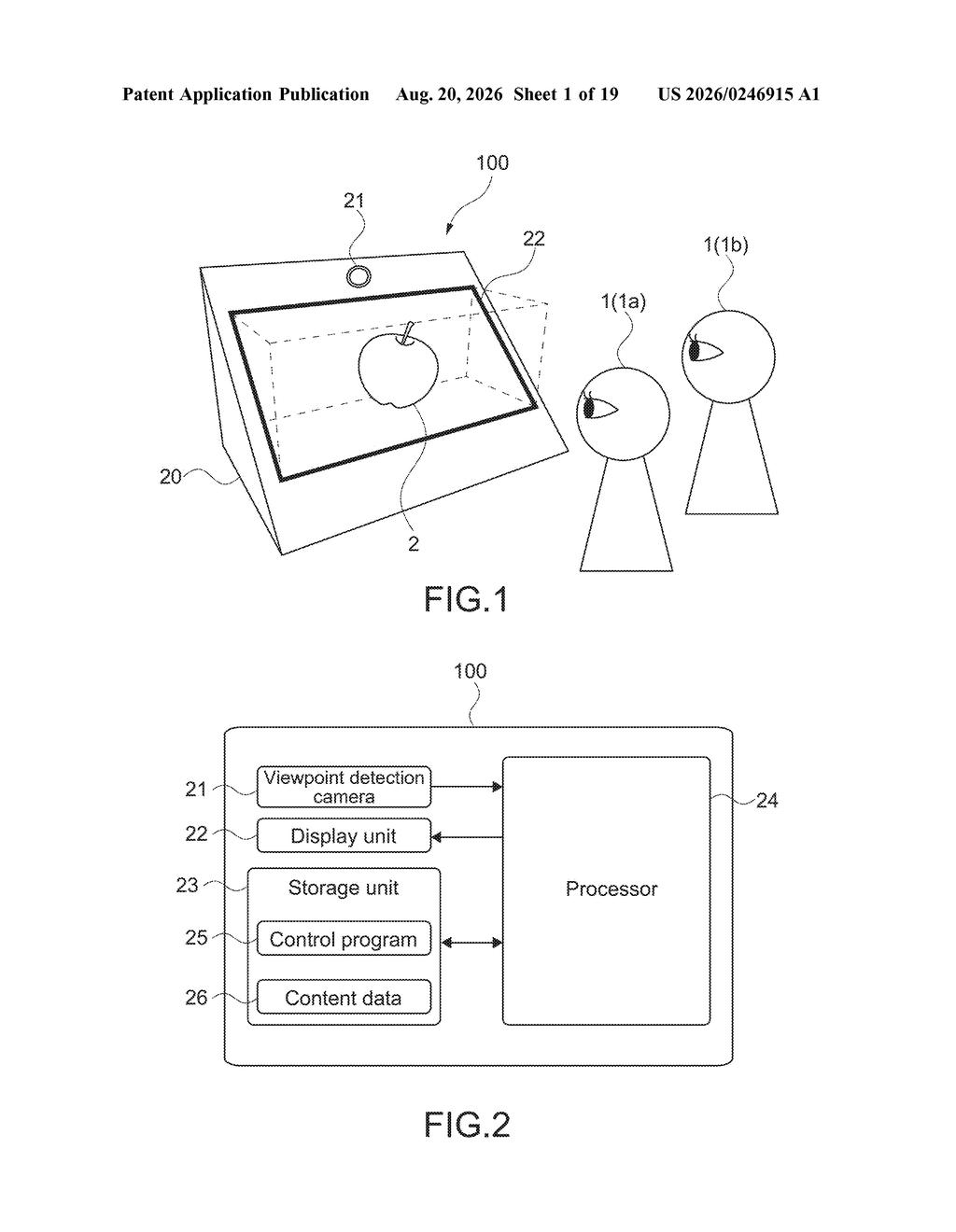
How Sony's split-view display separates what each person sees
Every time two people sit down in front of the same TV and one of them wants to watch a movie while the other wants to play a game, they compromise. Sony's patent describes a screen that would make that compromise unnecessary, at least in terms of what each person actually sees.
The display tracks where each viewer is sitting and uses physical optical layers built into the screen itself to route different images to different people. One viewer gets a full stereoscopic 3D image, with separate pictures sent to their left eye and their right eye. The other person gets their own completely separate image, no 3D required. No glasses, no head-mounted hardware, just the screen doing the sorting.
The system relies on a sensor to figure out where viewer one is positioned in the room, then generates left-eye and right-eye images tailored to that exact position. At the same time, it prepares a distinct image for viewer two. Two fixed optical layers handle the physical separation, one splitting by viewer and one splitting by eye.
… generate an image for a right eye of the first user and an image for a left eye of the first user on a basis of the position information of the first user, generate an image for a second user, which is targeting the second user different from the first user …
Translation: The system tracks where two people are sitting to show each person a unique image tailored to their specific location.
How the two optical layers carve up the screen's output
Sony's patent describes a display with two stacked optical filter layers, both physically attached to the screen surface, that work together to direct different parts of the displayed image to different people.
The first layer is a user separation layer, which acts like a directional filter: it sends certain pixels toward viewer one's position and other pixels toward viewer two's position. The second layer is a left-and-right image separation layer (essentially a lenticular lens or parallax barrier, the same kind of optic used in glasses-free 3D screens), which splits the image intended for viewer one into a left-eye feed and a right-eye feed.
A processor handles the software side:
- It reads position data from a sensor tracking where viewer one is sitting in physical space.
- It generates two slightly offset images for viewer one, one for each eye, calibrated to that person's exact position so the 3D effect works correctly.
- It generates a separate, independent image for viewer two, which does not need to be 3D.
- It composes all three images (left-eye, right-eye, and second-viewer) into a single combined frame that the display outputs simultaneously.
The key insight is that the optical layers are fixed to the screen, not mechanically steered, so the system uses the sensor data to adapt the content rather than to move the hardware.
The user separation layer is relatively fixed with respect to a surface of the display and separates the display image into a viewpoint of the first user and a viewpoint of the second user.
Translation: A physical layer attached to the screen directs light so that two people can see different content from the same display.
What this means for shared screens and 3D without glasses
Glasses-free 3D has been attempted many times, and the recurring complaint is that it only works if you sit in exactly the right spot. Sony's approach tries to solve that by tracking the viewer and adjusting the image to match their actual position, rather than assuming they'll sit still in the sweet spot. The addition of a second simultaneous viewer stream takes that a step further, aiming at shared-screen scenarios where people in the same room want fundamentally different experiences from the same display.
The practical use cases here are broad: a TV that lets one person watch a 3D film while another uses the screen for something else entirely, or an arcade cabinet, a digital signage display, or a home console setup serving multiple users at once. Sony makes both televisions and PlayStation hardware, so the overlap between entertainment screens and interactive experiences is obvious territory. Display technology at this level of optical complexity is one of the more active areas covered by new Big Tech patents, as companies race to add viewer-aware intelligence to screens that have otherwise been passive for decades.
Sony's 344th filing we've tracked since May in our Sony coverage follows work like faster AI training data and dual-mode pixel reads.
The problem Sony is trying to fix is real: 3D screens that need no glasses have never caught on, mainly because the effect breaks down the moment you move your head or share the screen with someone else. Sony's solution tracks where each viewer's eyes are and sends each eye its own custom picture at the same time, which is a much smarter attack on the problem than older screens that just fired light in fixed directions and hoped for the best.
The big unanswered question is whether two people can actually watch at once without seeing a ghost of each other's image bleeding through. The patent describes a solid plan but does not prove the picture will look clean in practice.
There are more where this came from
We read every patent application Big Tech publishes and send you the ones worth knowing. Plain English, free, every week.
The drawings
19 drawing sheets from US 2026/0246915 A1 · click any drawing to enlarge


Want this weekly breakdown for a company we don't cover? Patentlyze Pro →
Be the first to weigh in