
IBM Patents a Way to Catch When Its AI Language Tools Stop Making Sense
AI language tools get worse over time as the world changes around them. IBM is patenting a system that catches this decay automatically, and can even tell you what kind of problem you're dealing with.
What IBM's language drift detector actually catches
Imagine you trained an AI assistant to answer customer questions about your products in 2023, and without anyone noticing, it starts giving subtly wrong answers in 2025 because the words customers use have shifted. That kind of slow, invisible failure is called "drift," and it is one of the most frustrating problems in real-world AI.
IBM's new patent describes a system that keeps watch for exactly this. It works by teaching a language model using a richer-than-usual set of examples, then measuring how far any new question or phrase falls from what the model already knows. If that distance gets too large, the system raises an alarm. It does not just say something is wrong; it tries to figure out what kind of wrong, so the people managing the AI know where to look.
Think of it like a spell-checker for the AI itself, one that runs in the background and notices when the tool is drifting into territory it was never trained to handle.
… computing a distance between the enriched language model embedding and a nearest embedding within the EES; detecting, based on the distance, whether the enriched language model is affected by drift; and responsive to detecting the enriched language model is affected by drift, diagnosing a type of the drift.
Translation: The system measures how far a user's input strays from known data to spot when the AI starts losing its accuracy.
How the enriched embedding space measures model drift
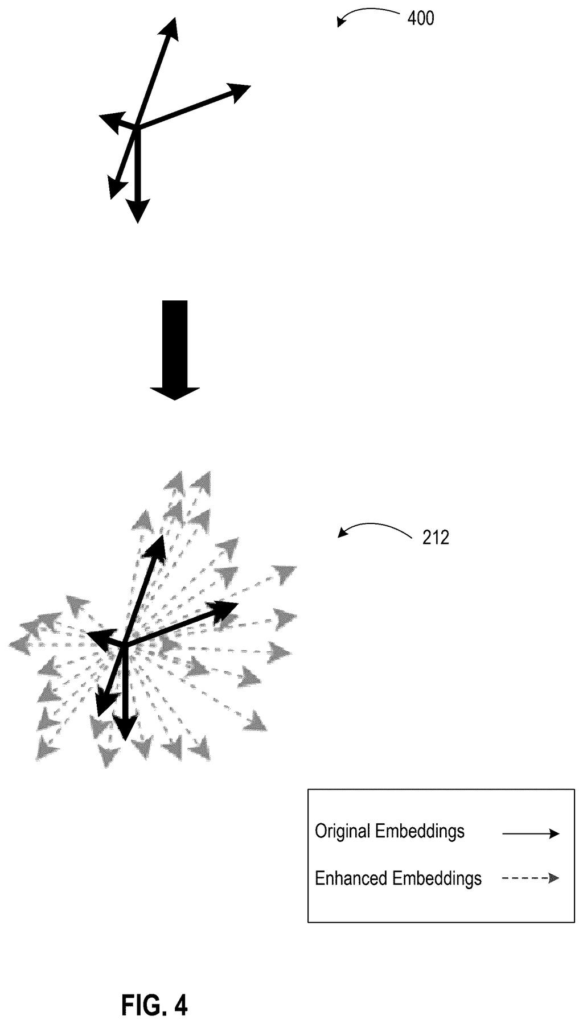
The patent centers on what IBM calls an Enriched Embedding Space (EES). An embedding space is a kind of map where words and phrases get plotted as points based on their meaning. Words with similar meanings cluster together; unusual or unknown phrases land far from any cluster.
To build this richer map, IBM trains an enriched language model on an expanded ground truth (a broader-than-usual training set that deliberately includes paraphrases, synonyms, and edge-case language). This gives the map more coverage than a standard training run.
When a user submits a query, the system:
- Converts that query into a point on the EES map
- Finds the nearest known point (the closest thing the model was trained on)
- Measures the gap between them
- Decides whether the gap is large enough to signal drift
If drift is confirmed, the system goes a step further and diagnoses the type of drift. Drift can mean several different things: the vocabulary users are reaching for has changed, the topic domain has shifted, or the model's own representations have decayed. Knowing which type is happening tells engineers where to intervene, rather than forcing a full retraining from scratch.
Detection of natural language data drift includes training an enriched language model using on an expanded ground truth. The enriched language model is trained to perform natural language processing (NLP) using a natural language vocabulary converted to embeddings comprising vectorial representations within an Enriched Embedding Space (EES).
Translation: IBM creates a map of language meanings to help the AI understand if its training data is becoming outdated.
What self-diagnosing AI means for business software
Drift is one of those problems that sounds technical but has very real costs. A customer service bot that slowly loses accuracy erodes user trust. A medical coding tool that drifts toward outdated terminology can produce billing errors. A document-classification system that no longer understands new jargon just silently misfires. The problem is not rare; it is essentially guaranteed to happen whenever language keeps evolving and the AI does not keep up.
What IBM is filing here is a monitoring layer, the kind of infrastructure that makes AI deployments easier to manage long after launch. For the Big Tech patent news beat covering AI governance and enterprise tooling, IBM's focus on drift classification is a sign that the industry is taking the "AI maintenance" problem as seriously as the initial build. Whether this becomes a product feature or stays as foundational research, the filing reflects a genuine need that every organization running language AI in production eventually runs into.
That makes this IBM's 43rd filing we've tracked since May in the AI guardrails race, following their work on catching made-up facts in summaries and blocking restricted users from AI answers.
Drift in AI language models is not a hypothetical. Any organization that deployed a chatbot or text classifier before 2023 and left it running has almost certainly experienced it. The cost shows up as quiet failures: wrong answers, missed categories, frustrated users who stopped trusting the tool. IBM is targeting a problem with real, measurable damage.
The approach here is measured and credible. Building a richer training map and then using geometric distance to flag anomalies is a defensible, interpretable method. It does not require constant retraining or massive infrastructure changes. That kind of fit-to-problem sizing matters; an overly complex solution to a monitoring problem would create its own maintenance burden.
The part worth taking seriously is the drift-type diagnosis. Knowing that a model has drifted is useful. Knowing whether it is vocabulary drift, topic drift, or representation decay tells engineers what to actually fix. That specificity is where practical value lives.
Get our take in your Top Stories
Liked this breakdown? Add Patentlyze as a preferred source on Google, and our plain-English take shows up more often in your Top Stories the next time IBM patent news breaks.
There are more where this came from
We read every patent application Big Tech publishes and send you the ones worth knowing. Plain English, free, every week.
The drawings
8 drawing sheets from US 2026/0252813 A1 · click any drawing to enlarge


Want this weekly breakdown for a company we don't cover? Patentlyze Pro →
Be the first to weigh in