
Samsung Patents a Camera Placement System for Phones That Fold Twice
Samsung is solving one of the hardest puzzles in foldable phone design: where do you put a front-facing camera when your screen folds in three separate places?
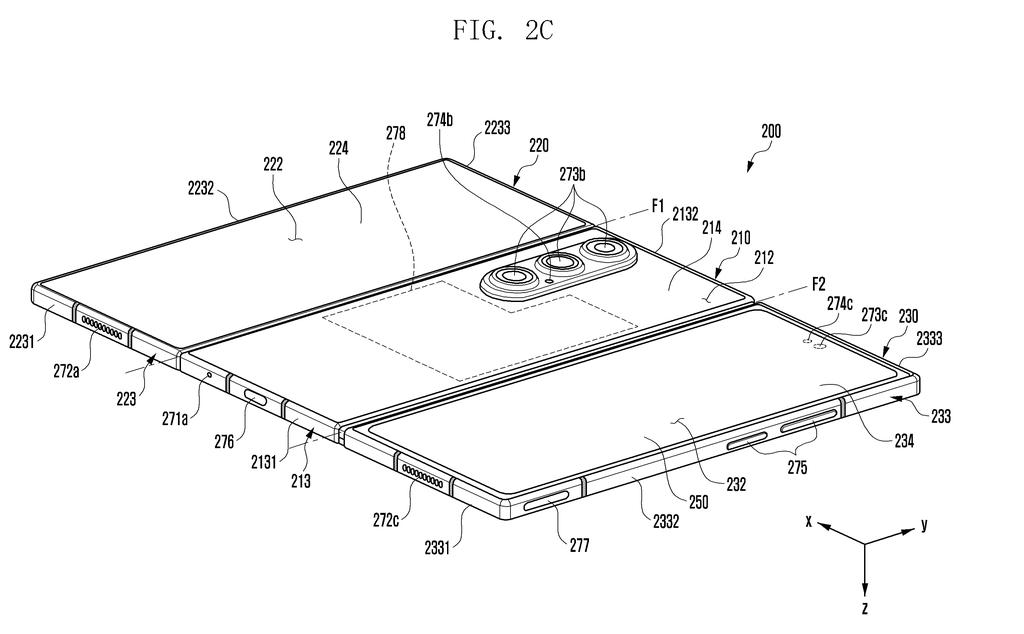
What Samsung's triple-fold camera layout actually does
A phone folds in half on a crowded subway and the selfie camera ends up pressed against the hinge, unusable. That problem gets multiplied when your phone has two hinges instead of one, and you suddenly have three separate screen panels to think about.
Samsung's patent tackles this by assigning each panel a specific job. The outer panel gets the front camera, so it's always accessible no matter how the phone is folded. The other outer panel houses the electronics that actually power the display. The middle panel is left clean, acting as the anchor between the other two.
This isn't a cosmetic choice. Where you put the camera and where you put the display-driving chip affects heat, battery life, and how thin each panel can be. Samsung is essentially working out the floor plan of a phone that doesn't quite exist in the market yet.
a foldable housing comprising a first housing, a second housing, and a third housing; a first hinge assembly disposed between the first housing and the second housing; a second hinge assembly disposed between the first housing and the third housing …
Translation: The phone uses three connected sections and two hinges to fold up.
How Samsung splits the camera and display driver across panels
The patent describes a portable device with three housing sections connected by two separate hinge assemblies. Think of it like a tri-fold brochure: a center panel, and two wings that fold inward or outward independently.
Stretched across all three panels is a single flexible display, but the patent treats each panel's screen area as distinct. The key decisions are:
- The front camera sits in the third housing's display area, meaning the outermost wing on one side.
- The display driving circuit (the chip that tells every pixel what color to show) lives in the second housing's display area, the opposite outer wing.
- The center panel holds neither, keeping its profile as slim as possible.
By separating the camera from the display driver and putting each on a different outer panel, Samsung avoids stacking bulky components in the same place. The display driving circuit is explicitly called out in the claim because on a flexible screen that bends repeatedly, where that chip sits affects signal routing, heat distribution, and whether the bending zones stay thin enough to actually fold.
… a flexible display including a first display area supported by the first housing, a second display area supported by the second housing, and a third display area supported by the third housing, and a first front camera disposed in the third display area of the third housing.
Translation: One continuous screen spans all three sections, with a camera hidden in the third part.
What this means for foldable phone design trade-offs
For anyone who has used a current foldable phone, the camera placement problem is real: Samsung's existing Galaxy Z Fold puts the selfie camera in a punch-hole cut-out in the inner screen, which limits how much of that screen you can use. A three-panel device makes that trade-off even sharper because there are now two fold lines to avoid. Dedicating one outer wing to the camera and the other to the display electronics is a practical attempt to stop those components from competing for the same limited real estate.
This filing sits at the early-blueprint stage. Real, mass-produced tri-fold hardware would need display materials that survive two separate daily bend points without degrading, hinge mechanisms precise enough to keep a single flexible panel aligned across three sections, and thermal management for a chip sitting in a panel that bends. Samsung's Galaxy Z Fold lineup shows the company is committed to the foldable category, but a triple-fold device at consumer scale is still a meaningful engineering distance away, and filings like this one are part of a broader wave of interesting tech patents mapping out where foldable display engineering is heading.
Samsung's 62nd filing we've tracked in our foldable phone patents watchlist since May builds on work like one on preventing screen cracks and one on sliding-screen audio.
Samsung's engineers have mapped out where the camera and the screen's control chip live inside a phone that folds at two separate points. That placement decision sounds minor, but on hardware this intricate, agreeing on which panel handles which job is a prerequisite for building anything at all.
Getting from this document to a product on a shelf requires several hard things to exist first: two hinges that survive years of daily folding, a screen that bends at two points without cracking over time, and software that knows when the camera is partially hidden because the phone is folded. None of those are solved by a filing that describes component locations.
What the document does show is deliberate, early planning rather than improvisation, and that discipline is how complicated hardware eventually reaches consumers. Whether this particular layout survives contact with manufacturing and real-world use is a separate question entirely.
Get our take in your Top Stories
Liked this breakdown? Add Patentlyze as a preferred source on Google, and our plain-English take shows up more often in your Top Stories the next time Samsung patent news breaks.
There are more where this came from
We read every patent application Big Tech publishes and send you the ones worth knowing. Plain English, free, every week.
The drawings
36 drawing sheets from US 2026/0254891 A1 · click any drawing to enlarge


Want this weekly breakdown for a company we don't cover? Patentlyze Pro →
Be the first to weigh in