
Apple Patents Software That Repairs Video Quality Lost During Compression
Every time a video is compressed, tiny details are thrown away to save space. Apple's new patent describes a neural network that steps in at the decoder to reconstruct what was lost, producing a sharper result than the standard math-based approach can manage.
How Apple's codec fix cleans up compressed video
Every video you watch online has been compressed, which means data was deliberately thrown away to make the file small enough to stream. The standard way to undo that process on your phone or TV works with math alone, and it never fully recovers what was discarded.
Apple's patent describes adding a neural network inside the video decoder, the software that turns a compressed file back into pictures you can see. Instead of relying only on the standard math, the neural network studies the compressed data and fills in the missing pieces more accurately, producing an image closer to what the camera originally captured.
The result is fewer blocky artifacts and softer degradation, especially in fast-moving scenes or detailed textures, without changing the compressed file itself. The fix happens entirely on the receiving end, which means it could apply to any video sent in a compatible format.
… reconstruction circuitry comprising a neural network to generate a recovered transform block comprising recovered transform coefficients for the quantized transformed residual block to reduce errors introduced by the quantization circuitry …
Translation: An AI neural network fixes the compression damage left behind by standard video processing.
How the neural network recovers discarded frequency data
When a video is encoded, each frame is broken into small blocks. The encoder computes the residual for each block, which is the pixel-level difference between what the encoder predicted the block would look like and what it actually looks like. That residual is then run through a transform (a mathematical step that converts the pixel differences into frequency values, like the bass and treble components of a sound) and then quantized, meaning the frequency values are rounded to coarser numbers so they take up less storage space. Quantization is where most of the quality loss happens.
The decoder normally reverses those steps with inverse quantization, but rounding is not reversible, so the reconstructed frequency values are only approximations of the originals.
Apple's patent inserts a neural network into the decoder that receives the quantized frequency block and produces a recovered transform block: a better estimate of the original frequency values before they were rounded. The claim specifies that the neural network's output must produce a smaller error against the original than plain inverse quantization would, measured by a cost function (a scoring rule the system uses to judge accuracy).
- The neural network sits inside the reconstruction circuitry of the decoder.
- It takes as input the quantized frequency block from the compressed bitstream.
- It outputs recovered frequency coefficients that better approximate the pre-quantization originals.
- Performance is verified by comparing two error scores: the network's output vs. The original, and the standard inverse-quantization output vs. The original.
A first error between the recovered transform block and a transformed residual block generated by the transform circuitry can be smaller than a second error between the transformed residual block and a dequantized transformed residual block …
Translation: The AI-repaired video gets noticeably closer to the original uncompressed quality than old methods.
What this means for video streaming and Apple devices
For everyday viewers, better compression recovery means less blockiness in dark scenes, sports, or anything with fast motion, without needing a higher-quality stream or extra storage. The improvement happens on your device, not on the server, so it could apply retroactively to existing video formats like HEVC or AVC.
Apple's run of video-codec neural-network filings fits into a broader push to move AI-assisted processing closer to the hardware doing the decoding. If this technology lands in chips inside iPhones, Macs, or Apple TV, it could give Apple's ecosystem a measurable visual quality edge on the same compressed video file that every other device also receives.
That makes this Apple's second filing we've tracked in our AI photo editing race watchlist since September, following one on auto-stylizing shots by subject.
Claim 1 is written around a decoder device , not an encoder. That is a specific and meaningful boundary: Apple is not claiming the compression method itself, only the playback-side correction. Any encoder, any service, any streaming platform using a standard format could theoretically benefit from a downstream Apple decoder that applies this fix.
The breadth question turns on how the claim defines success. It does not specify a particular neural-network architecture; it specifies an outcome, namely that the network's error must be lower than standard inverse quantization's error, as measured by a cost function. That outcome-based framing is aggressive: it could be read to cover a wide range of neural-network implementations as long as they outperform the baseline math on that scoring rule.
In practice, a claim this broad at publication often faces narrowing during examination, because the outcome definition alone may not be enough to distinguish prior art in the neural-network video-restoration space. The real-world value of this filing likely depends on how tightly Apple can hold the outcome framing during prosecution.
Get our take in your Top Stories
Liked this breakdown? Add Patentlyze as a preferred source on Google, and our plain-English take shows up more often in your Top Stories the next time Apple patent news breaks.
There are more where this came from
We read every patent application Big Tech publishes and send you the ones worth knowing. Plain English, free, every week.
The drawings
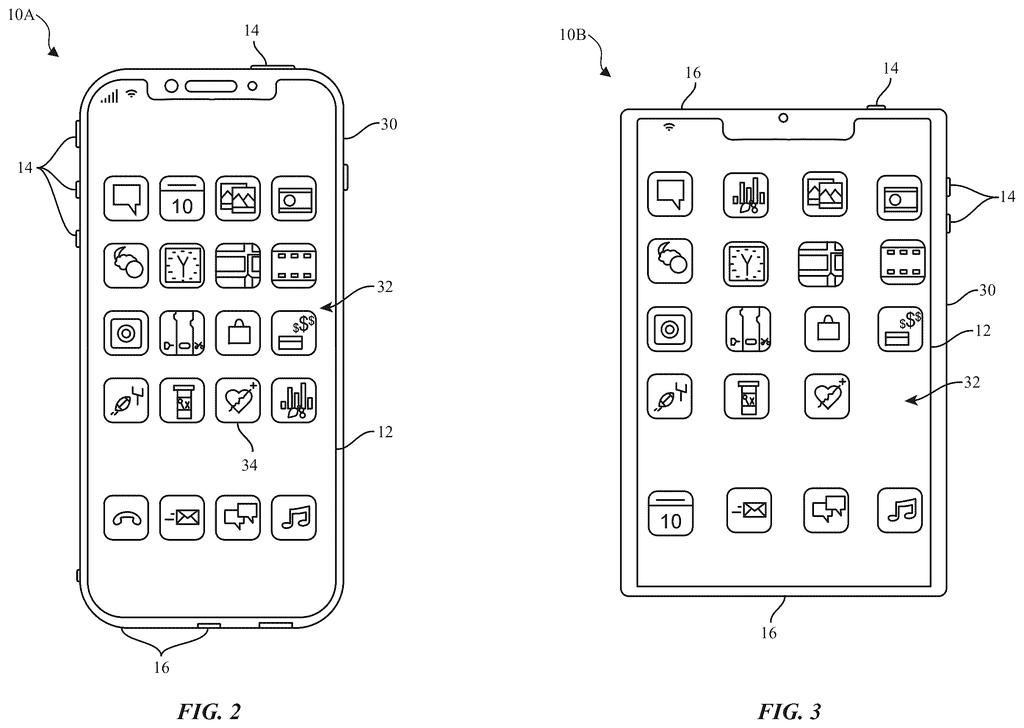
12 drawing sheets from US 2026/0260387 A1 · click any drawing to enlarge


Show the other 4 sheets


Want this weekly breakdown for a company we don't cover? Patentlyze Pro →
Be the first to weigh in