Samsung
Samsung · AI / ML · Filed Apr 20, 2026 · USPTO published Aug 27, 2026 · Aug 27 release
Samsung Patents an AI Photo Editor That Writes Its Own Edit Suggestions
Samsung wants to take the blank-page problem out of AI photo editing. Instead of asking you to type an edit command from scratch, the phone figures out what's in your photo and offers ready-made suggestions you can tap to tweak.
- Publication number
- US 2026/0253291 A1(US20260253291A1)
- Applicant
- SAMSUNG ELECTRONICS CO., LTD.
- Filed · Published
- Apr 20, 2026 · Aug 27, 2026
- Inventors
- Daeyoung HYUN, Sungtae KIM, Jihun MUN, Jiyoon PARK, Nagyeom YOO
- Status when we published
- Waiting for an examiner
- Document
- 20 claims
- US classification
- 345/619
- Parent application
- Continuation of PCT/KR2024/013091 (filed Aug 30, 2024)(PCTKR2024013091)
How Samsung's tap-to-edit photo prompts actually work
Every time you try to edit a photo with an AI tool, you hit the same wall: a text box that says 'describe what you want.' Most people have no idea what to type, so they guess, get odd results, and give up.
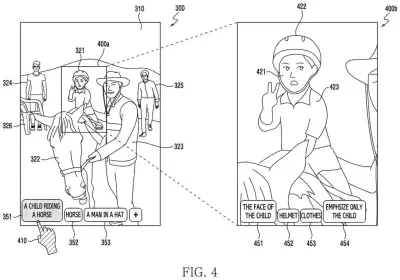
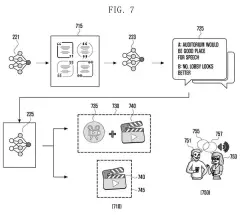
Samsung's patent describes a system that skips that blank box. You open a photo, and the device automatically spots the main subject, say, a person in front of a building, and the surrounding details like the sky or a car in the background. It then generates ready-to-tap suggestion chips for each of those objects, so you can pick 'change jacket color' or 'make background sunset' without writing a single word.
When you tap a suggestion, the system builds a proper edit instruction behind the scenes and hands it to an AI image model that actually makes the change. The idea is that you stay in control of what gets edited, but the phone does the hard work of speaking the AI's language for you.
identify a primary object and one or more secondary objects associated with the primary object in an input image; generate candidate prompt portions for the primary object and the one or more secondary objects using an artificial intelligence (AI) model …
Translation: The system uses AI to spot the main subject and surrounding details in a picture.
How the AI identifies objects and builds editable prompt pieces
The patent describes an electronic device, most likely a smartphone, that processes an input image in two steps before the user does anything.
Step one: object identification. The device uses an AI model to find a primary object (the main subject of the photo, such as a person or a vehicle) and one or more secondary objects associated with it (background elements, clothing, nearby props). This relationship between primary and secondary objects matters because editing the main subject often requires adjusting the things around it to stay consistent.
Step two: candidate prompt generation. Rather than producing a single edit suggestion, the system generates candidate prompt portions, discrete, pre-written text fragments that map to each editable object. These fragments are displayed alongside the original photo, giving the user a visual menu of what can be changed and how.
When the user taps one of those fragments, the device assembles the selected pieces into a complete prompt and sends it to a separate image AI model (think of it as the engine that actually redraws pixels). The final output image reflects only the edits the user chose, with the rest of the photo left intact. The claim covers both the on-device logic for identifying objects and generating suggestions, and the pipeline that connects user selections to the image generation model.
… generate a prompt to modify the primary object based on a user input received for a candidate prompt portion of the candidate prompt portions; and generate an output image by providing the image modification prompt to an image AI model.
Translation: When you pick a suggestion, the software builds an editing command and creates a new photo.
What this means for AI photo editing on Galaxy phones
The friction point in AI photo editing today is not the AI itself, it is the empty text field. Most users who encounter a 'describe your edit' prompt either type something vague and get unpredictable results, or abandon the feature entirely. Samsung's approach attacks that specific drop-off by making the prompt-writing step automatic, which could meaningfully raise how many Galaxy users actually finish an AI edit rather than closing the app.
For Samsung's broader strategy, this fits a pattern of embedding AI into everyday camera workflows so the gap between 'point and shoot' and 'professionally retouched' gets smaller. It also positions the company in a space where Apple, Google, and Adobe are all filing interesting tech patents around AI-assisted image editing, making the prompt-generation angle a concrete differentiator worth watching in future Galaxy software updates.
That makes this Samsung's 17th filing we've tracked since July in our AI photo editing race, joining earlier applications like one sharpening blurry photos and one adjusting subject depth.
Source: US 2026/0253291 A1 at the USPTO (PDF). Full patent text and figures are in the official publication.
Get our take in your Top Stories
Liked this breakdown? Add Patentlyze as a preferred source on Google, and our plain-English take shows up more often in your Top Stories the next time Samsung patent news breaks.
Add Patentlyze on Google
One click.
There are more where this came from
We read the new patents from Big Tech, carmakers and more and send you the ones worth knowing. Plain English, free, every week.
The drawings · 14 sheets
14 drawing sheets from US 2026/0253291 A1 · click any drawing to enlarge


Show the other 6 sheets


More from Samsung
All 1,662 Samsung patents →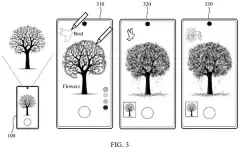
More in AI image & video
All 226 AI image & video patents →
Google
Google Patents a Step-by-Step Noise-Removal System for Generating AI Video
Adobe
Adobe Patents a Second-Pass AI That Cleans Up Messy Edges in Photo Edits
Intel
Intel Patents a Way to Blend AI-Generated Video Into Live Camera Footage in Real Time
Adobe