
Samsung Patents a Shared Battery System That Protects Storage Drives During Sudden Power Loss
When a server loses power mid-write, data corruption is almost guaranteed. Samsung is patenting a smarter backup system that routes emergency battery power to every storage drive at once, so nothing gets lost in the gap.
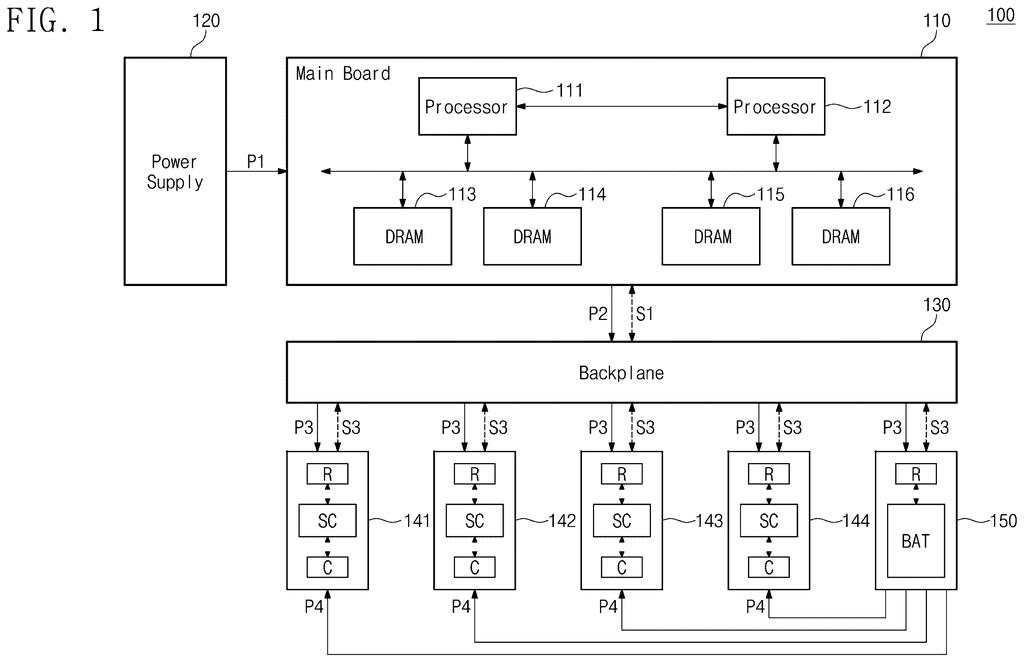
How Samsung's backup power keeps your data safe mid-write
Every storage drive needs a brief burst of power to finish saving data when the lights go out. Today, each drive typically handles this on its own, using a small on-board capacitor that can only hold enough charge for that one drive.
Samsung's patent describes a different setup: a central battery device that knows the state of all the storage drives in a system, and can push emergency power to any or all of them the moment it detects an unexpected shutdown. Each drive still has its own small capacitor as a first line of defense, but the shared battery acts as a second layer that covers the whole system.
The battery controller keeps a running record of which drives need attention and routes backup power through a dedicated wire. For everyday consumers this is invisible, but for the data centers that store your photos, emails, and financial records, it's the difference between a clean recovery and corrupted files.
… a battery controller including a shared register, the shared register configured to store information related to the plurality of storage devices through the plurality of first wires; and a battery …
Translation: The shared battery tracks the status of all connected drives using dedicated communication wires.
How the battery controller coordinates power across all drives
The patent describes an electronic device, likely a server or storage array, built around two layers of emergency power protection.
Layer one is familiar: each storage drive (a nonvolatile memory device, meaning flash storage that retains data without power) has its own small capacitor. When the main power disappears, the capacitor dumps its stored charge into the drive, buying just enough time for the drive's controller to flush any in-flight data to the storage chips.
Layer two is the invention's core: a centralized battery device that sits alongside all the drives and is connected to each one through a shared wire. Inside the battery device is a controller with a shared register (essentially a small memory table) that continuously collects status information from every drive via their individual data lines. The moment the battery controller detects a sudden power-off (SPO) event, it reads that register to understand the state of each drive and then supplies supplemental power through the shared wire.
This matters because a single capacitor per drive can only do so much. The battery provides a larger and more reliable energy reserve, and because the controller has information about all drives simultaneously, it can triage and direct power where it's needed rather than each drive fending for itself.
… configured to supply a second auxiliary power from the battery to the first battery power port based on the information in response to a sudden power off (SPO) event being detected …
Translation: The system automatically routes backup battery power to the drives the moment a sudden power outage occurs.
What this means for servers that can't afford data loss
Data centers run hundreds or thousands of storage drives, and a single unexpected power failure can corrupt data across all of them at once. The current per-drive capacitor approach works, but it scales poorly: add more drives, add more single points of failure, with no coordination between them.
Samsung's approach centralizes that coordination. For the people whose data lives on those servers (which is nearly everyone, given how much storage has moved to the cloud), a more reliable recovery from power events means fewer incidents where a file, a transaction, or a backup comes back corrupted. This is Samsung's interest in enterprise storage reliability showing up as infrastructure-level engineering rather than a feature you'd ever see advertised on a spec sheet.
Samsung's 37th filing we've tracked since June in our next-generation SSD patents builds on the self-correcting storage system and the file pre-loading chip.
When your phone or laptop dies mid-save, you lose a document. When a storage system inside a data center loses power mid-write, thousands of people can lose files, transactions, or messages at once. Samsung's patent builds a shared battery backup directly into storage hardware so every drive gets emergency power the moment an outage hits.
The smarter piece is that a central controller checks what each drive needs before routing that backup power, rather than letting every drive scramble on its own. That coordination stretches the recovery window and gives the system a real chance to finish what it was doing.
For anyone using cloud storage, online banking, or streaming services, this is the hidden layer that turns a potential disaster into nothing you ever notice. The measure of whether it works is simple: you open your app after an outage and everything is exactly where you left it.
There are more where this came from
We read every patent application Big Tech publishes and send you the ones worth knowing. Plain English, free, every week.
The drawings
9 drawing sheets from US 2026/0277288 A1 · click any drawing to enlarge


Want this weekly breakdown for a company we don't cover? Patentlyze Pro →