Samsung
Samsung · Memory & storage · Filed Apr 10, 2026 · USPTO published Aug 20, 2026 · Aug 20 release
Samsung Patents Technology to Stop Storage Drives From Overheating During Heavy Data Saves
Every time your SSD rewrites old data to make room for new data, it burns extra power you never asked for. Samsung has filed a patent for a controller that watches that hidden work in real time and automatically slows writes down to keep power consumption in bounds.
- Publication number
- US 2026/0244352 A1(US20260244352A1)
- Applicant
- Samsung Electronics Co., Ltd.
- Filed · Published
- Apr 10, 2026 · Aug 20, 2026
- Inventors
- Taegwang JO
- Status when we published
- Waiting for an examiner
- Document
- 20 claims
- US classification
- 711/103
- Parent application
- Continuation of 18/801,953 (filed Aug 13, 2024)(18801953)
What Samsung's write-throttling idea actually does
Imagine you ask a friend to move one box, but they end up reshuffling the entire storage unit to fit it in. That extra work costs time and energy you didn't budget for. Flash storage chips do something very similar, and it happens constantly in the background.
When you save a file, an SSD doesn't just write it once. It often has to copy, erase, and rewrite existing data to free up space, so your one write turns into two, three, or more actual writes under the hood. Samsung's patent describes a controller that keeps score of this "extra work" ratio in real time and automatically dials back how fast new writes happen when the ratio gets too high.
The result is that the drive stays within a safe power budget instead of spiking whenever it gets busy internally. For most people using a laptop, this is invisible. But for engineers running hundreds of drives in a server rack, keeping each drive's power draw predictable is a big operational deal.
a write amplification factor (WAF) calculator configured to calculate a WAF value relating to a ratio of an amount of data written to the memory device to an amount of write data provided from the host …
Translation: It measures how much extra data the drive has to write behind the scenes.
How the WAF calculator and performance controller work together
The patent centers on a concept called Write Amplification Factor (WAF), a ratio that measures how much data a storage device actually writes compared to how much the host computer asked it to write. A WAF of 1.0 means the drive wrote exactly what was requested. A WAF of 3.0 means it wrote three times as much internally, mostly because of housekeeping operations like garbage collection and wear leveling.
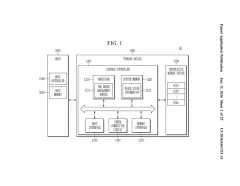
Samsung's proposed controller has three main parts working together:
- WAF Calculator: continuously computes the current write amplification ratio by comparing host-requested writes to actual device writes.
- Performance Controller: uses that ratio to decide how much to slow down write throughput. Critically, the slowdown is inversely proportional to the WAF increase (meaning the higher the WAF climbs, the more aggressively write speed is pulled back, in a mathematically predictable relationship).
- Command Processor: translates those throttling decisions into actual control over which write commands get executed and when.
The key engineering choice here is that the throttle is continuous and proportional, not a simple on/off cap. The controller doesn't just say "too much power, stop." It keeps write performance as high as the power budget allows, backing off only as much as necessary given the current WAF reading. This keeps the drive useful while staying within a defined power envelope.
… a performance controller configured to adjust performance of the write operation such that the performance of the write operation decreases, compared to a certain reference performance value, as the calculated WAF value increases …
Translation: It automatically slows down write speeds when things start getting too intense.
What this means for data center storage efficiency
For consumers, SSDs already manage power fairly well, so this patent's impact lands most directly in enterprise and data center settings, where hundreds or thousands of drives run simultaneously inside tightly constrained power budgets. When a drive unexpectedly draws more power during a garbage-collection surge, it can trip power limits or thermal thresholds across a whole server rack. A controller that self-regulates against those spikes removes a real operational headache for storage engineers.
The approach described here is also largely self-contained: it doesn't require the host server to send special commands or expose internal drive state. That makes it easier to deploy across existing infrastructure without software changes on the host side. Storage system designers watching the newest Big Tech patents in the flash memory space will recognize this as part of a broader push to make drives behave more predictably under enterprise workloads, where power and thermal budgets are as important as raw speed.
Samsung's 29th filing we've tracked since June in our next-gen SSD applications builds on earlier work like faster file-save times and AI ransomware detection.
Source: US 2026/0244352 A1 at the USPTO (PDF). Full patent text and figures are in the official publication.
Get our take in your Top Stories
Liked this breakdown? Add Patentlyze as a preferred source on Google, and our plain-English take shows up more often in your Top Stories the next time Samsung patent news breaks.
Add Patentlyze on Google
One click.
There are more where this came from
We read the new patents from Big Tech, carmakers and more and send you the ones worth knowing. Plain English, free, every week.
The drawings · 18 sheets
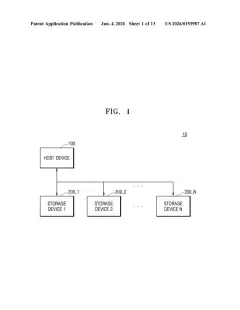
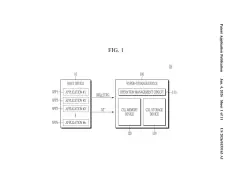
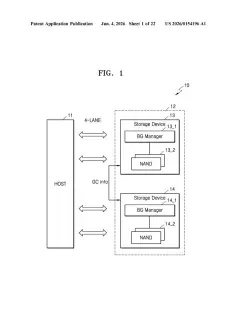
18 drawing sheets from US 2026/0244352 A1 · click any drawing to enlarge


Show the other 10 sheets