
Apple Patents a Light-Based Memory System for High-Powered Computing
Apple is filing patents on memory systems that route data using light instead of electricity, a shift that could matter enormously as the company builds its own AI server infrastructure.
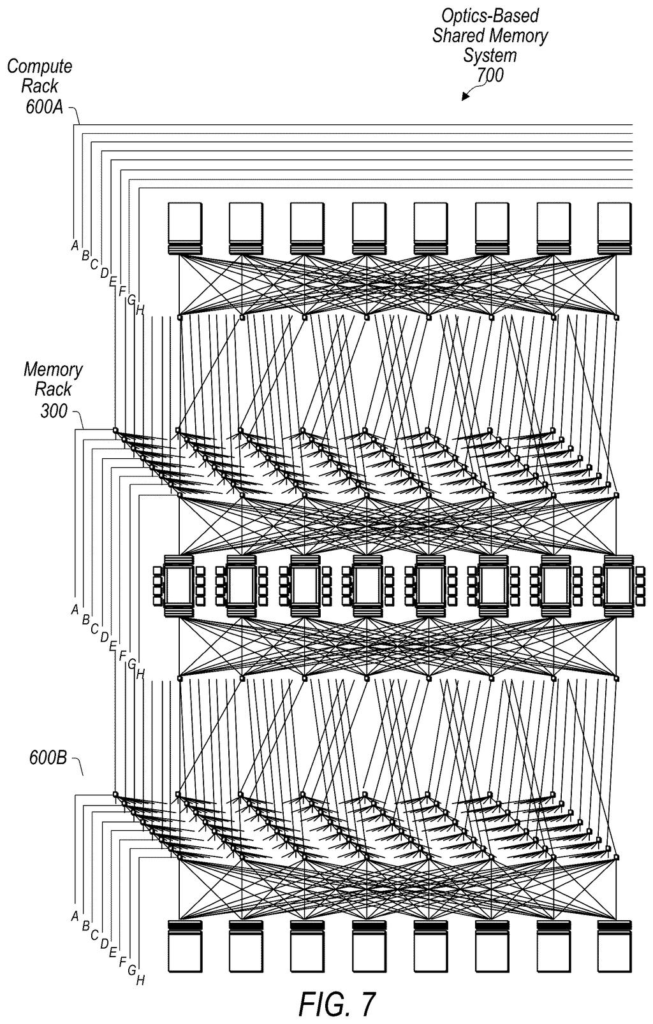
What Apple's optical chip-memory link actually does
Today's chips and memory chips sit close together and talk over copper wires. That works fine for a single device, but when you spread dozens of processors and memory banks across a large server, those electrical connections become a bottleneck: slow, power-hungry, and hard to scale.
Apple's patent describes a system where memory requests travel as light pulses through optical fiber rather than as electrical signals through metal traces. Each memory package in the system gets its own optical interface, so processors can send requests to any part of a shared pool of memory as if it were all sitting right next to them.
The idea is called a unified memory architecture at distributed scale. You can think of it like giving every member of a large team the same instant access to one shared filing cabinet, no matter where they are in the building, because the messages travel at the speed of light.
… a computing system includes a plurality of compute die packages that include processors configured to execute program instructions that operate on data stored in a distributed memory accessible via a unified memory architecture.
Translation: The system uses multiple processor chips that share a single, unified pool of memory to run complex tasks.
How light pulses carry memory requests between chips
The patent describes a computing system built from two kinds of building blocks: compute die packages (chips that run programs) and memory die packages (chips that store data). Both types are spread across a larger system rather than packed tightly onto a single board.
The key innovation is in the memory packages. Each one includes:
- One or more optical interfaces that receive memory requests arriving as light signals (silicon photonics converts electrical signals to light and back)
- One or more memory controllers that take those requests and fetch or write the right data
The processors treat all of this distributed memory as one unified pool. In computer science terms, this is a unified memory architecture (UMA), a design where every processor sees the same address space and can reach any byte of memory without special instructions. Normally UMA is confined to a single chip or board. Apple's patent extends it across many separate packages connected by light.
Silicon photonics is the underlying technology that makes this possible. It etches optical components directly onto silicon chips using the same manufacturing processes used for ordinary transistors, which keeps costs manageable compared to traditional fiber-optic hardware.
What this means for Apple's server and AI chip ambitions
Apple has spent years building its own chips for iPhones, Macs, and iPads, and the unified memory design in those chips is one of their signature advantages: the CPU, GPU, and AI accelerators all share the same fast memory pool. This patent suggests Apple is thinking about how to extend that same philosophy to server-scale systems, where you might have dozens or hundreds of processor chips that all need fast, shared access to a large memory pool. That is exactly the kind of infrastructure needed for large AI models.
For everyday users, the direct impact is indirect: faster, more efficient Apple server infrastructure could mean faster Siri responses, better on-device AI, and lower energy costs for Apple's data centers. The latest Big Tech patents in the chip and optical interconnect space show that Apple is not alone in chasing this goal, making filings like this one useful signals of where server hardware is heading.
Apple's fifth filing we've tracked since August in our AI chip wars watchlist builds on earlier work on freeing stuck memory and juggling multiple tasks at once.
Claims 1 through 20 are canceled, meaning this filing currently has no enforceable scope. A patent without active claims cannot block anyone from doing anything, so whatever Apple has designed here, it is not yet protected by this document.
The architecture the abstract describes is ambitious: light-based connections between memory packages and processors, all sharing a single address space so software sees one giant pool of memory rather than isolated islands. If Apple refiles and wins broad claims on that combination, the coverage could extend to any system where memory packages use optical links to receive requests and serve data back to processors under a unified scheme.
Whether that happens depends entirely on what the patent office accepts in future claims. For now, the disclosure is a public record of Apple's thinking, and nothing more.
Get our take in your Top Stories
Liked this breakdown? Add Patentlyze as a preferred source on Google, and our plain-English take shows up more often in your Top Stories the next time Apple patent news breaks.
There are more where this came from
We read every patent application Big Tech publishes and send you the ones worth knowing. Plain English, free, every week.
The drawings
12 drawing sheets from US 2026/0252278 A1 · click any drawing to enlarge


Want this weekly breakdown for a company we don't cover? Patentlyze Pro →
Be the first to weigh in