
Sony Patents a LiDAR Sensor That Recovers Faster After a Blinding Flash of Light
When a laser-based distance sensor gets hit by a flood of light, it can go temporarily blind, and that's a serious problem if the sensor is steering a car. Sony's new patent describes a way to shrink that blind spot automatically, one laser pulse at a time.
What Sony's blinded-sensor fix actually does for you
You're riding in a self-driving car and it fires a brief pulse of laser light to measure how far away the truck ahead of you is. The truck's chrome bumper reflects the pulse back so intensely that the sensor's light detectors are overwhelmed. For a fraction of a second, those detectors stop working, and the car briefly loses its sense of where things are.
Sony's patent tackles exactly that problem. When a pixel inside the sensor detects an oversaturated return (too much light, lasting too long), the system doesn't just wait for it to recover on its own. Instead, it schedules a "rest window" for that pixel that gets a little shorter with every new laser pulse. The pixel comes back online gradually, so the sensor loses as little coverage as possible.
The practical result is a distance sensor that bounces back from bright-light events faster than one that simply waits out a fixed recovery period. Over many pulses per second, that can add up to a meaningfully clearer picture of the space around a vehicle or robot.
a determination unit that, in a case where a saturated echo in which the echo is saturated for a predetermined time or more is detected, determines an invalidation section …
Translation: The system detects when a bright flash overwhelms a pixel and marks that area for temporary shutdown.
How Sony's shrinking blackout window restores pixel coverage
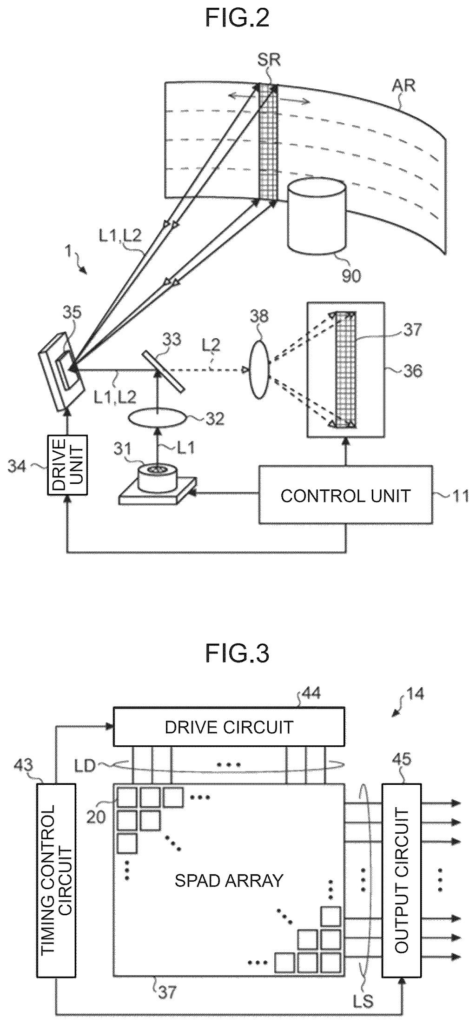
The patent centers on a type of light detector called a SPAD pixel (Single-Photon Avalanche Diode, meaning a semiconductor cell so sensitive it can register a single photon of light). LiDAR sensors pack thousands of these pixels together, firing rapid pulses of laser light and timing how long the echo takes to bounce back from objects. That timing tells the system exactly how far away each object is.
The problem the patent addresses is called a saturated echo: when a highly reflective surface sends back far more light than the pixel can handle, the pixel gets locked in an overloaded state for a measurable period. During that time, it can't report useful distance data.
Sony's proposed fix introduces two new components:
- An invalidation section determination unit that watches for saturated echoes and, when one is detected, calculates a custom "blackout window" for the affected pixel. Crucially, the window's start point is anchored to when the saturation began (not some arbitrary fixed time), and the window gets shorter each time the laser fires again.
- A SPAD control unit that enforces those windows, disabling only the affected pixels for only as long as the shrinking schedule requires, then letting them back into service.
Because the blackout shrinks incrementally rather than lasting a fixed duration, the sensor recovers its full field of view faster and with finer control than a simple timeout approach would allow.
… the invalidation section determination unit determines a SPAD invalidation section so that a start time point of the SPAD invalidation section invalidating the SPAD pixel that has detected the saturated echo is set as a start time point of the saturated echo and the SPAD invalidation section gradually decreases every time the laser light is emitted.
Translation: The sensor gradually re-enables blinded pixels over a series of laser pulses instead of turning them back on all at once.
What faster LiDAR recovery means for cars and robotics
For anyone riding in a vehicle that uses LiDAR, a faster sensor recovery from bright-light events means fewer moments where the system is working with incomplete data. Highly reflective surfaces (wet roads, chrome, emergency vehicle lights) are exactly the kinds of things that appear in critical driving situations, so closing that gap matters in practice, not just on a spec sheet.
The engineering here is incremental rather than a category leap, but incremental reliability improvements in safety-critical sensors are how real-world autonomy gets better over time. Sony already sells image sensors and LiDAR components to automotive and robotics companies, so this kind of pixel-level control work fits squarely into that supply chain. The newest Big Tech patents in the LiDAR and autonomous-sensor space show a consistent push toward finer per-pixel management, and Sony's filing adds a specific, well-scoped idea to that body of work.
That makes this Sony's 16th filing we've tracked since July in the self-driving sensing race, adding to earlier work like one on spotting transparent surfaces and one on previewing nearby parking spots.
The failure this patent prevents is specific and real: a sensor that goes partly blind at exactly the wrong moment. If a LiDAR camera gets overwhelmed by a sudden bright reflection, it can lose track of nearby objects during the recovery window, and that window is where risk lives. Sony's approach shrinks that blind window automatically, pulse by pulse, as the sensor confirms it's stabilizing.
For a driver or passenger, you'd never notice a single moment where this kicked in. What you'd notice, over millions of miles of fleet data, is a small reduction in edge cases where the sensor missed something right after a bright flash.
This is focused, testable engineering on a real pain point, and it's exactly what ends up baked into production hardware that people trust with their lives.
Get our take in your Top Stories
Liked this breakdown? Add Patentlyze as a preferred source on Google, and our plain-English take shows up more often in your Top Stories the next time Sony patent news breaks.
There are more where this came from
We read every patent application Big Tech publishes and send you the ones worth knowing. Plain English, free, every week.
The drawings
12 drawing sheets from US 2026/0251768 A1 · click any drawing to enlarge


Want this weekly breakdown for a company we don't cover? Patentlyze Pro →
Be the first to weigh in