
Qualcomm Patents a Voice Verification System That Adjusts When Your Speaker Is Playing
Every time you say "Hey Google" or "Hey Siri" while music is playing, the device is trying to recognize your voice while its own speaker is drowning you out. Qualcomm has filed a patent for a system that automatically adjusts how strict voice identification needs to be, depending on how loud that interference actually is.
What Qualcomm's audio-aware voice ID actually does
When sound is already coming out of your phone or earbuds, your microphone picks up two things at once: your voice, and the audio the device is playing back. That echo makes it harder for voice-ID systems to confirm it's really you, and most devices today apply a fixed standard regardless of how bad the interference is.
Qualcomm's patent describes a system that checks what the speaker is doing right now before deciding how confident it needs to be about your voice. If the volume is low and interference is minimal, it can apply a stricter identity check. If playback noise is heavy and the echo is hard to separate out, it can loosen that bar rather than failing you unfairly.
The result, in theory, is a voice assistant that says "yes, that's you" more accurately whether you're in a quiet room or mid-playlist, rather than either locking you out or waving through someone who sounds close enough.
determine that an audio playback path of a device is currently enabled, wherein the audio playback path includes a speaker configured to output sound from the audio playback path …
Translation: It checks if the device is currently playing sound through a speaker.
How the threshold shifts based on volume and echo data
The system works in a few connected steps:
- Echo detection: The device's microphone captures an audio sample that mixes your actual voice with whatever the speaker is outputting at that moment. This mixed signal is the raw input.
- Echo cancellation context: A software component called an echo cancellation engine is already trying to subtract the playback audio from the microphone signal. The patent proposes reading that engine's data, including how much cancellation it was able to do, as a signal of how polluted the voice sample is.
- Volume level check: In parallel, the system looks at the current playback volume. A louder speaker means a messier microphone signal.
- Dynamic threshold: Instead of comparing your voice against a fixed pass/fail score, the system sets a verification threshold that shifts based on those two inputs. A noisier environment means the threshold adjusts to account for the degraded signal quality before judging whether the confidence score (how closely the voice matches the stored voiceprint) is good enough to pass.
The claim covers the apparatus itself, specifically a processor and memory configuration that runs this logic inside a device. It applies to any scenario where a speaker and microphone are both active simultaneously.
What this means for voice assistants on earbuds and phones
Voice authentication is increasingly used for payments, app access, and assistant personalization. A system that applies a single fixed standard to every listening condition is going to produce false failures in noisy situations and, depending on how it's tuned, false passes in quiet ones. Getting that balance wrong in either direction has real costs for users.
For Qualcomm specifically, this is squarely in the territory of its audio and AI processing chips, which power a large share of earbuds, headsets, and Android phones. Qualcomm's run of audio-intelligence filings signals continued investment in on-device signal processing, where decisions like "is this the right person speaking" need to happen fast and without sending audio to a server.
Qualcomm's seventh filing in the audio patents we cover since July follows earlier work like one on silencing idle recording and one using sound to locate objects.
The underlying problem here is real. Anyone who has tried to use a voice assistant while music is playing has experienced the frustration of being rejected or, worse, having the assistant respond to a lyric instead of to them. The friction isn't trivial; it erodes trust in voice-based features over time, and most users just stop using them in those conditions.
What makes this patent interesting is that it attacks the problem at the calibration layer rather than the recognition layer. Rather than trying to extract a cleaner voice signal (which is what echo cancellation already attempts), this approach asks a simpler question: given how noisy things are right now, what should count as "good enough"? That's a practical engineering tradeoff, and it matches the size of the problem.
That said, the approach is incremental. Echo cancellation information and volume levels are already available data inside these systems; the patent is largely about using them as inputs to a threshold adjustment, which is a modest architectural step. Whether that step is enough to move the needle on real-world voice authentication depends heavily on implementation quality, not the concept itself.
There are more where this came from
We read every patent application Big Tech publishes and send you the ones worth knowing. Plain English, free, every week.
The drawings
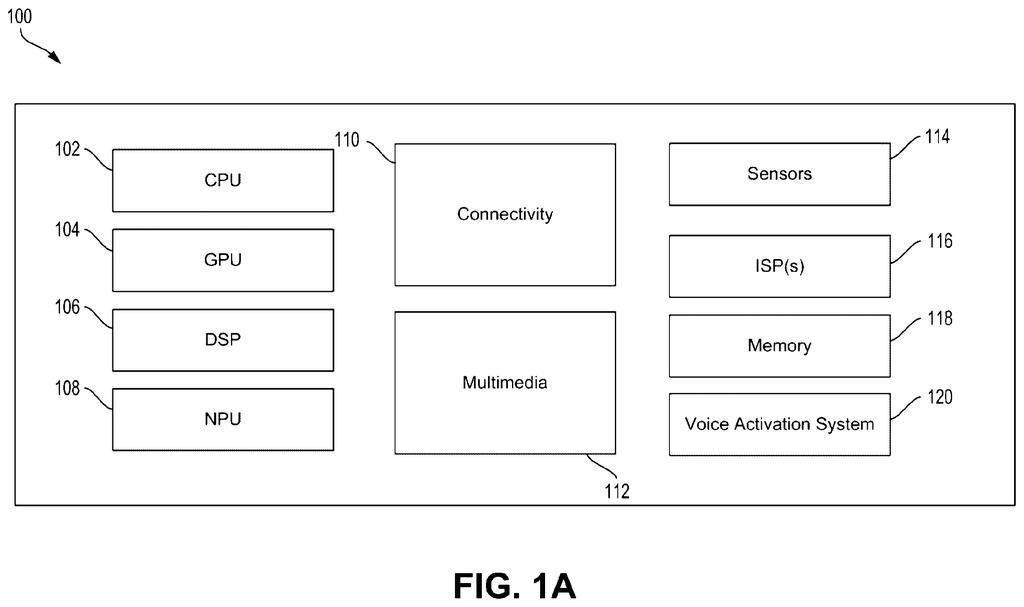
10 drawing sheets from US 2026/0290350 A1 · click any drawing to enlarge


Want this weekly breakdown for a company we don't cover? Patentlyze Pro →
Be the first to weigh in