
Qualcomm Patents an Indoor Location System That Reads the Room Around You
GPS falls apart the moment you walk inside a building. Qualcomm's new patent takes a different approach: instead of one-size-fits-all location math, it changes its calculation method depending on whether you're in a narrow corridor or an open floor.
How Qualcomm's indoor positioning filter actually works
Every time a mall app tries to guide you to a store, or a hospital system tries to locate a staff member, it runs into the same wall: GPS doesn't work indoors. Signals bounce off walls, drop through ceilings, and generally make your phone think you're somewhere you're not.
Qualcomm's patent describes a system that tries to solve this by being context-aware. It maps the building and then asks: where are you right now? If you're in a narrow hallway, your possible positions are constrained to a thin line. The system treats you as moving in one dimension, like a bead on a wire. If you step into a lobby or a wide-open floor, your possible positions spread out in two dimensions, and the system switches modes to match.
The idea is that fewer math operations are needed when your surroundings already limit where you could be. A hallway basically rules out most of the building on its own, so the system should take advantage of that instead of recalculating across the whole map every second.
… applying a one-dimensional (1D) positioning filter to the plurality of potential positions based on the plurality of potential positions being in the first area, wherein the plurality of potential positions propagate in one dimension along one or more edges of a graph corresponding to the environment; …
Translation: The system uses a simple linear tracking method when you walk down narrow spaces like hallways.
How the filter switches between hallway mode and open-room mode
The patent describes a hybrid particle filter, a technique where the system tracks a large cloud of "possible you" locations and narrows them down over time using sensor data and movement.
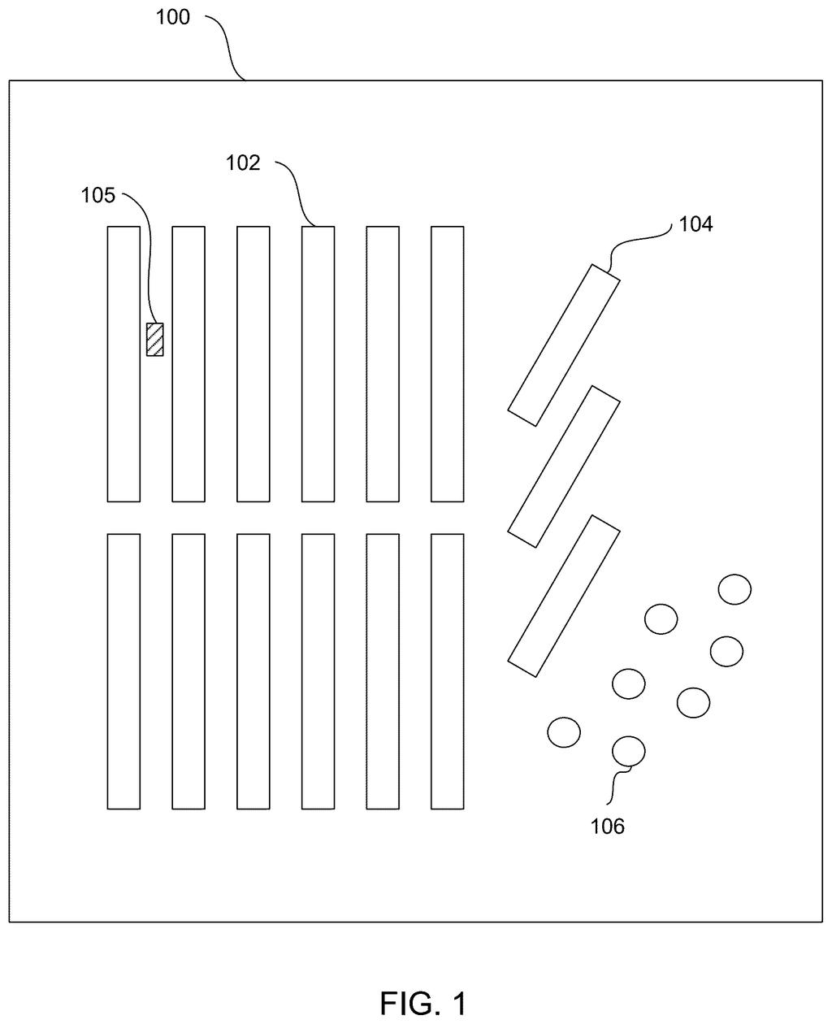
The twist here is that the filter is topology-aware: it uses a map of the building, represented as a graph (a network of nodes and connecting paths), and classifies every area as either corridor-like or open-plan. In corridor zones, the filter constrains particle movement to one dimension, meaning guesses about your location can only travel along the path, not drift sideways through walls. In open zones, particles move freely in two dimensions across a flat plane.
When you move from a corridor into a room, the system detects the zone change and promotes those 1D particles into 2D space, spreading them out to match the new uncertainty. When you go back into a hallway, it collapses them again.
This matters computationally because:
- 1D filtering is cheaper and faster than 2D filtering
- Constraining particles to realistic paths reduces false position estimates
- Switching modes dynamically means accuracy can stay high even with limited sensor input
What this means for GPS-free navigation inside buildings
Indoor positioning is one of those problems that feels solved until you actually try it. Qualcomm keeps filing on indoor and RF-based positioning Phones can already do rough indoor location using Wi-Fi, Bluetooth, and sensor fusion, but the accuracy is often off by several meters, which matters a lot when you're trying to navigate a hospital floor or a warehouse.
This patent's approach is essentially software-only, which means it could, in principle, run on existing hardware if the building provides a usable map. For you as an end user, better indoor positioning could mean turn-by-turn directions inside airports, more reliable asset tracking in factories, or emergency responders finding people faster inside large structures.
Qualcomm's 457th filing in our Qualcomm coverage since May adds to a run that includes cars and drones sharing airspace and eye-distance zoom control.
The shortest path to shipping something like this is shorter than it looks on paper, because the core requirement is software and a floor map, not new chips. A building already needs to be mapped and tagged with zone types (corridor vs. Open space) for the system to work, and that data infrastructure is the real bottleneck, not the algorithm.
The math here is legitimate and the insight is clean: hallways are informative constraints, so use them. But particle filters for indoor positioning aren't a new idea, and the "hybrid 1D-2D" framing is an incremental refinement rather than a departure. What Qualcomm is patenting is a specific way of switching between modes, not the concept of particle filtering indoors.
For the patent to become a real product feature, someone has to build and maintain detailed indoor maps at scale. That's the hard part, and this filing doesn't address it.
There are more where this came from
We read every patent application Big Tech publishes and send you the ones worth knowing. Plain English, free, every week.
The drawings
12 drawing sheets from US 2026/0287706 A1 · click any drawing to enlarge


Want this weekly breakdown for a company we don't cover? Patentlyze Pro →
Be the first to weigh in