
Google
Google · AI / ML · Filed May 26, 2026 · USPTO published Sep 24, 2026 · Sep 24 release
Google Patents a System That Writes Your Spreadsheet Formulas From Examples
Most people who use spreadsheets avoid writing formulas because the syntax is unforgiving and the learning curve is steep. Google has filed a patent for a system that watches what you type into a cell and generates the right formula for you automatically, without you ever needing to know the function names.
- Publication number
- US 2026/0288424 A1(US20260288424A1)
- Applicant
- GOOGLE LLC
- Filed · Published
- May 26, 2026 · Sep 24, 2026
- Inventors
- Rishabh Singh, Aaron Zemach, Chiraag Galaiya, Dima Brezhnev, David Lick, Francisco Velasquez, Max Lin, Neha Bhargava, Peilun Zhang, Rahul Srinivasan, Simon Tong, Victoria Taylor, Vishnu Sivaji, Zifan Xiao
- Status when we published
- Waiting for an examiner
- Document
- 20 claims
- US classification
- 717/115
- Parent application
- Continuation of 18/767,743 (filed Jul 9, 2024)(18767743)
How Google's formula-writing AI actually works
Every time you type a number into a spreadsheet cell and expect the sheet to do something useful with it, there's a good chance you've had to stop and Google the right formula syntax. That friction is small but it happens constantly, and for many people it's enough to make spreadsheets feel intimidating.
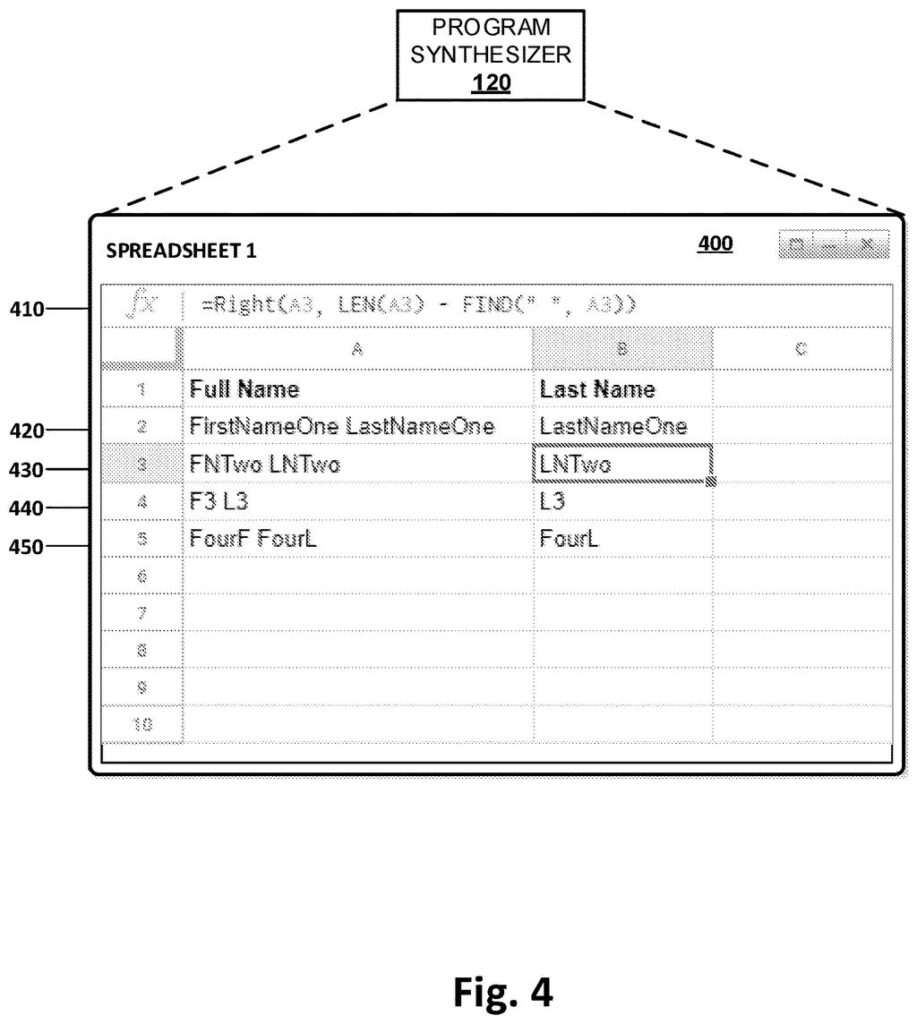
Google's patent describes a system that learns what formula you probably need just by looking at one example you type. You put a value in a cell, the system studies it, compares it against a library of formula patterns built from analyzing huge numbers of real spreadsheets, and generates a working formula that produces that output. You don't write the formula; the system figures it out from what you're trying to accomplish.
The key ingredient is that the system doesn't start from scratch. It uses pre-identified "idioms," which are common formula combinations that real people use all the time. That prior knowledge makes the suggestion faster and more likely to match what you actually want, not just a formula that technically works.
… automatically synthesizing a candidate program consistent with the first example, wherein the candidate program comprises at least one program idiom of a plurality of program idioms, the plurality of program idioms having been identified based on analyzing a corpus of spreadsheets …
Translation: The system builds a formula by matching your example against common patterns found in existing spreadsheets.
How the system learns formula patterns from millions of sheets
The patent describes a process called program synthesis (the automatic generation of working code from examples, rather than from explicit instructions). Applied to spreadsheets, the system takes a single example you provide in a cell and reverse-engineers a formula that would produce that result.
The core technical ingredient is what the patent calls program idioms: predefined groupings of multiple spreadsheet functions that commonly appear together in real-world use. Google says these idioms were identified by analyzing a large corpus (a big collection) of existing spreadsheets. Instead of searching through every possible formula combination, the system narrows its search to patterns that real users actually use. That's a significant efficiency gain.
From there, the system:
- Generates multiple candidate programs (possible formulas) that are all consistent with your example
- Ranks those candidates, presumably by likelihood or simplicity
- Stores the highest-ranked formula in association with your cell
The ranking step is where the system decides which formula to actually show you. The patent doesn't specify exactly how ranking works in every case, but the general approach is to surface the formula most likely to match your intent based on the idiom library and the context in the surrounding spreadsheet.
What this means for everyday Google Sheets users
For everyday Google Sheets users, this could remove one of the most common stopping points: knowing the name and syntax of the function you need. If the system works well, you'd type the result you want and the formula appears, ready to apply across a whole column.
The design also has limits worth noting. The system learns from what's common in existing spreadsheets, which means unusual or highly custom formulas may not be covered well. the pattern in Google's productivity-AI filings suggests the company is betting that covering the most frequent use cases well is more valuable than covering every edge case, and for most users that's probably a fair trade.
Google's 45th filing we've tracked since May in our AI agents that act for you watchlist builds on earlier applications like its proactive on-device assistant and its background audio search tool.
Source: US 2026/0288424 A1 at the USPTO (PDF). Full patent text and figures are in the official publication.
Get our take in your Top Stories
Liked this breakdown? Add Patentlyze as a preferred source on Google, and our plain-English take shows up more often in your Top Stories the next time Google patent news breaks.
Add Patentlyze on Google
One click.
There are more where this came from
We read every patent application Big Tech publishes and send you the ones worth knowing. Plain English, free, every week.
The drawings · 5 sheets
5 drawing sheets from US 2026/0288424 A1 · click any drawing to enlarge


More from Google
All 1,079 Google patents →
More in AI / ML
All 2,637 AI / ML patents →
Google
Google Patents an AI System That Reads Image Text and Decides What to Do With It
OpenAI
OpenAI Patents a Way for Its AI to Answer Questions Using Company Documents Securely
Microsoft
Microsoft Patents an AI Engine That Writes Animation Instructions From Plain Text
Microsoft
No comments yet