
Samsung Patents a Fix That Keeps AI Running Smoothly Without Draining Device Memory
Running a generative AI model on a phone is memory-hungry work, and most phones don't have enough to spare. Samsung is patenting a way to free up that memory mid-session and then bring it back when the AI needs it again.
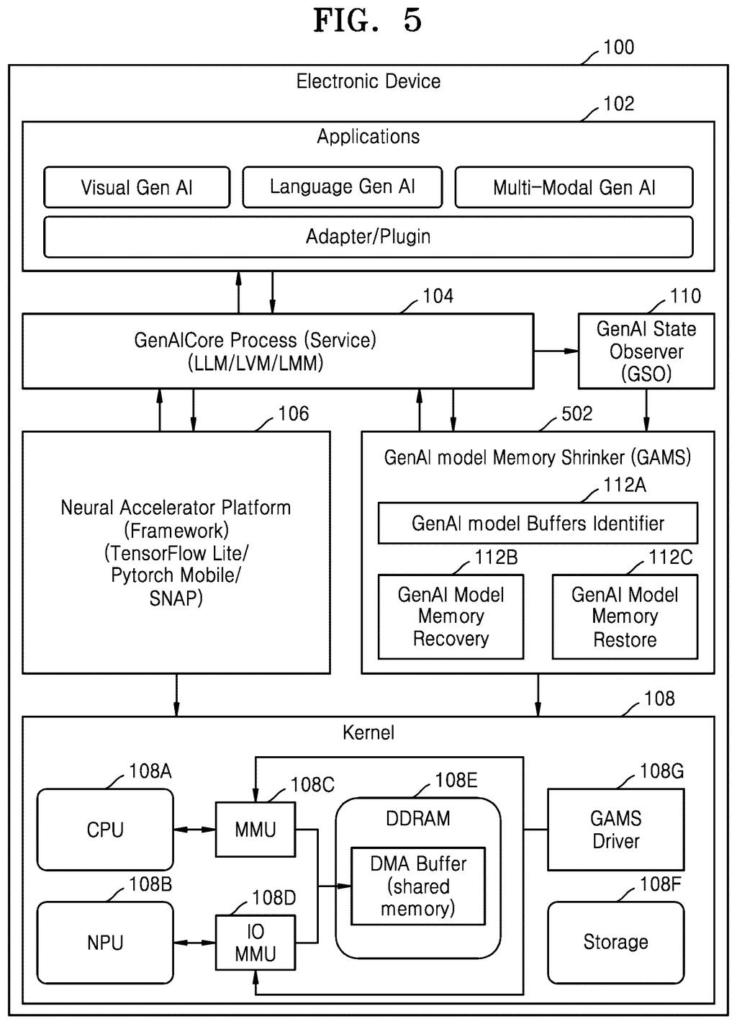
How Samsung keeps AI running when your phone runs low on memory
When your phone runs a generative AI model, such as a built-in chatbot or image generator, it reserves large chunks of memory to keep things running fast. The problem is that memory is shared with everything else on your phone, and if another app needs space, something has to give.
Samsung's patent describes a system that watches the AI model's current state and, when memory gets tight, identifies chunks of that reserved memory that are safe to temporarily take back. It frees them up for other uses, then restores them automatically when the AI needs to run again.
You'd likely never notice this happening. The goal is that your AI assistant keeps working without crashing or slowing down, even when your phone is juggling a lot at once. Think of it as a memory valet that parks and retrieves the AI's luggage on demand.
… determining, by the electronic device, a trigger for a GenAI model memory shrinker (GAMS) based on the state of the GenAI model; …
Translation: The system figures out when it needs to free up space based on how the AI is currently running.
How GAMS decides which AI buffers to reclaim and restore
The system centers on something Samsung calls a GenAI Model Memory Shrinker, or GAMS. It monitors the state of a generative AI model running on a device, tracking parameters that indicate whether the model is actively working or sitting idle.
When a trigger condition is met (for example, system memory running low or the AI model pausing between tasks), GAMS identifies which DMA buffers (Direct Memory Access buffers, meaning blocks of memory the AI hardware uses to move data quickly without involving the main processor) can safely be reclaimed. "Safely" here means the model won't lose its place or corrupt its output if those buffers are temporarily freed.
GAMS then executes two operations in sequence:
- Memory recovery: releasing the identified buffers back to the broader system memory pool
- Buffer restore: reallocating and refilling those same buffers when the AI model needs to run again
The patent describes this as a cycle the device can repeat as conditions change, making AI memory use on mobile hardware more elastic than the current all-or-nothing reservation model.
… determining, by the electronic device, at least one buffer from a plurality of DMA buffers associated with the GenAI model that are safe for recovering based on triggering the GAMS; …
Translation: It identifies temporary memory areas that can be safely cleared without breaking the AI.
What this means for running AI on phones with limited RAM
On-device AI is only useful if it actually runs, and right now one of the biggest obstacles is memory. Phones have a fixed pool, and a large AI model parked in memory competes directly with your camera, browser, and apps. Systems that can't manage that tension either crash, run slowly, or refuse to load the model at all.
This patent describes infrastructure that would let phones treat AI memory as something that flexes with demand rather than something locked in place. Samsung keeps filing around on-device AI efficiency in ways that suggest the company sees memory management as a core bottleneck to solve before large models can live comfortably on a handset.
Samsung's 58th filing we've tracked in our AI chip wars watchlist since June adds to earlier work on rerouting data on overload and rerouting on chip conflicts.
GAMS works by betting it can reload those memory buffers fast enough that you won't notice the gap. That bet fails the moment a user taps the assistant a half-second after the system freed the memory, because everything has to be rebuilt before the response can begin.
The cost is occasional sluggishness at exactly the wrong moment. Whether that trade is worth it depends on the alternative, which is a phone that holds all that memory locked up permanently, or simply refuses to run large AI models at all. Accepting some restore delay in exchange for overall stability reads as the right call for hardware that can't be expanded.
Getting this scheduling right is what separates an AI assistant that works reliably from one that only performs well when nothing else is happening on the device.
There are more where this came from
We read every patent application Big Tech publishes and send you the ones worth knowing. Plain English, free, every week.
The drawings
19 drawing sheets from US 2026/0288585 A1 · click any drawing to enlarge


Want this weekly breakdown for a company we don't cover? Patentlyze Pro →
Be the first to weigh in