
Zoox Patents a System That Warns Nearby Robots Cars About Road Confusion Before They Ask
When one Zoox robotaxi gets confused by something on the road, a central system could already be warning the next car behind it before that car even notices the problem.
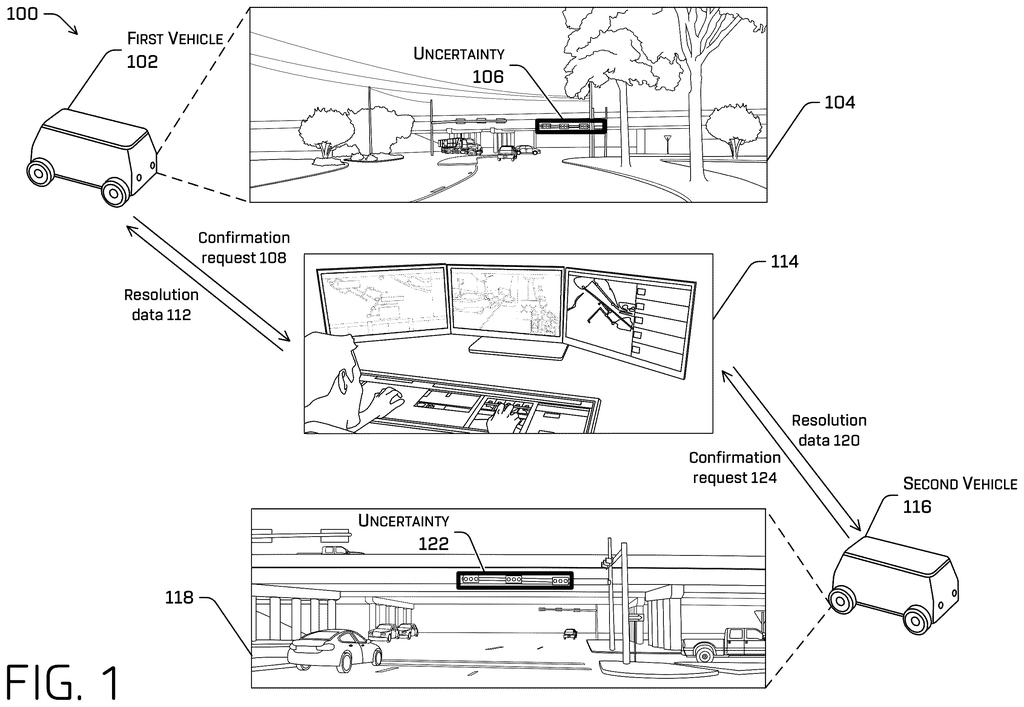
How Zoox's pre-warning system for self-driving cars works
Every time a self-driving car hits something it isn't sure about, it has to stop and ask for help. That takes time, and the car behind it will probably hit the exact same confusing situation seconds later and have to ask the same question all over again.
Zoox's patent describes a way to break that cycle. When one vehicle sends a "help, I'm confused" message to a remote operations center and gets a useful answer back, the system doesn't just forget about it. Instead, it looks at where other vehicles are headed and asks: will any of them run into the same thing? If the answer is probably yes, it sends the fix to those cars before they even need it.
Think of it like a traffic dispatcher who, after helping one driver avoid a pothole, immediately radios every other driver heading down that street. You get a smoother ride, and the cars spend less time frozen at the edge of a situation they can't figure out on their own.
… determining, based at least in part on a geolocation associated with a second vehicle operating in the environment, a likelihood that the second vehicle will perceive the uncertainty at a second time after the first time; …
Translation: The system calculates the chance another nearby car will hit the exact same confusion spot.
How the system predicts which car will hit the same confusion
The system has three main jobs, running in sequence.
Step 1: Handle the first vehicle's problem. A self-driving car perceives something in its environment it can't confidently interpret. It sends a request to a remote operations system, which determines a suggested action (essentially a resolution: treat this object as X, or proceed in Y direction). That suggestion goes back to the car, and the car confirms whether it worked.
Step 2: Identify nearby vehicles at risk. Using the second car's geolocation, orientation, and perception context (where it is, which way it's pointing, what it's already sensing), the system calculates a likelihood score that this second vehicle will encounter the same or similar sensor uncertainty. If that score clears a set threshold, the system proactively pushes the same resolution data to the second car, timed to arrive before the second car reaches the problem spot.
Step 3: Update shared map data. If the second car also confirms the fix worked, the system writes that information into the underlying map. So future vehicles crossing the same area benefit automatically, without any car needing to request help at all.
The result is a feedback loop: one confused car triggers a fix, that fix gets pre-loaded into approaching cars, and confirmed fixes harden into permanent map knowledge.
Aspects of this disclosure relate to proactively transmitting resolution data to vehicle(s) in an environment that experience the same or similar uncertain sensor data.
Translation: The technology sends out solutions before other self driving cars even reach the tricky area.
What proactive vehicle guidance means for autonomous fleets
For autonomous vehicle fleets, the biggest operational bottleneck right now isn't the hard-to-solve edge cases, it's the repeat edge cases. Every time a car has to pause and radio for help, that's a delay. When ten cars hit the same confusing intersection over one afternoon and each one asks for help separately, that's ten delays and a lot of wasted remote-operator attention.
This patent describes infrastructure that could meaningfully reduce that repetition, at least within a single operating area. Zoox's interest in remote operations and fleet coordination shows up repeatedly in their filings, and this one fits a very practical gap: the space between "one car learned something" and "all cars benefit from it." If the system works as described, your robotaxi ride gets less likely to stall at an ambiguous intersection that tripped up the one in front of it.
Amazon's 28th filing we've tracked since May in the self-driving sensing race adds to earlier Zoox work like one forecasting object paths and one color-coding lane maps.
The shortest path from this patent to a shippable feature is actually not that long, because most of the required infrastructure already has to exist for any serious autonomous vehicle operation. You need remote operations, you need vehicle-to-cloud communication, and you need some form of shared map. This patent adds coordination logic on top of those foundations, not new hardware.
The tricky part is the prediction step. Calculating whether a second car will perceive "similar" sensor uncertainty to a first car requires real confidence in modeling how two different vehicles, at different times, with potentially different sensor loadouts, would experience the same physical situation. That's a harder software problem than the patent's claim language makes it sound.
Still, the map-update loop at the end is the most durable piece here. Even if the proactive push to the second car is imperfect, any confirmed fix that hardens into permanent map data compounds over time. That part earns its keep regardless of how well the prediction threshold is tuned.
There are more where this came from
We read every patent application Big Tech publishes and send you the ones worth knowing. Plain English, free, every week.
The drawings
7 drawing sheets from US 2026/0301566 A1 · click any drawing to enlarge


Want this weekly breakdown for a company we don't cover? Patentlyze Pro →
Be the first to weigh in