
Samsung Patents a System That Routes Signals Between Wearables Through Your Body
What if your smartwatch and your earbuds could talk to each other by sending a tiny signal through your skin? Samsung has filed a patent for exactly that, describing a system where wearable devices can discover each other and choose the best communication path, including one that runs straight through the human body.
What Samsung's body-signal wearable link actually does
Ever tried to get two wireless gadgets to talk to each other, only to watch them drop the connection or pick the slowest possible route? That frustration is the problem Samsung is tackling here.
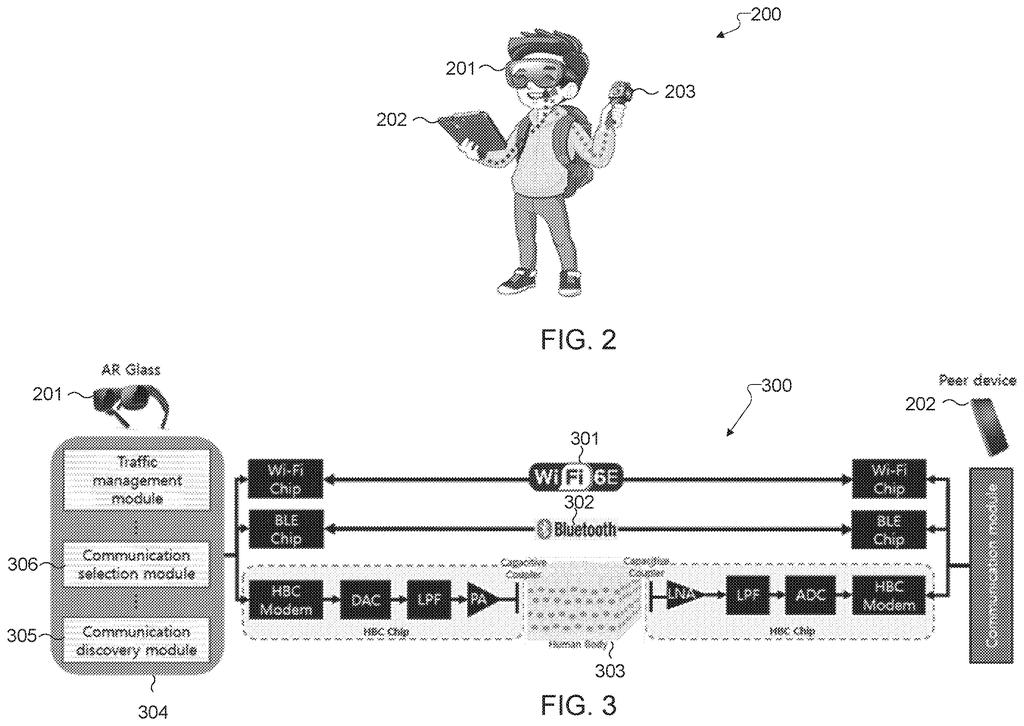
This patent describes a system where two wearable devices, say a smartwatch and a pair of earbuds, can find each other and figure out all the ways they could communicate. One of those options is called human body communication, or HBC, which sends a weak electrical signal along your skin rather than through the air like Bluetooth. The devices then pick whichever mode works best for the moment.
The idea is that your gear handles all of this automatically, without you digging through menus. Your body becomes part of the network connecting your own devices, potentially offering a more private and power-efficient link than a standard radio signal bouncing around the room.
performing, by a first electronic device, discovery of a second electronic device and one or more communication modes associated with the second electronic device, the one or more communication modes including a human body communication mode (HBC) …
Translation: One gadget scans for another and checks if it can send data through your skin.
How devices discover, pair, and switch communication modes
The patent describes a four-step process that runs on the first device (for example, a smartwatch):
- Discovery: The device scans for nearby electronics and lists every communication method each one supports, including whether human body communication is available.
- Association: The two devices perform an initial handshake on one communication mode to establish trust and identity, similar to how a phone pairs with Bluetooth headphones for the first time.
- Mode selection: The first device then evaluates the available options and picks a second, potentially different, communication mode for the actual data transfer.
- Communication: Data flows over that chosen channel.
The standout option in the list is human body communication (HBC). Rather than broadcasting a radio signal outward, HBC uses the body's surface as a conductor, sending a low-power electrical signal from one worn device to another. Because the signal stays close to the skin, it theoretically leaks less into the surrounding environment than Bluetooth or Wi-Fi.
The patent is device-agnostic at the claim level, but the obvious context is Samsung's Galaxy ecosystem, where a watch, earbuds, and a ring might all sit on or near the same body at once.
… selecting, by the first electronic device, a second communication mode to communicate with the second electronic device; and performing, by the first electronic device, communication with the second electronic device in the second communication mode …
Translation: The device picks the best way to talk to the other gadget and starts sending the data.
What this means for future Samsung wearable ecosystems
The real value here is power and privacy. Bluetooth signals radiate in all directions, burning battery and making it easier for nearby devices to detect that a signal is being sent. A body-channel link uses far less power over short distances and keeps the signal confined to the wearer, which matters for health data traveling between a ring and a watch.
For you as a user, the goal is that the system makes these choices invisibly. You put on your devices and they negotiate the best link on their own. Whether Samsung can make HBC reliable enough in everyday conditions, through clothing, movement, and skin variation, is the engineering challenge this patent does not fully answer.
Samsung's 1371st filing in our Samsung coverage since May adds to a growing body of location work, joining simultaneous distance and scanning and low-power device pinpointing.
The problem this addresses is real. As people wear more devices simultaneously, the radio environment around a single person gets crowded. Two earbuds, a watch, a ring, and a phone all trying to maintain Bluetooth links create interference and drain batteries faster than any one device would alone.
Human body communication has been in academic research for years, but it has rarely made it into consumer hardware at scale. The gap between a working lab demo and a reliable product that handles sweat, movement, and different body types is significant. A patent that describes the selection logic is a start, but it says little about how Samsung solves the physical reliability problem.
Samsung's track record in wearable communication patents suggests the company is thinking seriously about what comes after Bluetooth for short-range, on-body links. Whether HBC is the answer or just one option in a menu that mostly falls back to radio is the question this filing leaves open.
There are more where this came from
We read every patent application Big Tech publishes and send you the ones worth knowing. Plain English, free, every week.
The drawings
7 drawing sheets from US 2026/0304283 A1 · click any drawing to enlarge


Want this weekly breakdown for a company we don't cover? Patentlyze Pro →
Be the first to weigh in