
Amazon Patents a Fix for Gesture-Sensing Antennas That Lose Accuracy at Variable Power
Your smart speaker's antenna can double as a touch-free gesture sensor, but only if the signal it sends stays consistent. Amazon has filed a patent for a correction system that keeps gesture detection accurate even when that signal power wanders.
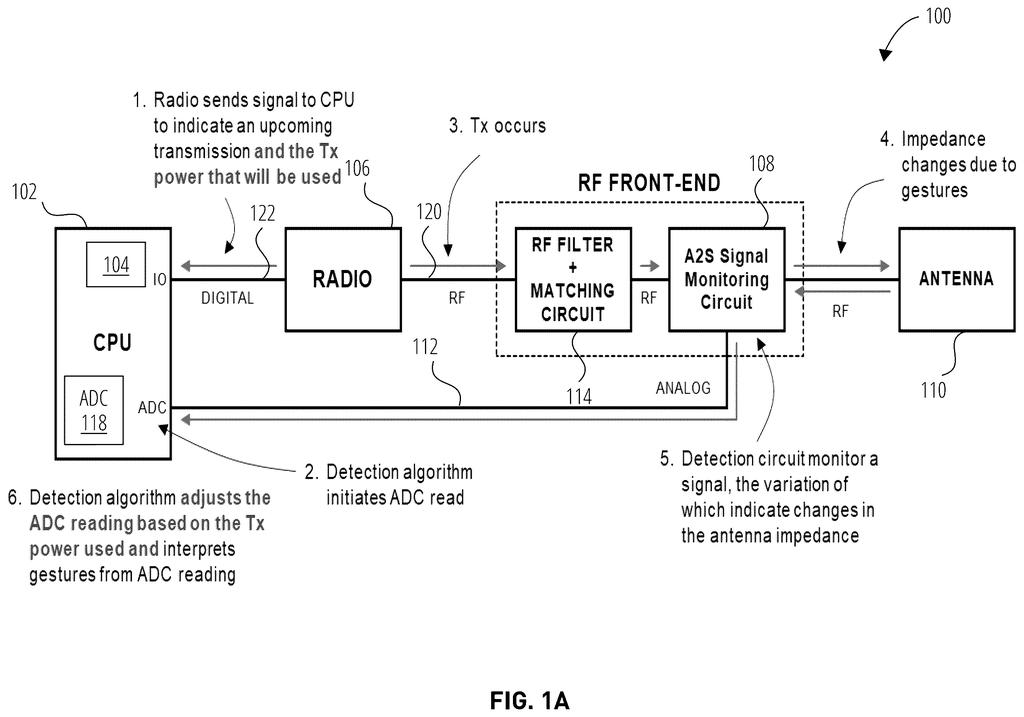
How Amazon's antenna-touch sensing actually stays accurate
Most wireless devices like smart speakers and Echo displays already have antennas. Amazon has been working on a trick where those same antennas can sense when your hand is nearby, letting you wave or hover to control the device without touching it. The catch: this sensing relies on measuring tiny electrical changes at the antenna, and those measurements go haywire if the radio inside the device doesn't transmit at exactly the right power level.
This patent describes a correction layer that watches for any drift in transmit power and automatically adjusts the sensor readings to compensate. Think of it like a bathroom scale that recalibrates itself when the temperature in the room changes.
The result is that the device can still correctly recognize your gestures, a wave to pause music or a hover to adjust volume, even when the radio is operating at a power level that wasn't originally planned for. You'd probably never notice any of this happening; that's the point.
… the detection logic is to determine that a first power level of a transmit power of the radio is different than a second power level of the transmit power, the second power level being a default power level; the detection logic is to adjust the A2S signal by a first adjustment amount corresponding to the first power level to obtain an adjusted A2S signal; …
Translation: The system checks if the radio is running at a non-standard power level and scales the sensor signal to compensate.
How the detection logic corrects for shifting transmit power
The system builds on a concept called Antenna as Sensor (A2S), where the same antenna used for Wi-Fi or Bluetooth also acts as a proximity detector. When an object like a hand comes near the antenna, it slightly changes the antenna's impedance (how much it resists the flow of radio-frequency energy). A detection circuit measures that change as a small analog voltage signal and converts it to digital data.
The problem this patent solves is that the detection circuit's readings are sensitive to how much power the radio is pushing through the antenna. If the transmit power is higher or lower than the default level, the voltage readings shift, and the system might incorrectly flag noise as a gesture, or miss a real one.
The fix works like this:
- The detection logic constantly monitors the radio's actual transmit power level.
- It compares that level to a stored default power level.
- If there's a difference, it calculates an adjustment amount and applies it to the raw sensor readings before any gesture analysis happens.
- The corrected data is then fed into the gesture recognition logic as normal.
This correction happens in software on the device's processor, so no extra hardware is needed beyond what an A2S-equipped device would already include.
The electronic device determines a variation in a transmit power level of the wireless communication component from a specified power level, and adjusts digital samples by an adjustment amount.
Translation: When the signal strength changes, the device automatically corrects its internal measurements to keep gesture tracking accurate.
What this means for hands-free controls on Amazon devices
If you use an Amazon Echo or similar device with hands-free gesture controls, the accuracy of those controls depends entirely on the antenna readings being trustworthy. Radios don't always transmit at a perfectly fixed power level; network conditions, temperature, and firmware decisions can all cause small fluctuations. Without a correction like this, a gesture sensor built on that antenna would be unreliable in real-world conditions.
For you as a user, this is the difference between a gesture feature that works every time and one that occasionally ignores you or triggers by accident. It also means Amazon can enable gesture sensing on more devices without requiring dedicated sensor hardware, which keeps costs down.
Amazon's 94th filing we've tracked since May in our Amazon coverage adds to a pattern that includes a coding assistant and an AI content filter.
Gesture controls on smart speakers and similar devices have a simple promise: wave your hand to skip a song, pause a video, or dismiss a timer without touching anything. That promise breaks down the moment the feature becomes unreliable, and unreliable usually means abandoned.
What this patent solves is a quiet but real source of that unreliability. The radio inside a device doesn't always broadcast at a perfectly steady power level, and those small fluctuations were enough to corrupt the signal the device uses to detect a hand moving nearby. This correction mechanism reads those fluctuations and adjusts for them before the device decides whether a gesture happened.
For the person actually using the product, the difference is whether they trust the feature enough to keep using it. A gesture control that works nine times out of ten trains people to reach for a button instead.
There are more where this came from
We read every patent application Big Tech publishes and send you the ones worth knowing. Plain English, free, every week.
The drawings
23 drawing sheets from US 2026/0298992 A1 · click any drawing to enlarge


Want this weekly breakdown for a company we don't cover? Patentlyze Pro →
Be the first to weigh in