
Qualcomm Patents a Feedback System That Prevents 3D Video Calls From Stalling Under Heavy Network Load
Holographic video calls send enormous amounts of data, and when the network gets crowded, the picture falls apart fast. Qualcomm has filed a patent for a system that automatically detects that congestion and tells the sender to back off before things get ugly.
What Qualcomm's holographic call fix actually does
A surgeon overseas performs a remote consultation while a dense crowd of conference attendees floods the same Wi-Fi network. The holographic feed starts glitching, and nobody is sure why. That scenario is exactly the kind of problem this patent tries to solve.
When you send a holographic stream, the data travels across the internet through routers that can get overwhelmed. Those routers already have a way to flag congestion: they stamp a small warning on individual data packets, like a yellow caution sign. The problem is that warning is hard to route back to the right sender when multiple devices are involved in a holographic session. Qualcomm's approach adds an identifier to the feedback message so the network knows exactly which device is flooding the pipe and needs to slow down.
The result is that the sending device automatically dials back its data rate before the connection breaks entirely. You get a degraded-but-functional call instead of a frozen, stuttering mess.
receive a first set of packets of a traffic flow associated with holographic communications, wherein at least one packet of the first set of packets includes an explicit congestion notification marking; and transmit, based at least in part on the explicit congestion notification marking, a feedback message comprising congestion information corresponding to the traffic flow …
Translation: The device spots network traffic trouble during a 3D video call and sends back a warning message.
How the ECN feedback loop finds the right sender
Holographic communications involve multiple devices sending and receiving extremely high-bandwidth streams simultaneously. When a router along the path becomes overloaded, it uses a standard mechanism called Explicit Congestion Notification (ECN) (think of it as a digital sticky note the router puts on packets saying "I'm overwhelmed") to signal that senders should reduce their data rate.
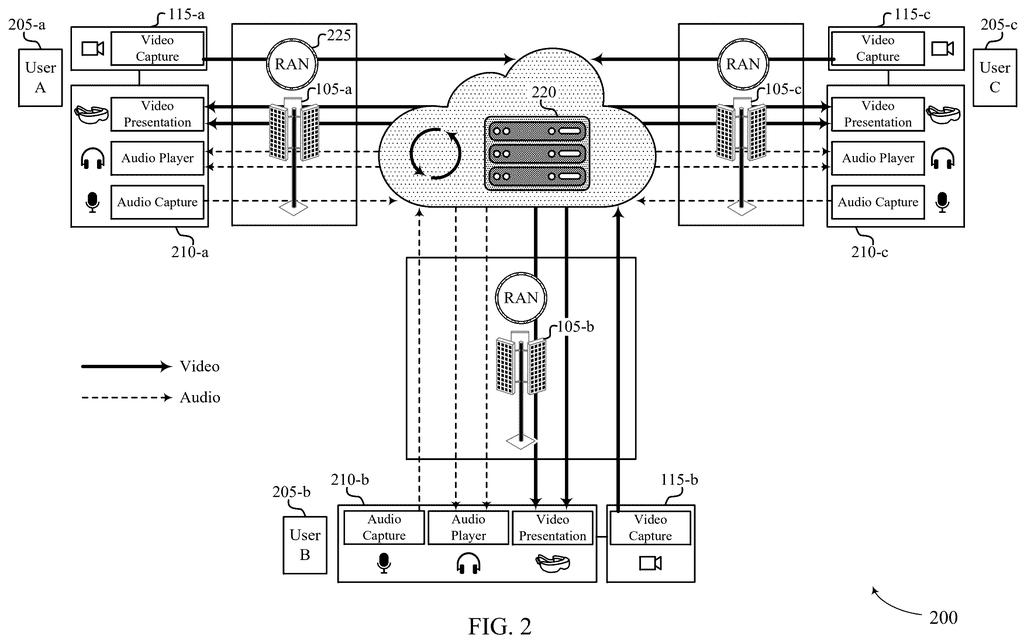
The catch in a holographic session is that the device receiving the congestion signal is often not the device that caused the problem. In a typical setup, an application server sits between multiple senders and receivers. The receiver spots the ECN marking on an incoming packet but has no clean way to tell the application server which specific sender's traffic is to blame.
Qualcomm's patent closes that gap. The receiving device:
- Detects the ECN marking on incoming packets
- Compiles a feedback message that includes the congestion information and a unique identifier for the sending device
- Sends that feedback message to the application server
The application server reads the identifier and forwards the congestion signal directly to the correct sender. That sender then automatically reduces its transmission rate for the affected traffic flow, relieving pressure on the overloaded router. The process is designed to work within existing network infrastructure without requiring routers to be rebuilt.
The source wireless communication device may modify a data rate associated with the traffic flow in accordance with the ECN feedback received from the application server.
Translation: The sending device automatically slows down its data stream to keep the video call running smoothly.
What this means for next-gen immersive video
Holographic and volumetric video are expected to demand orders of magnitude more bandwidth than standard HD streaming. If the plumbing for managing congestion does not scale alongside that demand, the technology will be too unreliable for anything serious, whether that is remote surgery, collaborative design, or live entertainment.
What makes this filing interesting is that it targets a real, specific gap in how congestion signals travel through multi-party sessions. Qualcomm has been filing around holographic communications infrastructure since 2024. Standard congestion-control protocols were not designed with the multi-sender, server-relayed architecture of holographic calls in mind, so this is not a minor tweak to existing tools. Whether it becomes part of a formal standard is a separate question, but the problem it addresses is a genuine obstacle for anyone trying to deploy high-fidelity immersive video at scale.
Qualcomm's 477th filing in our Qualcomm coverage since May adds to a run that includes live video lag reporting and GPS-anchored headphone audio.
Holographic video, where a three-dimensional image of a person floats in a room as if physically present, demands far more data than any video call or streaming service running today. When the network gets crowded, the current system sends the slowdown signal to the viewer's device rather than the sender's, which is roughly as useful as asking a passenger to stop moving when you need the driver to brake.
That mismatch grows more expensive as holographic formats get closer to real products. A congestion warning that reaches the wrong device does nothing to reduce traffic, so the image stutters or breaks apart while the actual source keeps flooding the network.
Qualcomm's fix is to attach a return address to every congestion warning so it reaches the device actually generating the problem. The logic is tight, the problem is real, and the cost of ignoring it scales directly with how widely holographic communication spreads.
There are more where this came from
We read every patent application Big Tech publishes and send you the ones worth knowing. Plain English, free, every week.
The drawings
24 drawing sheets from US 2026/0303537 A1 · click any drawing to enlarge


Want this weekly breakdown for a company we don't cover? Patentlyze Pro →
Be the first to weigh in