
Google Patents a System That Teaches AI to Copy Text Styles in Images
Getting AI to reproduce a specific font style, color treatment, or animated text effect accurately requires enormous amounts of labeled training data. Google's new patent describes a way to manufacture that data automatically, at scale.
What Google's synthetic text-style training actually does
Imagine opening a design app and asking its AI to write a movie-poster title in that same cracked, neon-lit font from the template you uploaded. Today, that kind of AI usually stumbles, producing blurry letters or ignoring the style entirely.
The reason is simple: teaching an AI to handle stylized text requires thousands of example images, each carefully labeled. Collecting those by hand is slow and expensive. Google's patent describes a system that builds that training library automatically, by taking existing styled-text templates and swapping in new words and backgrounds while preserving the original look.
The result is a large dataset of image-and-description pairs, all generated by software rather than human annotators. Another AI then trains on that dataset, learning to produce or recognize stylized text on its own.
… generating, with a generative language model, a natural language description based on a plurality of tags that comprise data representing a plurality of attributes associated with the graphical text and the animation template; …
Translation: The AI writes out a detailed text description using tags that describe the original image and its text style.
How the pipeline swaps words while locking in the style
The system works in two connected stages Google calls a template description generation pipeline and an instance rendering pipeline.
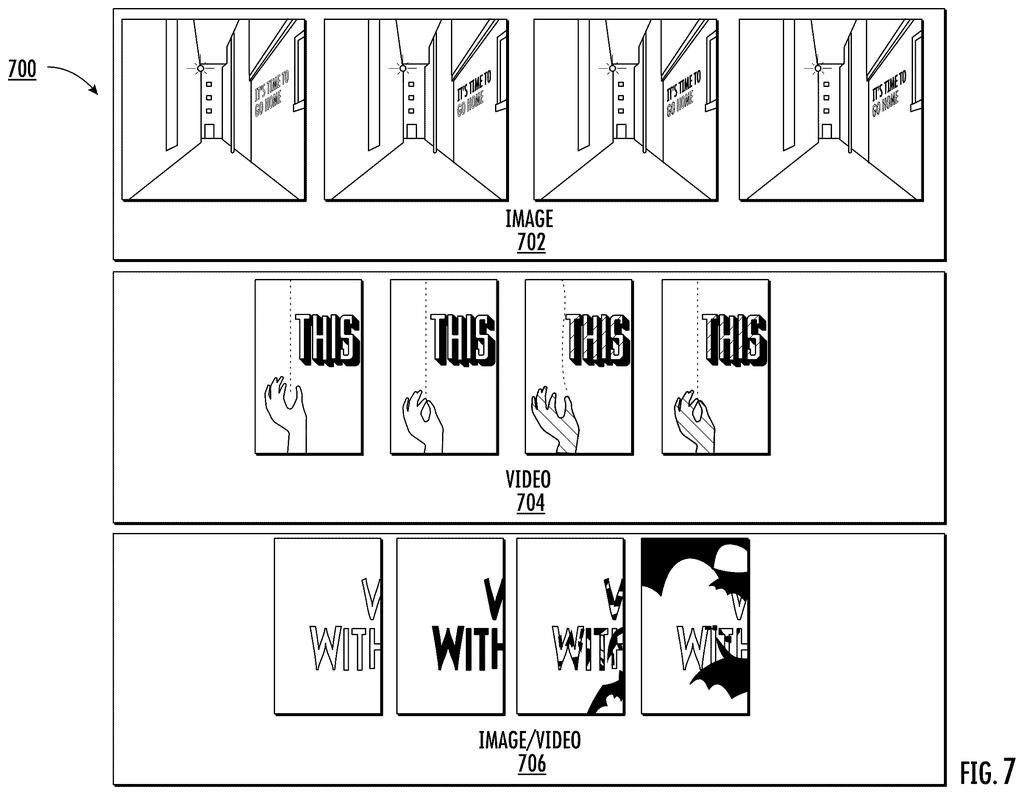
In the first stage, the system takes an existing animation template (an image or video clip containing styled graphical text) and reads its attributes automatically. Those attributes, things like font weight, color, motion type, and layout, are stored as tags. A generative language model (essentially a text-generation AI similar to the kind behind chatbots) then turns those tags into a plain-English description of the template.
In the second stage, the system picks new words and a new background, then builds an augmented description that combines the original style description with those new choices. A rendering engine uses that description to produce a new image: the new words, drawn in exactly the same stylistic treatment as the original template, placed on the new background.
- Each output image is paired with its augmented description.
- Thousands of these pairs form a synthetic training dataset.
- A separate machine-learning model then trains on that dataset, learning to generate or recognize styled text in new images and videos.
The machine-learned models can utilize the template descriptions associated with the graphical text to generate images and/or videos with graphical text.
Translation: The system then uses these descriptions to create new images and videos featuring the exact same visual text style.
What this means for AI-generated images with readable text
For you as someone who uses AI image or video tools, the payoff is text that actually looks right. Right now, asking most AI image generators to place styled words into a scene often produces garbled letters or text that ignores the requested look. That failure comes directly from too little training data covering the full range of fonts, effects, and animations that exist in real design work.
A pipeline that manufactures that training data automatically, rather than relying on hand-labeled examples, is one of the more practical routes to fixing the problem. Google's run of synthetic-data filings suggests the company sees data generation itself as a core engineering challenge, not just a preprocessing step. If the approach works as described, future AI tools could handle animated text overlays, styled titles, and branded graphics with far more accuracy than today.
Google's 63rd filing we've tracked since May in the AI photo editing race builds on earlier applications covering how light affects photos and facial expression edits.
When you ask an AI tool to put a birthday message on a card or a headline on a poster, the words often come out scrambled, melted, or styled completely wrong. Google's patent targets exactly that moment of failure, by building a system that teaches its models using thousands of matched examples of real styled and animated text, generated automatically rather than assembled by hand.
The practical upside is that text in AI-generated images gets more reliable: legible, styled the way you asked, and consistent across a design without requiring you to fix it afterward.
That matters most when the output needs to be presentable to someone else, not just good enough for a rough idea. A tool that handles type correctly means fewer workarounds and less time cleaning up something that should have worked the first time.
There are more where this came from
We read every patent application Big Tech publishes and send you the ones worth knowing. Plain English, free, every week.
The drawings
22 drawing sheets from US 2026/0301260 A1 · click any drawing to enlarge


Want this weekly breakdown for a company we don't cover? Patentlyze Pro →
Be the first to weigh in