
Google Patents a Way to Pull Individual Visual Concepts Out of a Single Photo
Most AI image tools treat a photo as one inseparable thing. Google has filed a patent for a system that learns a separate "text token" for each visual idea inside a single image, so you could pull out the wooden chair, the tiled floor, or the potted plant as individually controllable pieces.
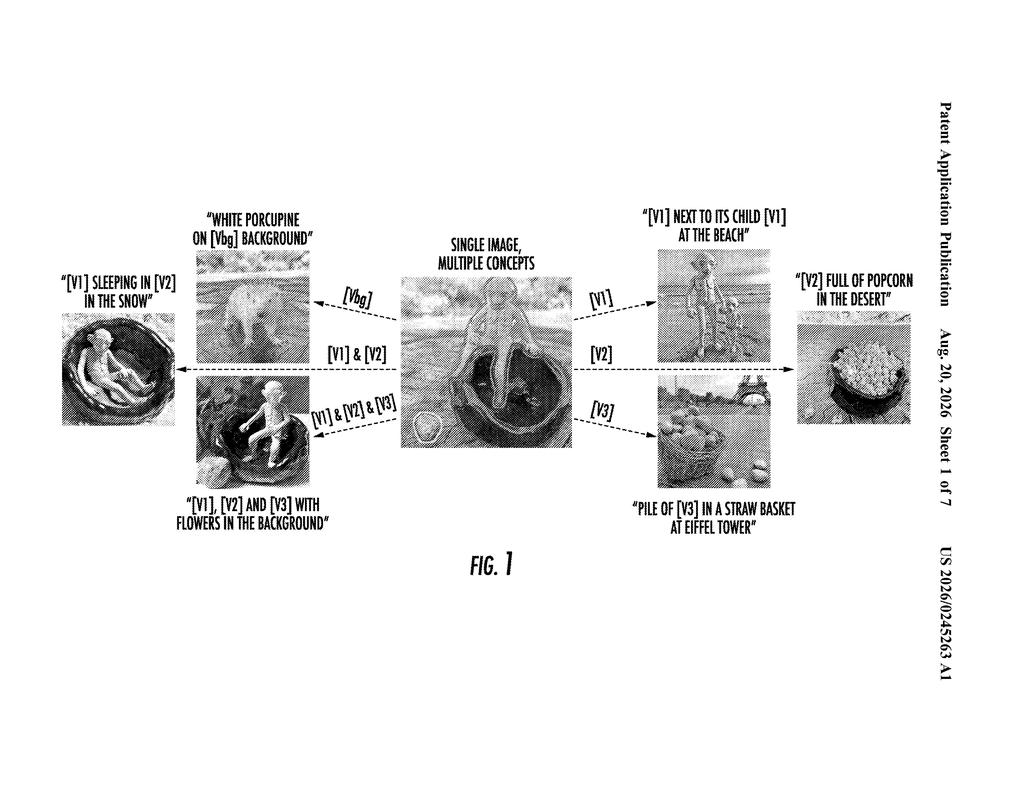
How Google teaches AI to see parts, not just the whole picture
Today's AI image editors are good at working with whole scenes but poor at isolating the individual things inside them. If you want an AI to re-create just the style of a lamp from a room photo, it usually drags the whole room along with it. Google wants to fix that.
The system described in this patent looks at a photo alongside a set of masks, one mask for each object or concept you care about. It then teaches the AI a unique text token (think of it as a label only the AI can read) for every concept, separately. Once each concept has its own token, you can mix and match them in new images without bleeding the wrong details in.
The practical payoff is fine-grained creative control: you could take the texture from one photo, the shape of an object from a second, and the lighting mood from a third, and combine them cleanly. That kind of precision is hard to get from today's tools without a lot of manual editing work.
given a single image of a scene that may contain several concepts, the proposed techniques are able to extract a distinct text token for each concept, enabling fine-grained control over the generated scenes.
Translation: The system breaks down a photo into separate text tags for every object inside it.
How the token-learning loop isolates each masked concept
The patent describes a textual scene decomposition method. Starting materials are an input photo and a set of masks (pixel-level outlines that say "this region is concept A, that region is concept B"). The system initializes a separate embedding (a numerical vector that acts as the AI's internal representation of a concept) for each masked region.
From there, it runs a learning loop:
- It builds a text prompt that includes one or more of these embeddings.
- It feeds that prompt to an image generation model (the kind of diffusion-based model that powers tools like Stable Diffusion or Imagen) to produce a synthetic image.
- It computes a reconstruction loss (a mathematical score measuring how far the generated image is from the original), but critically, only over the masked regions that correspond to the embeddings used in that prompt. This stops concept A from accidentally "leaking" into concept B's score.
- It updates the embeddings to reduce that loss, repeating until each token reliably represents its assigned concept.
The mask-restricted loss is the key design choice. By scoring only the relevant pixels, the system forces each token to encode only what it was assigned to encode, not the surrounding context. The result is a set of tokens that can be recombined in new prompts to produce images that mix and match those concepts in novel ways.
generating, by the computing system, a text prompt comprising one or more of the plurality of embeddings; processing, by the computing system, the text prompt with an image generation model to generate a synthetic image that depicts the visual concepts associated with the one or more embeddings included in the text prompt; …
Translation: It builds new images using the learned concepts to check if it understood them correctly.
What this means for AI image editing and creative control
For anyone who uses AI image tools creatively, the gap this patent targets is real and frustrating. Current workflows often require a user to describe everything in a scene from scratch in text, or to do painstaking masking inside an editor, just to get the AI to focus on one element. A system that automatically learns per-concept tokens from a single reference photo would cut that effort down significantly and open up more precise remixing.
On the strategic side, Google has strong incentives here: its Imagen and Gemini image tools compete in a crowded space where fine-grained control is a frequent user complaint. The techniques described in this filing sit squarely in the area of concept personalization, a fast-moving corner of AI image research, and the latest Big Tech patents in this space show multiple companies racing to make AI image generation feel less like autocomplete and more like a real creative tool.
Google's 40th filing we've tracked in our AI photo editing race since May follows patents like one rebuilding any camera angle and one sharpening only moving parts.
For any designer who has tried to pull one element from a reference photo and watched the AI copy the entire mood, colors, and layout along with it, this patent fixes that exact problem. The system teaches itself to lock each visual idea to its own separate word, so a texture or object can move to a new image without dragging its surroundings with it.
That control becomes obvious the first time someone reuses a single visual idea across projects and it works immediately.
There are more where this came from
We read every patent application Big Tech publishes and send you the ones worth knowing. Plain English, free, every week.
The drawings
7 drawing sheets from US 2026/0245263 A1 · click any drawing to enlarge


Want this weekly breakdown for a company we don't cover? Patentlyze Pro →
Be the first to weigh in