
Nvidia Files Patent on Teaching Self-Driving Cars to Trace Curving Lane Lines
Nvidia's patent has a self-driving car lay a few hundred invisible guide lines over a bird's-eye map, some straight, some slanted, some curved. It then checks along each one for a lane marking, which skips the slow clean-up step older systems need.
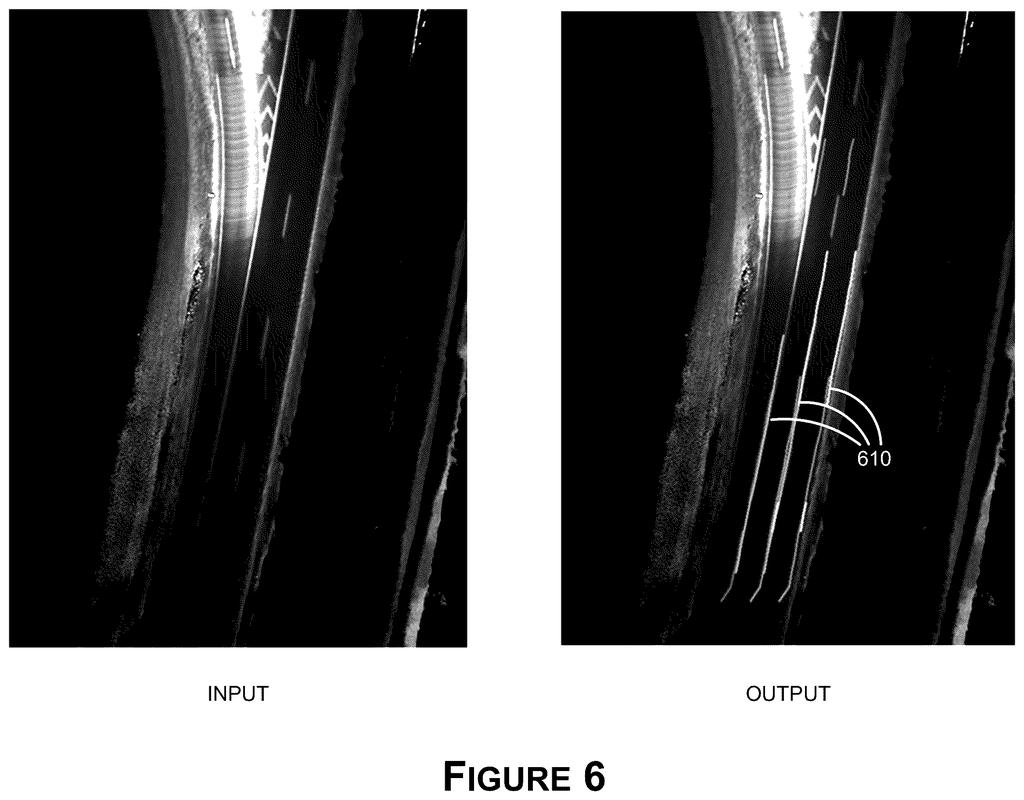
What Nvidia's slanted lane-guide system does
Today, many self-driving systems find lane lines by predicting lots of short line fragments, then running a clean-up step to work out which fragments belong to the same lane. That extra step is slow, and it can trip up right where driving gets hard: lanes that split, merge, or sit close together.
Nvidia's patent skips the stitching. Before the car even looks at the road, the system lays out a few hundred invisible guide lines on a bird's-eye map of the surroundings, some straight, some slanted, some curved. It then checks along each guide line for a lane marking and records how far the real paint sits from it.
So when you're cruising through a bend, the system asks a simple question for every guide line: is there a lane here, and where exactly does it curve? The answers go straight to the part of the car that plans and steers.
… generate, for at least one individual anchor of one or more linear or curved anchors, a set of sampled features based at least on sampling from the set of extracted features at locations associated with the at least one individual anchor …
Translation: It analyzes shapes by taking samples along pre-established straight or curved guide lines.
How the guide lines trace a lane point by point
The system starts with sensor data from the machine, such as a LiDAR point cloud (a cloud of 3D dots made by bouncing laser pulses off the road and everything around it), which can be stacked over several moments to build a denser picture. That data is flattened into a top-down image, and a neural network pulls out a feature map (a grid of numbers summarizing what is where).
Next come the guide lines, which the patent calls anchors. The filing gives an example of about 300 of them, each sampled at about 50 evenly spaced points. For every anchor, the network reads the feature map at those points and runs them through shared layers with four kinds of output:
- Existence: how likely it is that a lane marking runs along this anchor.
- Regression: at each point, the sideways offset of the lane's center, its width, its elevation, and whether the point is visible or hidden.
- Uncertainty: how sure the network is about each of those values.
- Classification: what each point is, such as a solid, dashed or double line, a left or right edge, or even a traffic sign.
An optional second pass re-samples the features at the offsets the first pass predicted, which sharpens results for sharply bending lanes. During training, each hand-labeled lane is matched to the anchor with the smallest total sideways distance, summed over all the sample points along the way. The results then feed the machine's planning and control software.
In various examples, surface features such as lane lines or road boundaries may be detected and 2D or 3D polylines representing their shape may be regressed.
Translation: The system spots road edges or lane markers and maps their exact shapes in two or three dimensions.
What this means for lane keeping and warehouse bots
Lane lines drive lane keeping, merging and lane changes, and the filing says splits and merges are exactly where older detectors struggle. Because each point on a guide line gets its own visibility score, your car could tell the difference between a lane that ends and a stretch that is hidden by a truck or worn-away paint.
The design also aims at cost. Nvidia says it needs simpler networks and less training data than the transformer-based detectors it compares itself to, which makes it easier to run in real time on car and robot chips. The claims cover cars, trucks, drones and warehouse vehicles, and the description mentions warehouse floor markings. It is a patent application, so nothing here promises a shipping feature.
Nvidia's 83rd filing we've tracked since May in the self-driving sensing race adds to a run that includes an eyelid-based drowsy driving camera and a two-camera distance tool.
Of everything Nvidia could patent in self-driving, a better way to find lane lines sits near the shippable end. It needs no new sensor and no new chip. The filing describes a software model for processors Nvidia already sells for cars and robots, and claim 17 even names one rated at 275 trillion operations per second.
What has to exist first is a big pile of labeled driving data, since people or tools must mark lane edges on it, and the model has to be tested in simulation before real roads, as the filing itself describes. The shortest route to a product is dropping this model into a car's existing lane-reading step and comparing it against whatever is there now.
The document gives no accuracy numbers. Every benefit is phrased as what the design should do, so the real proof will come from a head-to-head test against current detectors.
Get our take in your Top Stories
Liked this breakdown? Add Patentlyze as a preferred source on Google, and our plain-English take shows up more often in your Top Stories the next time Nvidia patent news breaks.
There are more where this came from
We read every patent application Big Tech publishes and send you the ones worth knowing. Plain English, free, every week.
The drawings
15 drawing sheets from US 2026/0311472 A1 · click any drawing to enlarge


Show the other 7 sheets


Want this weekly breakdown for a company we don't cover? Patentlyze Pro →
Be the first to weigh in