
A New Tesla Patent Has Nearby Cars Fix Each Other's GPS Errors
Your car's GPS is only a good guess, so Tesla describes cars that check it against what their cameras see, then share the error with every car nearby.
What Tesla's car-to-car GPS fix actually does
Your phone's GPS can be off by about five meters, and it gets worse around tall buildings, bridges and trees. That is fine for finding a coffee shop. It is a real problem for a car trying to drive itself, which needs to know which lane it is in.
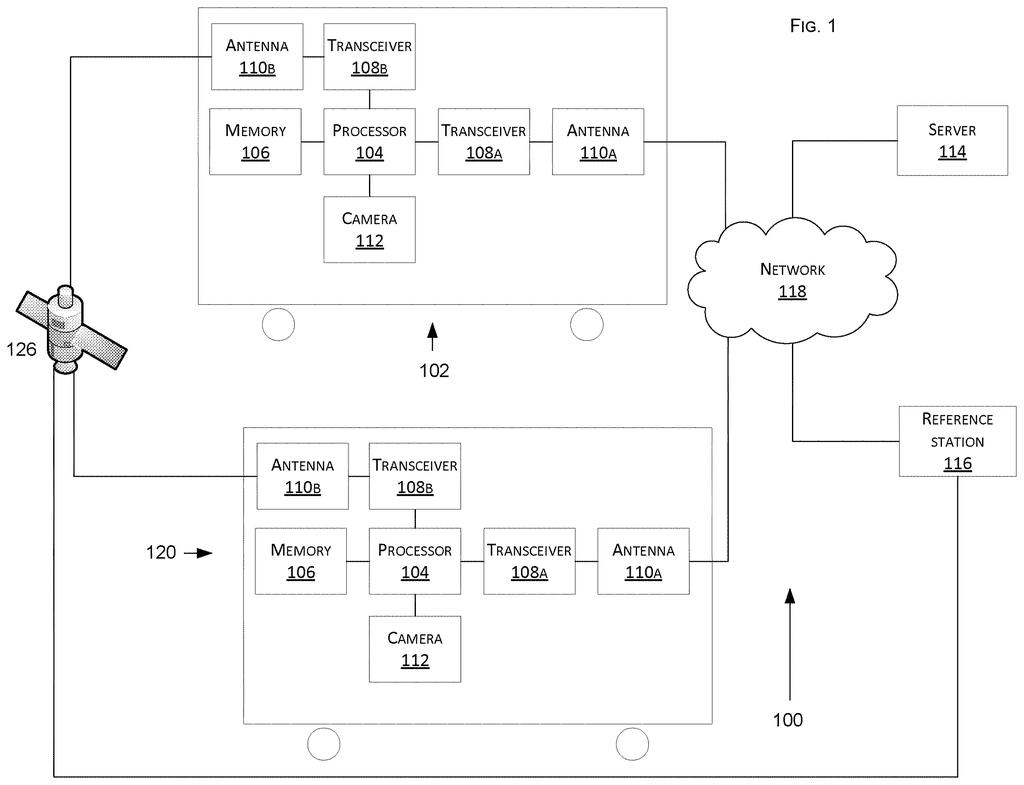
This Tesla patent describes a way for cars to fix the problem together. A car uses its cameras to recognize landmarks and lane markings, and matches them against a stored map to pin down exactly where it is. It then compares that against what its GPS says. The gap between the two is the GPS error, and the car sends it to a central server.
The server passes that information to other cars close by at the same time. Those cars use it to correct their own GPS readings, so one car's good view of the road helps its neighbors.
… generate correction data corresponding to the average of the plurality of position measurements of the vehicle position over the period of time and the threshold being satisfied, wherein the correction data includes an offset based on the average and a position of the vehicle indicated by the pose data …
Translation: The car calculates a correction offset by averaging its positions over time.
How cars check GPS against camera and map
The first independent claim covers a vehicle with a processor that vision-localizes itself to a map. In plain terms, it compares camera images against stored images to get map coordinates. The description adds that the car can nudge its location estimate until the lane edges the camera sees line up with the lane edges on the map. The result is pose data, meaning where the car is and which way it is facing.
From there, the claim lists several steps:
- The car averages many position measurements over a period of time, once the variance (how much the readings jump around) meets a threshold.
- It builds correction data: an offset between that average and the position given by the pose data.
- It generates a raw positioning measurement, which is unprocessed satellite data (the claims tie it to GNSS signals, the umbrella term for GPS-style systems).
- It sends the pose, the correction and the raw measurement to a server.
The server then broadcasts all three to a second vehicle that is close in both place and time. That second car uses the pose and raw measurement, along with its own data, to work out a position vector: the distance and direction between the two cars. The server can pick vehicles by how near they are in space and time, and can broadcast to every car in an area.
The description also covers related setups, such as parked cars acting as reference stations and cars passing along corrections from fixed ground stations to cars out of range.
Various vehicle technologies for improving positioning accuracy despite various factors that affect signals from navigation satellites.
Translation: The system makes car navigation more accurate even when satellite signals are bad.
Why lane-level accuracy matters for Tesla cars
If your car knows where it is down to the lane, driver-assist features have a better chance of behaving well where GPS struggles: downtown streets lined with tall buildings, spots under bridges, roads under heavy tree cover. The patent's own background says five meters of error is fine for some uses but falls short for autonomous driving.
The idea also spreads the work around. The description notes that corrections from a fixed ground station get less useful as you move away from it (it gives ranges like thirty miles). Here, each car adds what it learns for the cars around it. The filing names a Tesla Model S with Autopilot as an example vehicle, so Autopilot-equipped cars are the obvious fit, though a patent is not a product.
Tesla's tenth filing we've tracked on our camera-only bet since May builds on earlier work like teaching its AI to focus and one on mapping still objects.
On the hardware side, this one asks for nothing new. The car in the filing already has cameras, a satellite receiver, a cellular connection and a computer, so the whole idea runs as software plus a server.
What has to exist first is harder: a detailed map the cameras can match against, and a server that can sort out which cars are close enough, in place and in time, to share data. Cars also have to trust each other's numbers, and the filing does not say how bad data would get caught.
The shortest route to a product is a software update for cars that already carry the cameras and radios. This family of filings traces back to 2017, so the idea has had years to mature. Still, the text gives no accuracy figures, so how much it would help you on the road remains unproven.
Get our take in your Top Stories
Liked this breakdown? Add Patentlyze as a preferred source on Google, and our plain-English take shows up more often in your Top Stories the next time Tesla patent news breaks.
There are more where this came from
We read every patent application Big Tech publishes and send you the ones worth knowing. Plain English, free, every week.
The drawings
7 drawing sheets from US 2026/0309876 A1 · click any drawing to enlarge


Want this weekly breakdown for a company we don't cover? Patentlyze Pro →
Be the first to weigh in