Tesla
Tesla · Automotive · Filed Jan 7, 2026 · USPTO published May 14, 2026 · May 14 release
Tesla Files Patent for Autonomous System That Reads Intent Before Moving
Tesla is patenting a system that won't just drive itself — it'll wait until it's confident both the car is ready and the occupant actually wants to go before it starts moving. That sounds obvious, but the technical coordination involved is surprisingly nuanced.
- Publication number
- US 2026/0131807 A1(US20260131807A1)
- Applicant
- Tesla, Inc.
- Filed · Published
- Jan 7, 2026 · May 14, 2026
- Inventors
- Shreyas Shivaprasad, Riccardo Lopez, Jason McLoud, Ibrahim Shaikh, Michael Rizkalla, Silvio Brugada, Aleksei Potov, Richard Baverstock, David Exe, Romanie Cnockaert, Alec de Zegher
- Status when we published
- Waiting for an examiner
- US classification
- 701/23
- Parent application
- Continuation of 18/449,606 (filed Aug 14, 2023)(18449606)
What Tesla's intent-triggered autonomous driving actually does
Imagine you get into your Tesla, toss your bag on the seat, and glance at your phone. The car doesn't just lurch forward — it's quietly checking: is the environment safe? Are you actually ready to go? This patent describes a system that waits for both conditions to be true before it does anything.
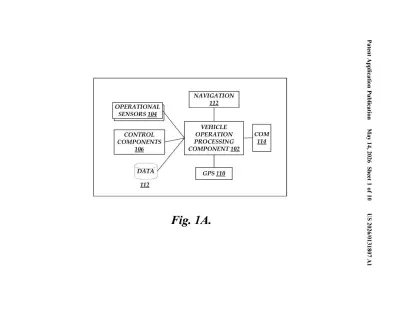
The system collects a bundle of inputs — things like sensor data, vehicle status, and signals that suggest you intend to start a trip — and only initiates driving when it concludes that both the vehicle is available and the occupant has signaled intent to travel.
Think of it like a two-factor check before your car starts moving autonomously. It's less about adding new sensors and more about building a smarter decision layer that coordinates everything before the wheels turn.
How Tesla's system processes inputs to decide when to move
The patent describes a pipeline with a few distinct stages. First, the vehicle collects a set of inputs — a broad term that likely covers camera feeds, sensor readings, GPS context, and cabin state data like door locks or seatbelt status.
A trigger event (something specific that kicks off the evaluation — possibly putting the car in drive, a voice command, or a scheduled departure) prompts the system to run two parallel assessments:
- Vehicle availability check: Is the car in a condition to safely travel? Think: no open doors, no obstructions, drivetrain ready.
- Occupant intent check: Has someone inside the car actually indicated they want to go somewhere? This is the more novel piece — the system is looking for intent signals, not just physical readiness.
Only when both checks return positive does the system identify a set of vehicle operational parameters — essentially a planned path and driving behavior profile — and initiate travel. The patent frames this as a coordinated decision loop, not a simple threshold trigger.
What this means for Tesla's Full Self-Driving ambitions
Tesla's Full Self-Driving software has faced persistent criticism for unexpected or poorly-timed autonomous decisions. A patent like this suggests Tesla is investing in the decision-architecture layer — the logic that governs when the car acts, not just how it drives. That's a meaningful shift from pure perception work toward operational judgment.
For you as a driver, this kind of system could make autonomous departure feel more intentional and less jarring — more like a competent chauffeur than a car that just starts moving. It's also relevant to Tesla's robotaxi ambitions, where no human is present to override a poorly-timed departure.
Source: US 2026/0131807 A1 at the USPTO (PDF). Full patent text and figures are in the official publication.
Get our take in your Top Stories
Liked this breakdown? Add Patentlyze as a preferred source on Google, and our plain-English take shows up more often in your Top Stories the next time Tesla patent news breaks.
Add Patentlyze on Google
One click.
There are more where this came from
We read the new patents from Big Tech, carmakers and more and send you the ones worth knowing. Plain English, free, every week.
More from Tesla
All 59 Tesla patents →
More in Automotive
All 432 Automotive patents →
Samsung
Samsung Patents a Two-Stage System for Reading Traffic Signs from a Moving Car
IBM
IBM Patents a Real-Time Map That Shows Nearby Self-Driving Cars to Pedestrians
Qualcomm
Qualcomm Patents a Map-Assisted System for Spotting Static Objects on Camera
Sony