
Intel Files Patent for Network Gear That Answers AI Requests on the Spot
The box that steers your internet traffic could also be the thing that answers your AI request. Intel's patent puts AI chips inside the network switch itself.
What Intel's AI-in-the-switch idea actually does
Ever asked a voice assistant a question and sat there waiting for the answer? Part of that delay is the trip. Your request travels across a network to a distant data center, gets processed, and the answer travels all the way back.
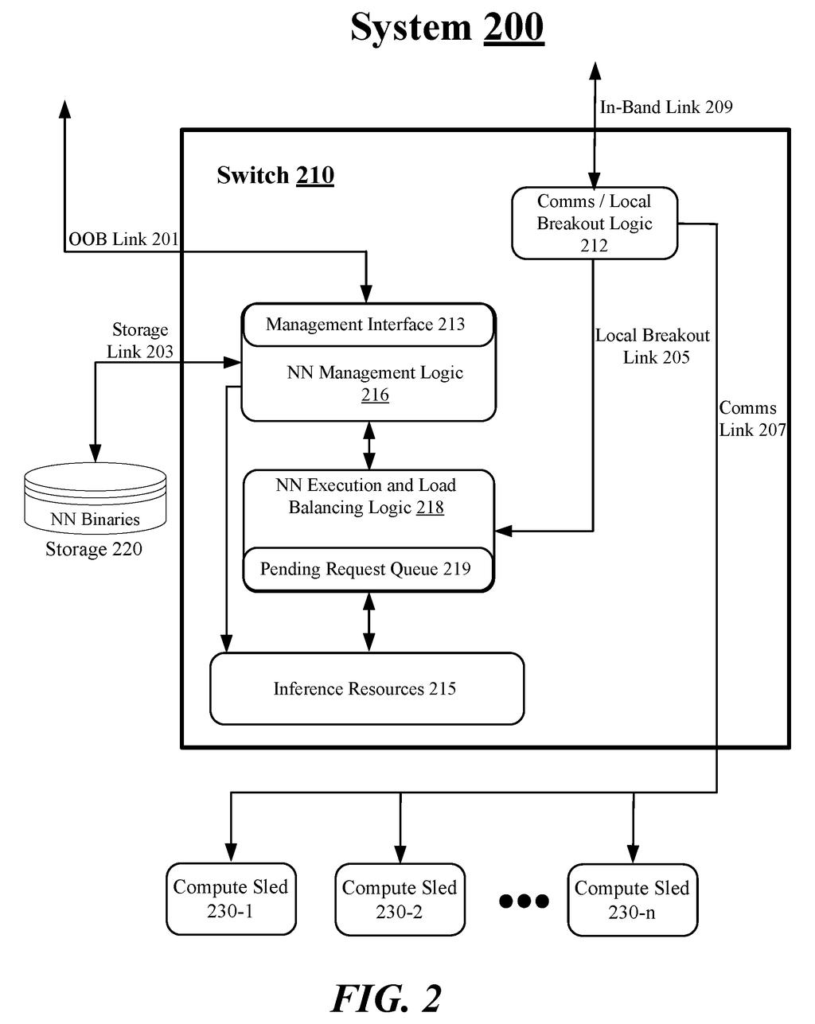
Intel's filing tries to shorten that trip by putting a small AI engine inside the network switch, the box that directs internet traffic along the way. When a request arrives for an AI service the switch already knows, it can answer on the spot instead of passing it along. Everything else gets forwarded as usual.
The patent also covers the business side. A company that sells an AI service (say, video analysis or speech recognition) registers it with the network operator, along with how fast the answers must be and what it is paying. The switch keeps track of who is who, and can give higher-paying customers priority.
… generate, based upon management data, configuration data, the configuration data to be used in association with configuring at least certain of AI inference resources to implement, at least in part, AI inference services associated, at least in part, with the multiple tenants …
Translation: The system creates setup instructions to configure AI hardware for different clients sharing the network.
How a switch registers and loads an AI model
The claims describe a data processing system for a cloud provider that serves multiple tenants (the companies renting AI capacity). It has interface circuitry to talk to those tenants over a network, and management circuitry that handles each tenant's AI requests and the results sent back. The management circuitry also generates configuration data used to set up the inference resources, meaning the chips (including GPUs, the graphics processors often used for AI) that run an already-trained AI model to produce answers.
Which resources a tenant gets depends on registration data, including the performance that tenant needs. Each tenant has an ID tied to those requirements, and the ID can also be tied to billing data for the AI service.
The description fills in the mechanics. An operator registers a model over a separate management link (an out-of-band channel, kept apart from regular traffic). The registration carries the model's loading instructions, a tenant ID, a service ID, a speed promise (an SLA, or service-level agreement) and a billing cost. The switch stores a copy and loads the model. When requests arrive:
- The switch checks whether each request matches a registered model.
- Matches go into a queue and are picked using weighted round robin (a fair turn-taking scheme), adjusted by each tenant's SLA.
- If the model is not loaded, it is fetched from storage and loaded first.
- The request's data goes in, and the result goes back to the user.
If the queue fills up, the least-used requests can be dropped, with tenant priority factored in. When an SLA ends, the model is deleted and unloaded. The filing also places these switches at different points in a wireless network, closer to users when answers must be very fast.
… receiving a request to register a neural network for loading to an inference resource located at the network switch and loading the neural network based on information included in the request to support an AI service …
Translation: The switch downloads an AI model directly onto its own hardware to handle incoming user requests on the spot.
Why faster AI answers depend on where they run
If AI can run inside the network gear your data already passes through, answers to latency-sensitive requests can come back faster. The filing's own examples include autonomous driving, video analysis for threat detection, augmented reality and speech recognition. In those cases a long round trip to a central data center is the delay you feel.
For Intel, the angle is infrastructure. The customers here are network operators and the companies that rent AI capacity from them, and the filing includes tenant IDs, speed promises and billing in its claims. That makes it a plan for selling AI processing as a metered service at the edge of the network, not only a faster chip design.
Intel's 48th filing we've tracked since May in the AI chip wars builds on ideas like one on predicting memory values and one on reshaping security hardware.
You will never see this switch, and that is the point. If it works, the only thing you notice is that a voice command, a video feature or a driving alert comes back faster, and eventually you stop noticing the delay at all.
The best case for it is where a late answer is a bad answer. The filing's own examples include steering a vehicle and spotting a threat on a video feed, where a long round trip to a distant data center can matter. For a plain voice search, the gain is smaller: a reply that feels a little less sluggish.
The billing and priority details show who benefits first. Customers with strict speed promises can be served ahead of others, so your experience may depend on which company's app you are using. The text traces back to a 2018 application, so this is a long-running idea being refined.
Get our take in your Top Stories
Liked this breakdown? Add Patentlyze as a preferred source on Google, and our plain-English take shows up more often in your Top Stories the next time Intel patent news breaks.
There are more where this came from
We read every patent application Big Tech publishes and send you the ones worth knowing. Plain English, free, every week.
The drawings
9 drawing sheets from US 2026/0312885 A1 · click any drawing to enlarge


Want this weekly breakdown for a company we don't cover? Patentlyze Pro →
Be the first to weigh in