
Intel Patents Built-In Fault Detection for AI Models Stored Directly in Hardware
Every time an AI model runs on a chip, tiny hardware errors can silently corrupt its answers. Intel has filed a patent for silicon that catches and fixes those errors on the fly, without slowing the model down.
What Intel's encrypted AI chip error-checking actually does
What happens when the chip running an AI makes a small mistake mid-calculation? The short answer is: nothing good. A corrupted memory cell can change an answer, and the AI has no way to tell you it's wrong.
Intel's patent describes a chip design that stores an AI model's data in encrypted form and wraps it with a self-checking code, a kind of built-in spell-checker for hardware. Every time the chip reads a piece of that data to run a calculation, it checks whether anything was scrambled in memory and, if so, fixes it before the math happens.
The encryption and error-checking are woven together, so the same key that unlocks the AI's data is also what lets the chip verify the data is still intact. For you, this is mostly invisible infrastructure, but it's the kind of thing that separates a chip you can trust in a medical device or a car from one that's fine for a chatbot.
… an error-correcting code (ECC) module to: generate an ECC codeword from the data of the neural network layer, and decrypt the ECC codeword using the one or more decryption keys; and a compute unit to perform one or more computations in the neural network layer based on the decrypted ECC codeword.
Translation: Hardware checks the data for corruption and unlocks it with a key before running calculations.
How the ECC module checks data before every calculation
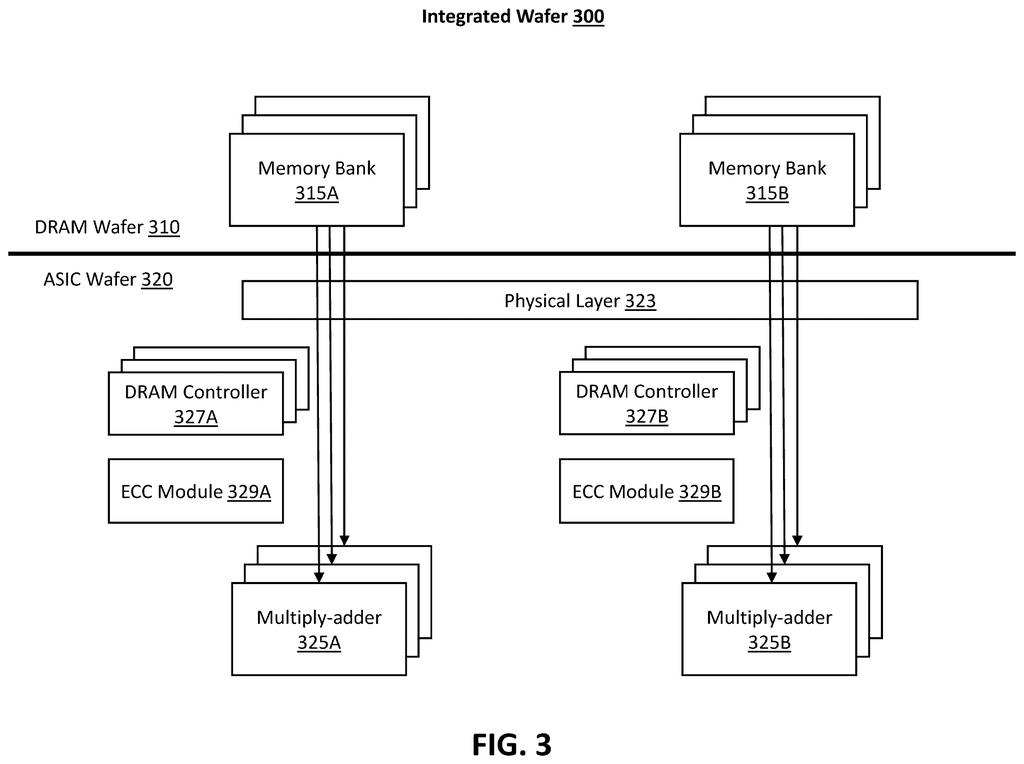
The patent describes a two-layer chip design. A memory layer holds the AI model's data (its weights, which are the numerical values that encode what the model has learned) in encrypted form, along with the decryption keys for each individual layer of the neural network.
A logic layer sits alongside the memory and contains two key components:
- An ECC module (ECC stands for Error-Correcting Code, a standard technique for detecting and fixing bit-level errors in memory)
- Compute units that perform the actual math of neural network inference, specifically multiply-accumulate operations, which are the basic arithmetic step of running an AI model
Here is the sequence: when data for a neural network layer is written to a memory bank, the ECC module generates an error-checking signature from that data, then decrypts the signature using the layer's specific key, and stores the result alongside the data. When the data is later read back for a calculation, the module uses that stored signature to detect or correct any errors that crept in.
A notable wrinkle: the decrypted ECC signature is sent to the decoder across multiple clock cycles rather than all at once, which lets the hardware spread the work without creating a bottleneck. Once the data is verified and corrected, the compute units perform their calculations on clean, trustworthy values.
What this means for AI hardware you depend on daily
AI chips are memory-intensive, and memory errors, while rare, do happen, especially under heat or over time. In most consumer applications you'd never notice a single flipped bit. But in high-stakes settings, like autonomous vehicles, medical diagnostics, or financial systems, a silent error in the model's weights could produce a confidently wrong answer with real consequences.
This patent also ties error correction directly to encryption, which matters for protecting proprietary AI models embedded in hardware. A chip that checks its own data integrity at each layer is harder to tamper with and more resilient to both hardware faults and certain classes of physical attack. Intel's track record in silicon security patents suggests this fits a longer push to make AI inference trustworthy at the hardware level, not just the software level.
Intel's 45th filing we've tracked in the AI chip wars since May follows one on shutting off processing units and one on faster memory location lookup.
For most people, this patent will never announce itself. You won't see a setting, a notification, or a new feature. What you might notice, years from now, is that the AI in your car still gives correct directions after summers of baking in a parking lot, or that a medical device running a diagnostic model hasn't drifted into unreliable territory.
Intel is building the case that an AI chip should check its own work and protect its model from corruption, silently, without asking the device or the user to do anything extra.
In regulated industries like automotive and healthcare, that silent reliability carries real weight. A medical device producing wrong outputs is a liability, and a self-driving system that degrades slowly is a safety risk nobody catches until something goes wrong. This patent is Intel working out how to make those failures far less likely before they ever reach a patient or a driver.
There are more where this came from
We read every patent application Big Tech publishes and send you the ones worth knowing. Plain English, free, every week.
The drawings
11 drawing sheets from US 2026/0300089 A1 · click any drawing to enlarge


Want this weekly breakdown for a company we don't cover? Patentlyze Pro →
Be the first to weigh in