
Apple Files Patent for Glasses That Do Different Things Depending on Which Arm You Touch
Apple has filed a patent application for glasses whose two arms do different jobs: touch one and you might get an assistant, touch the other and you might start filming.
What Apple's two-armed glasses controls do
Imagine you're walking down the street in a pair of glasses with a computer built in, and your hands are full of groceries. A call comes in, and at the same moment you spot something you want to film. Reaching for a phone or a menu is the last thing you want to do.
Apple's patent describes a simple fix: let the two arms of the glasses (the parts that hook over your ears) act as two separate controls. An input on one arm might call up a virtual assistant, while an input on the other arm could start recording video. Other examples in the filing include playing and pausing music, changing the volume, and answering, ending or muting a call.
The filing also says the two arms could feel different under your fingers, so you can tell which is which without looking. Folding the arms could even switch the device between power states.
in accordance with a determination that the input is on the first arm of the wearable component, performing a first operation; and in accordance with a determination that the input is on the second arm, different from the first arm, of the wearable component, performing a second operation that is different from the first operation.
Translation: Touching the left side does one thing while touching the right side does something else.
How each glasses arm gets its own job
The core idea is short. A wearable device has two arms holding up a part with lenses. When the device detects an input, it works out which arm that input landed on. An input on the first arm triggers one operation, and an input on the second arm triggers a different one. The claims cover this as a computer system, a method and a stored set of instructions.
The claims then list examples of what each arm could do:
- Assistant and camera: one arm invokes a virtual assistant, the other starts video capture. A separate dismissal input on the assistant arm can cancel the assistant.
- Media: playing, pausing or stopping media, and changing the volume.
- Calls: answering, ending or muting an ongoing call.
- Camera: taking a picture or stopping a video recording.
The claims add hardware details. The arms can have different tactile feels, and each arm can carry a different type of activatable input device (a physical control you press or touch). If the arms change position, for example from extended to not extended, the device can change its power state. Sensors can also tell whether the device is being worn, and how, and adjust its activity state to match.
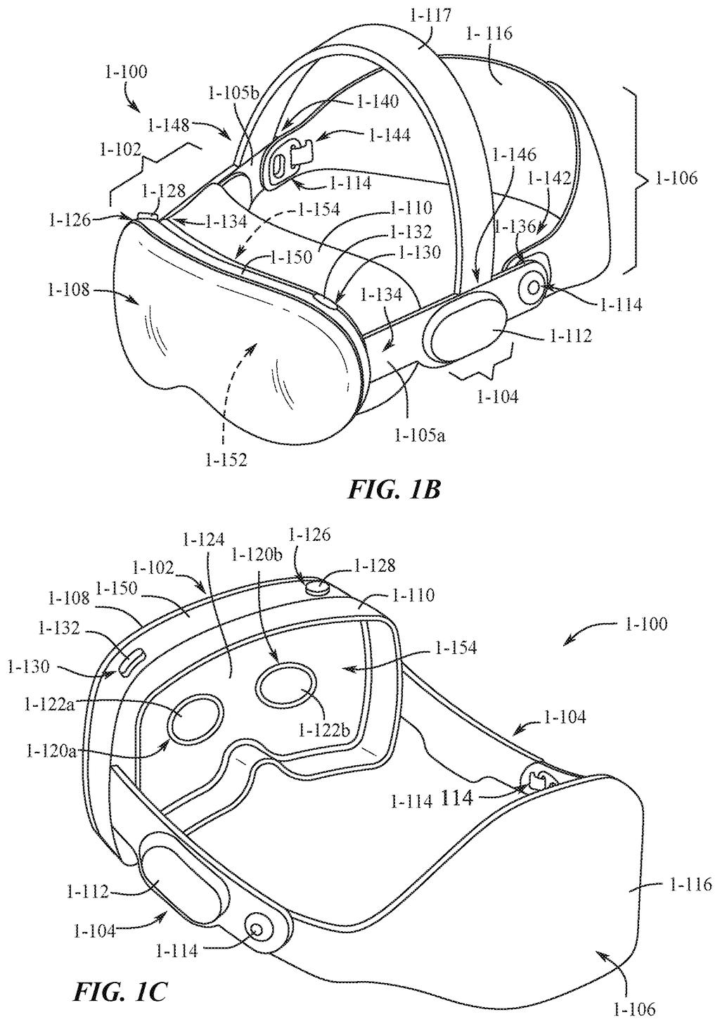
The description is written mostly around Apple's headset-style hardware. It also describes a separate idea, not in the claims, for blocking a camera's view using an input made away from the lens.
Why arm controls matter for Apple glasses
Glasses give you very little to tap. There is no screen under your finger, and talking out loud to an assistant is awkward on a train or in a meeting. Separate controls on each arm would give you a physical, silent shortcut: one spot for the assistant, another for the camera, with calls and music alongside.
For you, that could mean answering a call or pausing a podcast without reaching for your phone, and starting or stopping a recording without digging through menus. The filing's own background says clumsy controls waste time and battery. It also describes a separate idea for blocking the cameras' view with an input made away from the lens. It is a patent application, so none of this is a promised feature.
Apple's 81st filing we've tracked since May in our Apple AR glasses watch builds on flipping windows between surfaces and editing without disrupting collaborators.
The software here is about as simple as it gets: work out which arm got touched, then run the matching action. Nothing in the claims needs new computing power or a new kind of sensor. How close this is to a real feature depends almost entirely on whether there are glasses to put it on.
The hardware part is modest too. Each arm needs a way to sense a press or touch, and the claims suggest making the arms feel different so you can find the right one without looking. The shortest route to a product is glasses with a camera, an assistant and touch controls in the arms, and the filing never says Apple has such a product coming.
That leaves a small, practical idea that is easy to build once the glasses exist and hard to judge before then. Think of it as a sensible control layout for a bigger device that has not been announced.
Get our take in your Top Stories
Liked this breakdown? Add Patentlyze as a preferred source on Google, and our plain-English take shows up more often in your Top Stories the next time Apple patent news breaks.
There are more where this came from
We read every patent application Big Tech publishes and send you the ones worth knowing. Plain English, free, every week.
The drawings
31 drawing sheets from US 2026/0313221 A1 · click any drawing to enlarge


Want this weekly breakdown for a company we don't cover? Patentlyze Pro →
Be the first to weigh in