
Meta Files Patent for a Wristband That Steers an On-Screen Cursor by Rolling Your Wrist
Meta's patent application teaches a wrist-worn device to tell a wrist roll from a forearm slide, then uses both to move a cursor on glasses, monitors or TVs. Two separate AI models do the sorting.
What Meta's wrist-roll cursor control does
Controlling a pair of smart glasses today often means big arm movements, voice commands that everyone nearby can hear, or a chain of taps through menus. Meta's filing describes a wrist-worn device built to skip all of that.
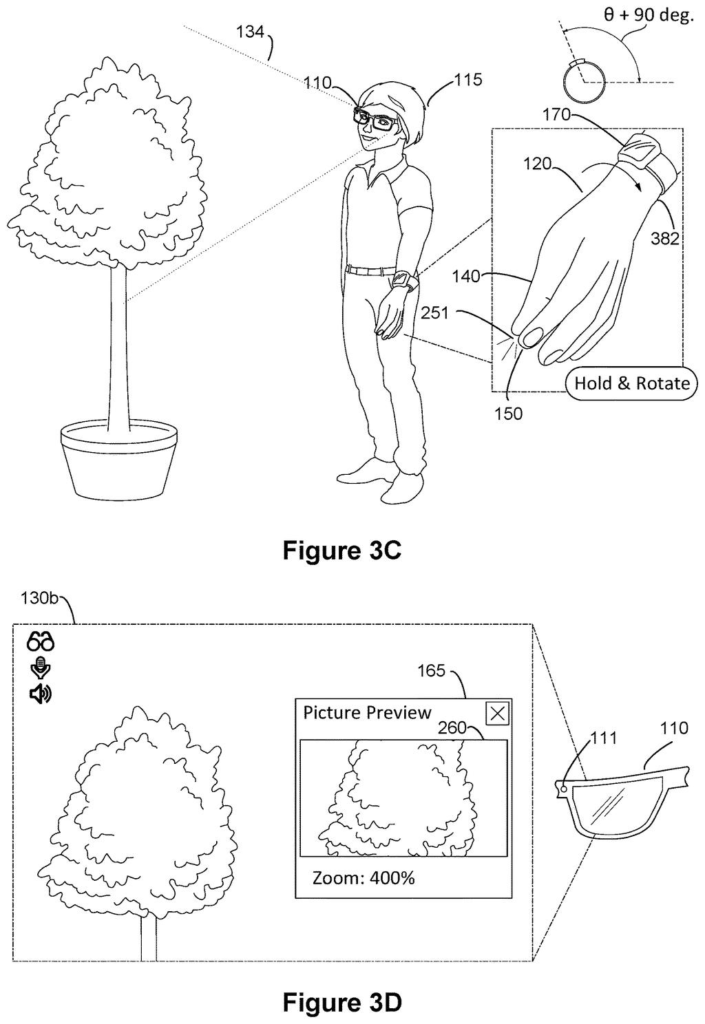
The band picks up two things: faint electrical signals from your forearm muscles and the motion of your arm. From those it works out whether you rolled your wrist (a bit like turning a doorknob) or slid your whole forearm up, down, left or right. Both movements steer an on-screen pointer, so a small turn plus a small slide can land the cursor where you want it.
The screen can be smart glasses, a computer monitor or a TV. A separate hand gesture, such as a pinch, can then select whatever the cursor is sitting on.
… determine, by a first machine learning model based on the biopotential data and the motion data, a wrist rotation performed by the user; determine, by a second machine learning model based on the biopotential data and the motion data, a forearm translation performed by the user …
Translation: AI algorithms analyze electrical signals and movement to figure out how you are turning and shifting your arm.
How two AI models split roll from arm slide
The system pairs a wrist-worn device with a display. The device carries biopotential sensors (electrodes that pick up the tiny electrical signals your muscles make, often called EMG) and IMU sensors (the same kind of motion and tilt sensors found in a phone).
Both data streams feed two separate machine learning models (software trained on examples to recognize patterns):
- The first model decides whether you performed a wrist rotation, such as a bend or roll of the wrist.
- The second decides whether you performed a forearm translation, meaning your whole forearm moved up, down, left or right.
The pointer (the claim calls it a selection indicator) moves in the direction of each movement, and the filing describes giving each one its own scaling factor. If only one movement is detected, the pointer still follows that one. In a "stacked mode" you switch into by command, the wrist moves the pointer while a forearm slide triggers discrete navigation steps instead.
The filing also covers a hand gesture that selects the item under the pointer, screens like head-wearable devices, monitors and TVs, and models calibrated with a person's own training data. The description shows wrist rolls adjusting volume, camera zoom and message scrolling, sometimes only while you hold a pinch.
… cause the cursor to move from a first location to a second location within the user interface based on the wrist rotation and the forearm translation.
Translation: Your arm movements drive the on-screen pointer across the display.
What this means for Meta's glasses controls
If you ever wear smart glasses, you need a way to point at things without a touchscreen or a mouse. A band that reads a roll or a slide lets you navigate with small, low-key movements instead of waving an arm or talking to your glasses in public. The filing itself says voice commands can be unsuitable in some social settings.
For Meta, this fits with how much Meta cares about wrist-based controls: the application continues a chain of earlier filings that began with camera control through hand gestures. It names no product, so treat it as one idea on paper.
Meta's 80th filing we've tracked in our smart glasses watchlist since May builds on earlier applications like microphone shutoff zones and processors behind the display.
Claim 1 is wide in one direction and tight in another. The wide part is the screen: any display that shows a user interface and a selection indicator counts, and claim 12 lists glasses, a computer monitor and a TV. The claim names no brand or screen type.
The tight part is the recipe. It asks for two kinds of sensors on the wrist (muscle-signal sensors and motion sensors) and two separate machine learning models, one to spot a wrist rotation and one to spot a forearm slide, both reading the same data. A setup built on a single model, or on motion sensors alone, would fall outside the wording of that claim.
The later claims fill in the practical picture: scaling each movement differently, a mode where the arm slide steps through menus, and training for each wearer. Together they describe a sensible answer to a real annoyance, which is how to point at things when you have no mouse.
Get our take in your Top Stories
Liked this breakdown? Add Patentlyze as a preferred source on Google, and our plain-English take shows up more often in your Top Stories the next time Meta patent news breaks.
There are more where this came from
We read every patent application Big Tech publishes and send you the ones worth knowing. Plain English, free, every week.
The drawings
60 drawing sheets from US 2026/0329390 A1 · click any drawing to enlarge


Show the other 52 sheets


Want this weekly breakdown for a company we don't cover? Patentlyze Pro →
Be the first to weigh in