
Google Files Patent for Training AI Image Makers to Match Your Words
Ask an AI for "a white boat out on the water" and you want a boat, not a vaguely nautical blur. Google's filing describes a training method that rewards the model for matching pictures to captions and punishes it for mismatches.
What Google's text-to-image training trick does
Early AI image generators had a habit of producing pictures that looked fine but missed the point. Ask for a scene with many objects, like a crowd on a baseball field, and the results got muddy. Older fixes often needed several models in a chain, or hand-drawn labels such as boxes around every object in the training photos.
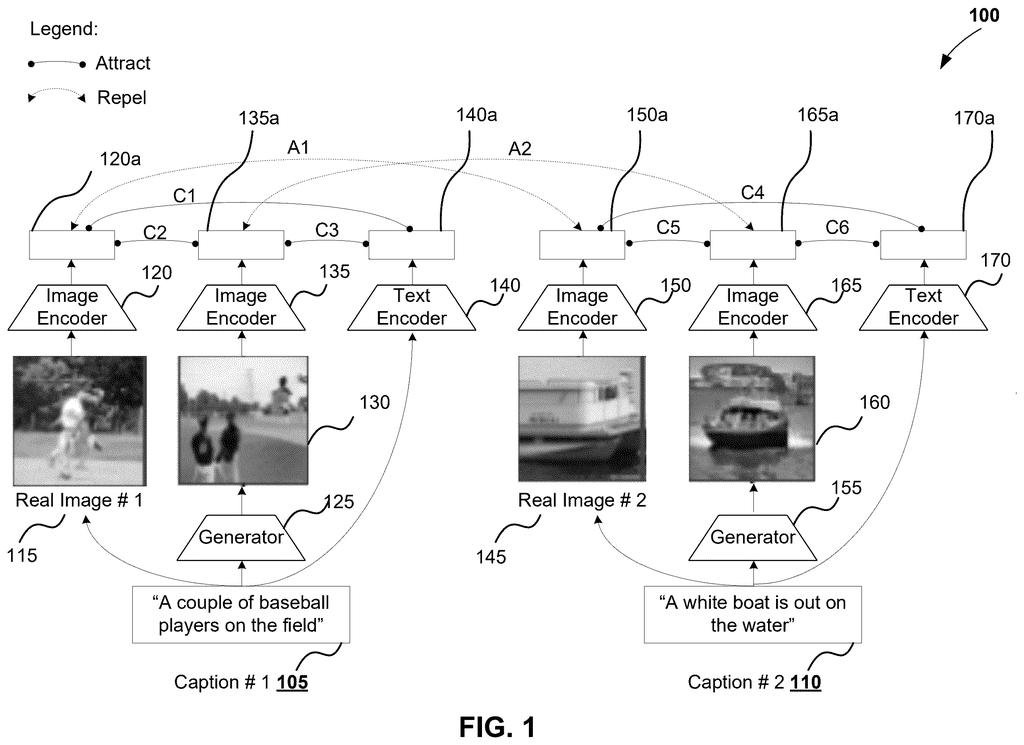
Google's filing takes a different route. During training, the AI is taught to pull together a caption, its real photo and its own generated picture, while pushing apart anything tied to a different caption. A baseball picture should sit far from a boat picture, and a baseball caption should sit close to a baseball image.
The result is a single model that learns, without extra labeling work, to make images that actually fit the sentence you typed.
… generative neural network has been trained using a contrastive loss objective that maximizes mutual information between image features and text features by causing paired image-text representations to attract in a feature space and unpaired image-text representations to repel in the feature space.
Translation: The AI learns by drawing matching words and pictures closer together while pushing mismatched pairs apart.
How the generator learns to pair words and pixels
The claims cover a text-to-image generator. You give it a written description of a scene, it starts from a block of random numbers (random noise), and it turns that into a picture. The generator is built with attention mechanisms (a way for the model to focus on the most relevant words while drawing each part of the image).
The key is how it was trained, using a contrastive loss (a scoring rule that rewards the model when matching items land close together and mismatched items land far apart). The claims say this maximizes mutual information, meaning the picture and the caption share as much of their meaning as possible. Closeness is measured with cosine similarity (a score of how similar two sets of numbers are).
The description names the system XMC-GAN. It compares three kinds of pairs:
- Image and sentence: does the whole picture match the whole caption?
- Image region and word: does each patch of the picture match a word like "boat"?
- Real and generated image: do two pictures from the same caption look alike?
A pre-trained language model (BERT) turns the text into numbers. The generator then mixes those numbers with the noise and builds the image in a single stage. Other claims cover a version that takes spoken input, transcribed to text.
… neural network for text-to-image generation to generate an output image rendition of the scene, the neural network having been trained to cause two image renditions associated with a same textual description to attract each other and two image renditions associated with different textual descriptions to repel each other …
Translation: Images sharing the same description are grouped together, while images with different descriptions are kept separate.
Why this could matter for Google's image tools
If you use any tool that turns a sentence into a picture, the practical payoff is simple: fewer images that ignore half of what you asked for. The filing says the single-stage design is easier to train than approaches that chain several models or need object labels, which matters to anyone building these tools at scale.
The description also mentions uses such as virtual and augmented reality scenes, game environments, art styles, and even video frames generated from a multi-scene description. It reports results on public image datasets, including a lower (better) image-quality score and strong human ratings against competing models. Those are the company's own test results, not a product launch.
Google's 53rd filing in the AI training & infrastructure work we've tracked since May adds to a run that includes fitting models to any budget and cutting training data needed.
From a shipping standpoint, this one is almost entirely a software story. Nothing here needs new hardware: it is a training recipe, and the description says the trained model can run on a single device or on a server that a phone or laptop talks to. That is a short path to a product, if a team wants it.
The catch is age. The filing describes a GAN (an older style of image generator built from two competing networks), and the comparisons are against other models of that same era. Today's headline image tools use different designs, so the most likely use of this patent is the underlying idea of pulling matched captions and pictures together, which can travel to other designs.
So treat this as a solid, well-tested piece of method, not a sign of a new feature coming. It is a continuation of earlier applications, which fits with a technique that has already had time to settle.
Get our take in your Top Stories
Liked this breakdown? Add Patentlyze as a preferred source on Google, and our plain-English take shows up more often in your Top Stories the next time Google patent news breaks.
There are more where this came from
We read every patent application Big Tech publishes and send you the ones worth knowing. Plain English, free, every week.
The drawings
15 drawing sheets from US 2026/0330705 A1 · click any drawing to enlarge


Show the other 7 sheets


Want this weekly breakdown for a company we don't cover? Patentlyze Pro →
Be the first to weigh in