
Apple Files Patent to Pack Extra Data Feeds Into a Single USB Connection
A USB4 connection can only juggle up to eleven data streams at once, no matter how fast the cable is. Apple's filing describes a way to cram more into each one, with a packing list sent ahead of time.
What Apple's USB4 stream-sharing idea does
Today, a USB4 or Thunderbolt connection can handle only up to eleven separate streams of data at once. The limit comes from the chip at each end, which has to set aside its own chunk of memory for every stream it manages.
Apple's filing describes a workaround. If a device needs to send fifteen streams, it can bundle several of them into one of the eleven allowed, a bit like loading different packages onto a single delivery truck. Before the truck leaves, the sender mails ahead a packing list (the filing calls it a manifest) that says which items ride in which order.
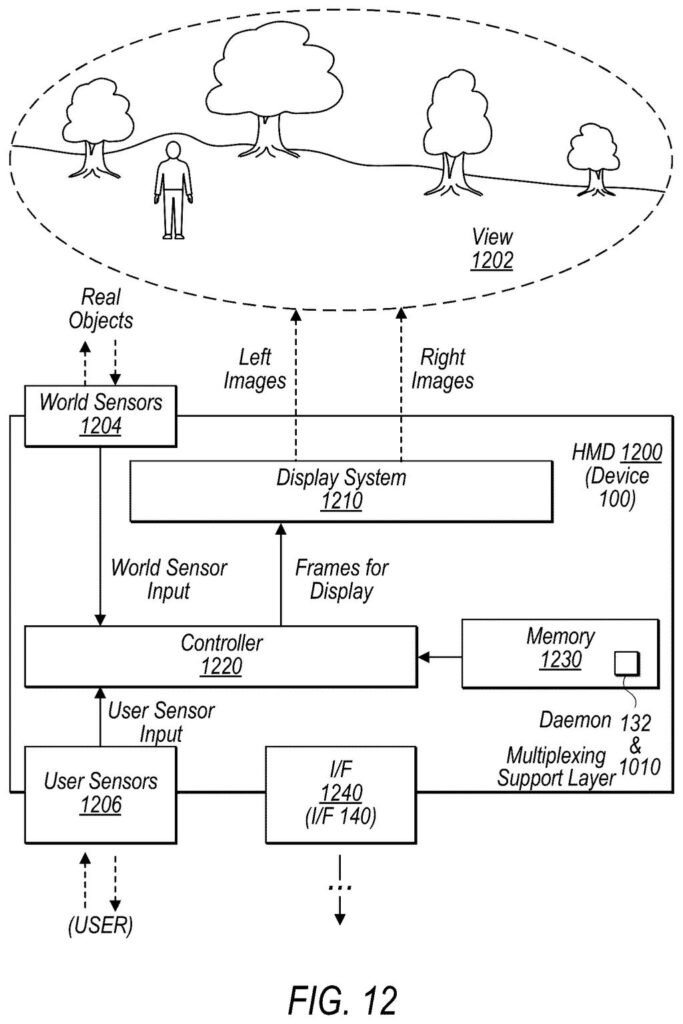
The receiving device reads that list and sorts everything to the right places. The filing's main example is a headset tethered to a nearby computer, where video, audio, camera and sensor data all have to travel at the same time.
receiving, from the sender device and via the interface controller, a manifest identifying an ordering in which a plurality of traffic sub-streams are to be multiplexed within a traffic stream supported by the interface controller …
Translation: The receiving device gets a roadmap that explains how multiple data streams are bundled together inside the connection.
How the manifest tells the receiver what's where
The filing describes both ends of the connection. A sender collects data from several sources (apps, drivers, or hardware such as cameras), picks the order in which to interleave them inside one supported stream, and sends a manifest (a list of that order) followed by the combined stream. The recipient reads the manifest, splits the stream back into its parts, and hands each part to whatever needs it. Claim 1 covers the receiving side.
- Frame counts. The manifest can say, for example, one data frame (a fixed-size chunk of data) for feed A, then three for feed B. A fresh manifest goes out ahead of each time slice, because the mix changes.
- Separate lane for the list. The filing describes sending manifests over a different, higher-priority USB channel, with resends if the receiver does not confirm them.
- Memory set aside early. Once a manifest arrives, the receiver reserves space in a ring buffer (a loop of memory where new data is added at one end and old data is read from the other), sized for each feed.
- No extra copies. Apps and hardware read their feed right where it landed, which cuts delay.
- Error check. A specially marked anchor frame sits at a known spot in the order. If it turns up somewhere else, the receiver knows data went missing and can ask for a resend or warn the consumer.
The description argues that this hardware-based sorting beats the software alternative, which sends internet-style traffic over USB and sorts it in software layers, costing more power, processor time and delay.
Why the eleven-stream cap matters to Apple
If you plug a headset, display or other gadget into a phone or computer, you want one cable to carry everything: video, sound, camera feeds and sensor readings. The eleven-stream cap in USB4 is a ceiling on that, and this filing describes a way past it while staying inside the USB4 rules, so devices are not stuck choosing which feeds to leave out.
The filing's main example is a head-mounted display sharing work with a nearby computer, where many feeds must move at once with little delay. Doing the sorting in the connection hardware instead of in software layers is meant to save power and cut lag, which matters for something you wear on your face. For most people the result would be invisible: it would just mean a wired headset or accessory that does more over the same port.
Apple's 566th filing in our Apple coverage since May adds to a run of cellular ideas that includes one on headset sleep cycles and one on upload conflicts.
Claim 1 is short and broad. It describes a receiving device with a processor, a connection chip and memory that gets a list saying what order several data feeds are packed in, gets the combined stream, and uses the list to split the feeds apart for whatever needs them.
Look at what the claim leaves out. USB, the memory loop, the marker frame for catching errors and the separate channel for the list all appear only in dependent claims, and the eleven-stream figure is only in the description. If the claim were granted as written, it could reach any receiving device that works from a packing list sent ahead of time, on any kind of connection.
Claim 11 covers the sending side, and claim 20 covers the receiving side as software. Packing several feeds into one pipe is an old idea, so the real question is whether the list-first approach is new enough to hold at this breadth. Narrowing before any grant would not be a surprise.
Get our take in your Top Stories
Liked this breakdown? Add Patentlyze as a preferred source on Google, and our plain-English take shows up more often in your Top Stories the next time Apple patent news breaks.
There are more where this came from
We read every patent application Big Tech publishes and send you the ones worth knowing. Plain English, free, every week.
The drawings
12 drawing sheets from US 2026/0332283 A1 · click any drawing to enlarge


Show the other 4 sheets


Want this weekly breakdown for a company we don't cover? Patentlyze Pro →
Be the first to weigh in