
Adobe Files Patent for Previewing Who Gets Which Version of a Marketing Email
Adobe has filed a patent application for a tool that tells marketers roughly how many customers will receive each version of a personalized email, before the campaign goes out.
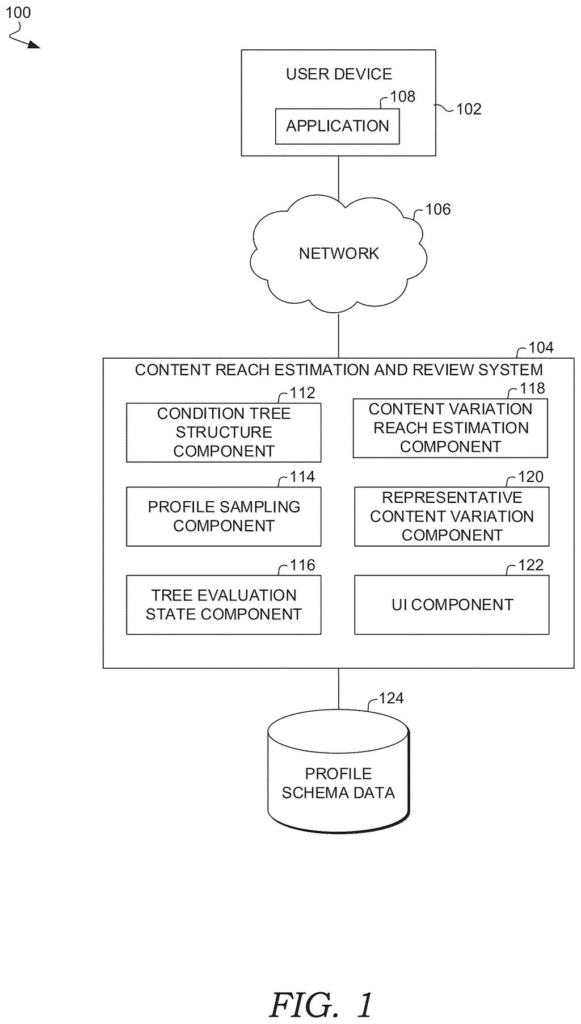
What Adobe's email reach estimator actually does
Every time a brand sends a personalized email, someone on the marketing team has to check that each version looks right. Customers over 30 might see one product, everyone else sees another, and a customer with no first name on file should not get a greeting that reads 'Hi,'.
Today that check is mostly manual. Designers build fake customer profiles, run the email against each one, and eyeball the results. Adobe's filing describes a tool that reads the email's if-then rules, takes a small random sample of your real customer list, and sorts each sampled customer into the version they would get. From those counts, it estimates how many people on the full list get each version.
Early numbers show up fast, then sharpen as the tool checks more customers in the background. It also shows one example of each version, with personal details hidden.
determining an abstract syntax tree (AST) from code-based content by processing condition statements of the code-based content such that nodes of the AST represent the condition statements and edges of the AST define condition branches representing execution paths …
Translation: The software builds a decision tree by analyzing the conditional logic inside the marketing email code.
How Adobe sorts sample customers into versions
The system starts by reading the email's code for its condition statements (the if-this-then-that rules, such as 'if the customer's age is above 30, show product A'). It turns those into an abstract syntax tree, which is a branching diagram where each rule is a point on the tree and each possible outcome is a path.
Next it pulls a random sample of profiles from the chosen audience. It can keep only profiles that contain the data the rules need, and it can weight groups so that, say, a minority gender is fairly represented. Each sampled profile gets a tree evaluation state: a string of true/false values, one per branch, like [1, 1, 0]. Each unique string stands for one version of the email.
The tool never builds or draws the email for each sampled profile; it only works out which branches the profile would follow. It then scales the counts up to the full audience with an estimator (the filing names the Horvitz-Thompson estimator, a standard statistics formula for estimating totals from a weighted sample).
A background process keeps going while the screen shows the latest numbers, growing the sample. The filing's example steps from 100 profiles to 1,000 to 10,000. The tool also renders one example of each version using a representative profile, and it masks sensitive personal data in those previews.
The estimated reach of each content variation is refined by increasing the sample size when sampling the target profiles.
Translation: The system improves its audience size estimates by analyzing a larger group of customer profiles.
Why marketers could skip the fake test customers
For anyone who builds personalized emails, the pitch is catching mistakes sooner. A version that reaches the wrong people, or almost nobody, would show up in the early numbers instead of after the campaign is already running. The filing also argues that testing fewer redundant fake profiles saves computing and network work.
The patent examiner has issued a final rejection of this application, so nothing here is approved or granted, and Adobe can still amend the claims or appeal. The filing's main example is the HTML email, though it describes the same approach for other personalized, code-based content such as web pages.
Adobe's 228th filing in our Adobe coverage since May continues its PDF work, following patents on finding the right table and partial PDF editing.
The big trade here is exactness for speed. A sampled estimate arrives fast, but it is a guess about your whole customer list, and a version that only a tiny slice of customers receives could be missed or badly misjudged when the sample is small. Letting the numbers refresh as the sample grows softens that, since you watch them settle, yet you still have to decide when settled is good enough.
The second cost is what gets skipped. Counting which branch each customer lands on means the tool never draws the email for each person, so a layout that breaks for one odd profile could slip by. Showing one masked example per version covers much of that gap, though only one example per version.
For marketing teams buried in manual checks, the trade reads as worth it. A fast, slightly fuzzy answer beats a slow, exact one that nobody has time to build.
Get our take in your Top Stories
Liked this breakdown? Add Patentlyze as a preferred source on Google, and our plain-English take shows up more often in your Top Stories the next time Adobe patent news breaks.
There are more where this came from
We read every patent application Big Tech publishes and send you the ones worth knowing. Plain English, free, every week.
The drawings
9 drawing sheets from US 2026/0329952 A1 · click any drawing to enlarge


Show the other 1 sheets

Want this weekly breakdown for a company we don't cover? Patentlyze Pro →
Be the first to weigh in