
Adobe Patents an AI Image Generator That Keeps Your Brand Style Intact
AI image generators are great at making things look good — but notoriously bad at making things look *yours*. Adobe's new patent describes a system that extracts a brand's visual DNA from reference images and uses it to anchor AI-generated outputs to a specific aesthetic.
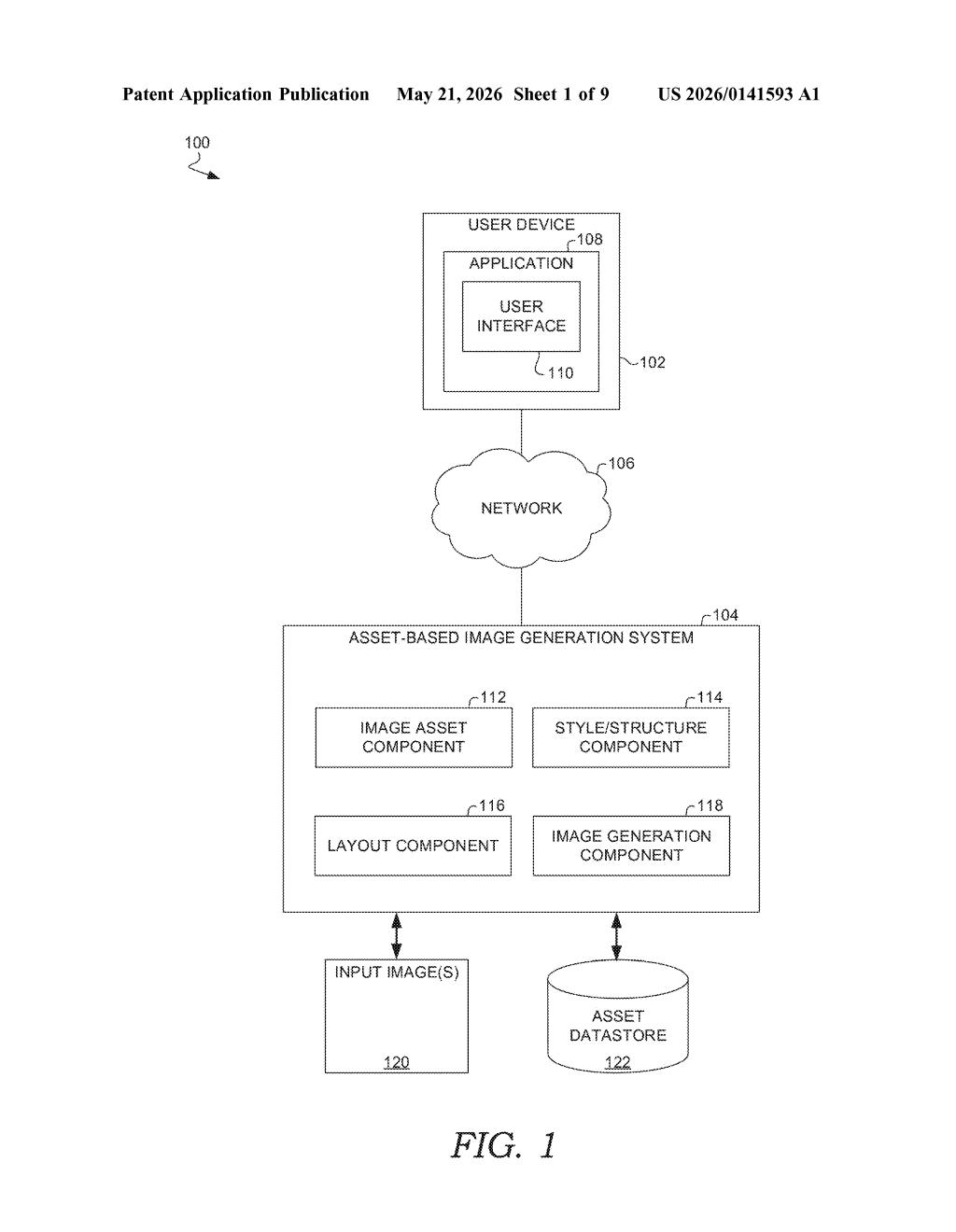
What Adobe's brand-locked AI image system actually does
Imagine you're a designer at a company with very strict brand guidelines — specific colors, a particular photographic style, a consistent way of laying out products. You want to use an AI image generator, but every time you do, the results look generic or off-brand. That's the problem Adobe is trying to solve here.
Adobe's patented system lets you feed in a set of brand reference images — photos or graphics that represent your visual identity. The system analyzes those images, pulling out their style (color, texture, mood) and structure (shapes, composition). You then tell it where each element should appear in your new image using layout masks — think of them like stencils.
The AI then generates a new image that combines your base scene with those brand-extracted elements, placed exactly where you specified, all while respecting the visual style it learned from your references. The result is supposed to feel like it was made by someone who really knows your brand.
How Adobe extracts style, structure, and layout masks
The patent describes a pipeline with three main stages: reference image analysis, layout control, and AI-driven image synthesis.
First, the system takes one or more brand-aligned reference images and identifies discrete image elements within them — things like a product, a logo treatment, a background texture, or a typographic block. For each of those elements, it generates two types of data: style data (capturing visual qualities like color palette, lighting, and surface texture) and structure data (capturing geometric and compositional properties — essentially the shape and layout skeleton).
Next, layout masks are received. These are essentially spatial maps — binary or weighted regions that tell the model exactly where in the output image each extracted element should land. Think of them like layer stencils in Photoshop, but used as instructions to the generative model rather than as manual cut-outs.
Finally, a generative AI model — likely a diffusion-based architecture, though the patent doesn't commit to one — synthesizes an output image by combining the base image with the positioned elements, using the style and structure data as conditioning signals to ensure visual coherence. The result is surfaced in a user interface presenting the final composite.
What this means for designers and brand teams
Brand consistency is one of the biggest friction points when enterprises try to adopt AI image tools. Marketing and design teams spend significant time correcting AI outputs that look great in isolation but clash with established visual identities. Adobe's approach — extracting style and structure as separable, reusable data — could make it much faster to go from a creative brief to an on-brand asset without manual touch-up rounds.
For Adobe's product strategy, this fits squarely into what Firefly Enterprise is pushing toward: giving large organizations a generative AI workflow that's controllable and auditable, not just fast. If this system ships in something like Adobe Express or Firefly for Enterprise, it could meaningfully differentiate Adobe from generic text-to-image tools that offer no brand guardrails.
This is a genuinely useful idea solving a real enterprise pain point, and it's the kind of patent that reads like a near-term product feature rather than a speculative moonshot. The core insight — that style and structure should be separable, extractable, and reusable as conditioning signals — is well-suited to diffusion model architectures Adobe is already building on. Worth watching when Adobe's next Firefly Enterprise update drops.
Get our take in your Top Stories
Liked this breakdown? Add Patentlyze as a preferred source on Google, and our plain-English take shows up more often in your Top Stories the next time Adobe patent news breaks.
There are more where this came from
We read every patent application Big Tech publishes and send you the ones worth knowing. Plain English, free, every week.
Want this weekly breakdown for a company we don't cover? Patentlyze Pro →