

AMD
AMD · Chip · Filed May 8, 2025 · USPTO published Nov 12, 2026 · This week's release
AMD Files Patent for Laptop Cameras That Cut Video Quality as the Battery Drains
A video call keeps your laptop's camera chip working hard, and AMD has a patent application for turning it down on purpose when your battery runs low. The idea is to drop from 30 or 60 frames per second to as few as 5 and switch off the extra picture polish.
- Publication number
- US 2026/0361998 A1(US20260361998A1)
- Applicant
- ATI Technologies ULC
- Filed · Published
- May 8, 2025 · Nov 12, 2026
- Inventors
- Wilson H. Yu, Benjamin Koon Pan Chan, Jin Li, ManZhou Fang, Wei Li, William Lloyd Atkinson, Sebastien J Nussbaum
- Status when we published
- Examiner raised objections; the company can respond
- Document
- 20 claims
- US classification
- 348/372
- Examiner
- LAM, HUNG H (Art Unit 2639)
What AMD's battery-aware camera chip actually does
Right now, a video call keeps your camera and its picture-processing chip running at full effort the whole time, whether your battery is nearly full or nearly dead. The filing calls that a big energy drain, and one that can make a laptop or phone run hot.
AMD's patent application describes a fix: let the device watch its battery and ease off when the charge gets low. Below a set level (the filing gives 20 percent as an example), the chip that cleans up camera images would handle fewer frames each second and skip some of its extras, such as heavy noise reduction. The basics that make you look normal on screen, like color and brightness, stay on.
Plugged in? Everything goes back to full quality.
an image signal processor configured to process image signals received from an image sensor; and a processor coupled to the image signal processor, the processor configured to cause an adjustment of a frequency at which the image signal processor processes the image signals based on a power state of the computing device.
Translation: The laptop adjusts how fast it handles camera video depending on how much battery power is left.
How the chip drops frames and skips polish
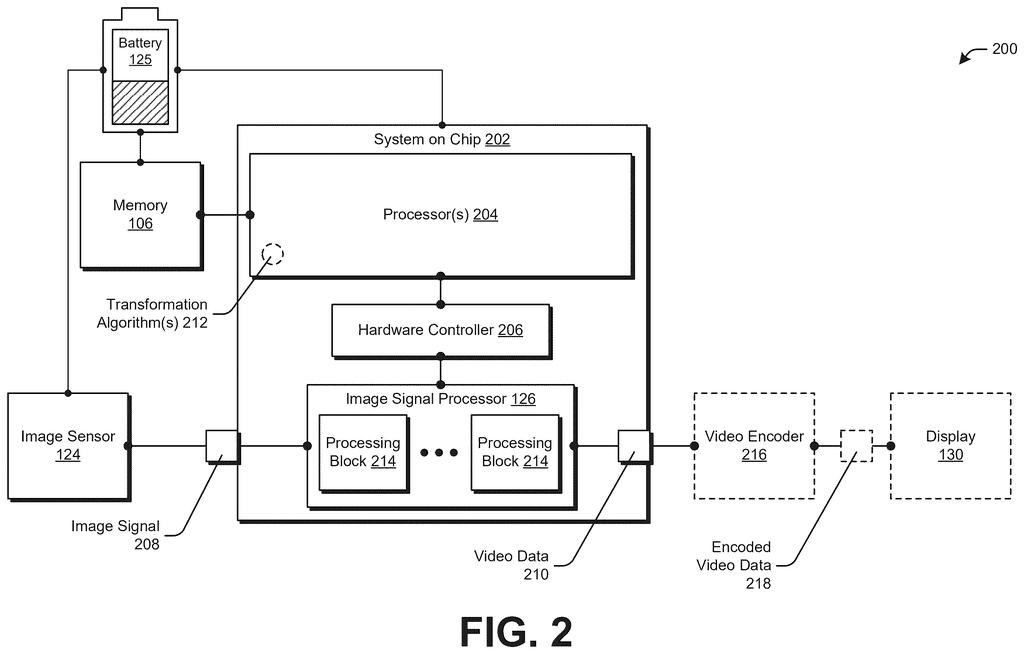
A camera sensor captures light and hands raw data to an image signal processor (ISP), a dedicated chip block that turns that raw signal into video that looks the way your eyes saw the scene. A separate main processor controls the ISP.
Under this filing, the main processor checks the device's power state: the battery charge level, whether it is plugged in, or a power mode you picked. When the charge falls below a threshold, it lowers the ISP's frequency (how many frames per second it processes), for example from a normal 30 or 60 down to 5.
It can also switch individual processing blocks on and off, even frame by frame. Each block does one job:
- Kept on: basic color correction, auto white balance and auto exposure, which the filing treats as the most important for natural-looking video.
- Turned off or reduced: things like advanced noise reduction and sharpening.
The filing also describes a camera app that runs a low-power preview, then switches to full processing when you press the shutter. In a vehicle version, the chip runs at 60 frames per second or more while the car moves and about 5 while it is parked, feeding a control unit that steers or brakes based on the video.
The processor may also selectively enable or disable one or more image transformations of the image signal processor based on the determined power state of the battery.
Translation: It can turn off specific video effects to save battery when power runs low.
Why longer video calls come with a catch
The practical payoff is more minutes of video on a low battery. The filing points to long meetings away from an outlet as the main case, and says the lighter load could also keep a laptop or phone from overheating. In a car, the same idea would let cameras idle while parked and speed up once the vehicle moves, which the filing says could potentially reduce hardware costs.
You would pay for that with a rougher picture while the battery is low, and the filing says the savings pause when you plug in. On the paperwork side, the examiner's first review rejected the claims as filed, which is routine at this stage and usually followed by amendments. What is on the page today may not be what ends up covered.
AMD's 71st filing we've tracked in our chip coverage since May adds to a run that includes a faster AI model switch and shared memory AI chip parts.
Source: US 2026/0361998 A1 at the USPTO (PDF). Full patent text and figures are in the official publication.
Get our take in your Top Stories
Liked this breakdown? Add Patentlyze as a preferred source on Google, and our plain-English take shows up more often in your Top Stories the next time AMD patent news breaks.
Add Patentlyze on Google
One click.
There are more where this came from
We read every patent application Big Tech publishes and send you the ones worth knowing. Plain English, free, every week.
The drawings · 4 sheets
4 drawing sheets from US 2026/0361998 A1 · click any drawing to enlarge


More from AMD
All 119 AMD patents →
More in Chip
All 645 Chip patents →
Samsung
Samsung Patents a Diode-Driven Optical Switch for Steering Light

Nvidia
Nvidia Patents a Matrix Multiply That Starts Before the Data Fully Arrives

Nvidia
Nvidia Patents an API That Lets GPUs Load Only Part of a Matrix at a Time

Nvidia
No comments yet