

Salesforce
Salesforce · Software · Filed Jul 8, 2026 · USPTO published Nov 12, 2026 · This week's release
Salesforce Files Patent for Drag-and-Drop Recommendations That Pull Live Data Without Copying It
Salesforce has filed a patent application for a drag-and-drop tool that builds recommendation cards by pulling in live data from a separate database, so nobody has to copy it first.
- Publication number
- US 2026/0359879 A1(US20260359879A1)
- Applicant
- Salesforce, Inc.
- Filed · Published
- Jul 8, 2026 · Nov 12, 2026
- Inventors
- Joel Ragnar Palmert, Kiran Hariharan Nair, Merwan Hade, Nikhil Kataria, Jia Lian Wang, Michael Moriarty
- Status when we published
- Waiting for an examiner
- Document
- 22 claims
- US classification
- 705/26.7
- Parent application
- Continuation of 18/528,520 (filed Dec 4, 2023)(18528520)
What Salesforce's no-code recommendation builder does
You're a sales rep at your desk when a card pops up: this customer is due for a renewal, and here's the product to pitch. That little card has to get its details from somewhere, often from more than one place.
Usually, getting the product details onto the card means copying them into the same storage as the recommendation itself. Copies pile up, and they go stale when a product description changes. Salesforce's patent application describes a different route: the card looks up the product info from wherever it already lives, at the moment the card appears on screen.
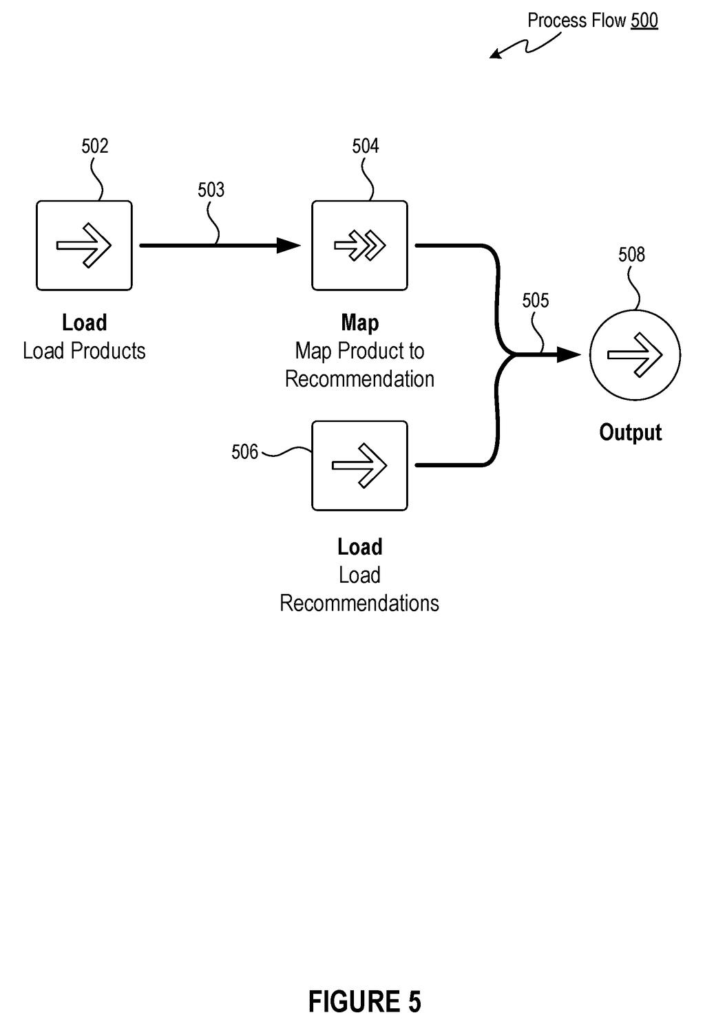
The person setting this up doesn't write code. They connect boxes on a canvas: one to load the recommendation, one to load the product details, one to link the two, and one to produce the finished card. Change the product info later, and the card shows the update.
… functionality to visually insert, edit, and connect nodes representative of a plurality of operations via one or more connectors without requiring a user to write code depicted visually as interconnected nodes for which connectivity of the nodes is modifiable by the user …
Translation: Users build workflows by connecting visual shapes on screen instead of writing code.
How the map box links two separate tables
The filing covers a database system that builds a content object (a ready-to-display package of fields, such as a recommendation card). It starts with a request to create the object and pulls a first batch of data, for example the recommendation record, from one database table. A second request asks for additional data to include.
That extra data sits in a second table stored separately. The system finds it, writes the queries (SQL, the standard language for asking a database questions) and maps the results into the card's fields. The card is filled in at runtime, meaning the moment it is generated, and the extra data is never duplicated into the first table.
What the claims emphasize is how the person sets this up. Both requests come from a flow built in a visual editor:
- Boxes (called nodes) stand for steps such as loading data and producing the card.
- Connectors link the boxes, and the user can rewire them at will.
- A map box ties the extra-data lookup to the finished card, with no code written.
The filing says the mapping works whatever shape the extra data takes, nested or flat. Its examples include customer relationship records, scheduling information, a prompt to take an action, and an 'up next' recommendation. The main worked example is a product table feeding a recommendation table.
Why fewer data copies matter to Salesforce users
If you work in sales or support, this is about the cards that tell you what to do next. Because the details are fetched when the card appears, an update to a product description can show up during your session, with no one re-copying anything.
For the people building those cards, the pitch is fewer duplicate records to maintain, especially when the source table is large, plus a builder that doesn't need a programmer. The filing names Einstein Next Best Action as one place this could apply, and it frames the work around customer relationship management data, the records companies keep on their customers.
The 105th Salesforce filing in our Salesforce coverage since May continues a thread on smarter AI memory, following the chatbot memory shrinker and the flawed-example web trainer.
Source: US 2026/0359879 A1 at the USPTO (PDF). Full patent text and figures are in the official publication.
Get our take in your Top Stories
Liked this breakdown? Add Patentlyze as a preferred source on Google, and our plain-English take shows up more often in your Top Stories the next time Salesforce patent news breaks.
Add Patentlyze on Google
One click.
There are more where this came from
We read every patent application Big Tech publishes and send you the ones worth knowing. Plain English, free, every week.
The drawings · 9 sheets
9 drawing sheets from US 2026/0359879 A1 · click any drawing to enlarge


Show the other 1 sheets

More from Salesforce
All 108 Salesforce patents →

More in Software
All 753 Software patents →
Microsoft
New Microsoft Patent Predicts Your Next Move During Drag-and-Drop
Samsung
Samsung Patents a Drag-and-Drop System for Merging Window Groups on Screen

Samsung
Samsung Patents a Mid-Drag App-Switching Gesture for Touchscreens
Apple
No comments yet