
Microsoft
Microsoft · Security · Filed Jul 20, 2026 · USPTO published Nov 12, 2026 · This week's release
Microsoft Files Patent for Telling a Gunshot From Its Echo in a City
In a city of glass and concrete, one gunshot reaches your ears as a dozen sounds, because every building bounces it back. Microsoft's patent application describes a way to work out which sound is the original.
- Publication number
- US 2026/0362081 A1(US20260362081A1)
- Applicant
- Microsoft Technology Licensing, LLC
- Filed · Published
- Jul 20, 2026 · Nov 12, 2026
- Inventors
- Sean Matthew ZIMMERMAN
- Status when we published
- Waiting for an examiner
- Document
- 20 claims
- US classification
- 381/17
- Parent application
- Continuation of 18/826,048 (filed Sep 5, 2024)(18826048)
What Microsoft's echo-proof gunshot locator does
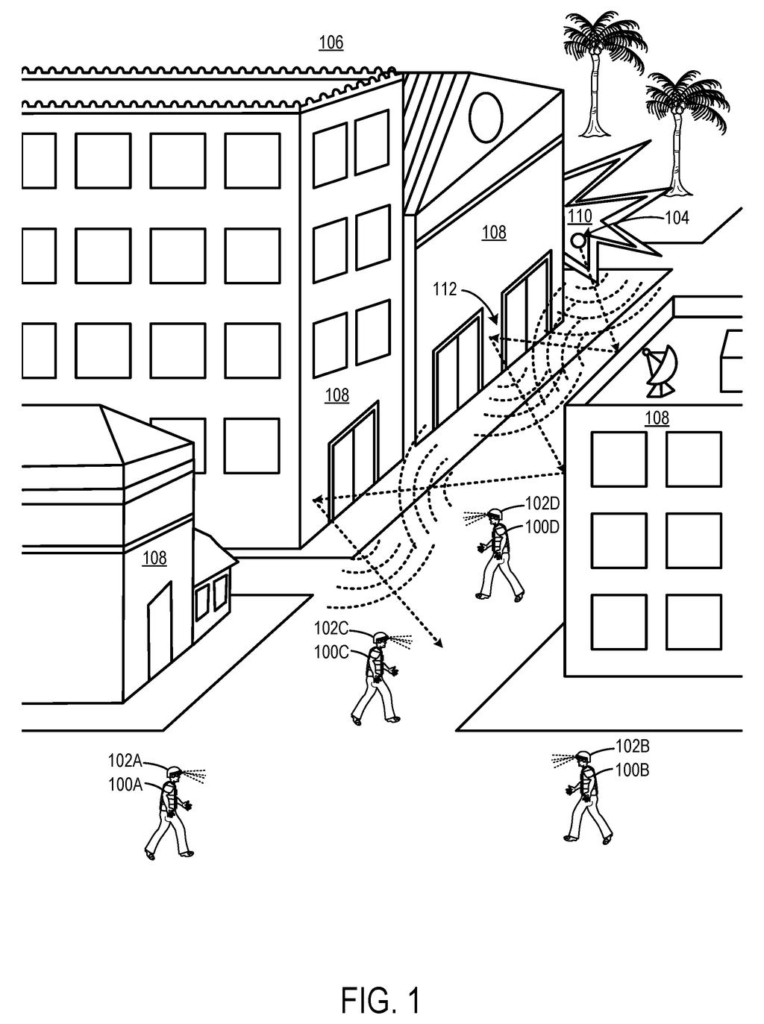
A gunshot rings out between two glass office towers. Within a second, the sound has bounced off both buildings and a parked truck, so anything listening hears the bang from several directions at once.
You know the effect if you've ever shouted in a parking garage and heard yourself come back. According to the filing, today's gunshot-location systems can mistake an echo for the real shot, which could send first responders to the wrong spot.
Microsoft's patent application describes a fix. A device with several microphones would use a 3D model of the surrounding streets, with each surface labeled by material (glass bounces sound back, wood soaks up more of it), then replay the bang virtually to work out where it must have started. The answer shows up as a marker on a map.
… simulating, via a geometric computer model of the real-world environment including virtual structures that model real-world structures in the real-world environment, an impulse response path of the audio impulse throughout the geometric computer model of the real-world environment …
Translation: It builds a digital 3D model of city buildings to trace how sound travels and bounces around.
How the 3D city model traces a sound's path
The claims cover a method, a computing system and a mobile device, all built on the same steps. A microphone array (several microphones fixed in place, eight in one example) records a sharp, sudden sound the filing calls an audio impulse, such as a gunshot or explosion. The system also gets each microphone's position and the array's DRTF (device related transfer function, a profile of how the microphones respond to sound from different directions and pitches).
Then it simulates the sound's impulse response path, meaning the route it took, with every bounce and absorption, through a geometric computer model. That is a 3D stand-in for the surroundings where buildings become virtual structures, and their surfaces carry acoustic values for materials such as cement, steel and glass. The output is an estimated origin point.
The filing also describes optional extras:
- Building the model from camera, satellite or drone images, with a machine learning model guessing each surface's material.
- Labeling the sound (explosion, gunshot, car crash, broken window) and filtering out background noise.
- Pooling microphones from several responders' devices into one larger array.
- Running simulations ahead of time and storing results in a lookup table, so a low-power device can answer without simulating live.
It can also run alongside a conventional TDOA locator (time difference of arrival, which compares when the sound reaches each microphone). If the two answers disagree, the system flags the conventional result as an echo.
The virtual structures include virtual surfaces that are assigned acoustic parameters.
Translation: The digital city map includes specific material details for how surfaces absorb or reflect sound.
Why wrong-block errors matter to responders
For responders, the practical gain is a more trustworthy pin on the map. The filing's main example is a head-mounted augmented-reality device that shows a waypoint at the estimated origin and labels the likely source, so a responder heading toward an explosion can get ready for fires or injuries before arriving.
Two caveats apply. The filing says the approach is more accurate than conventional systems but gives no accuracy numbers, and it depends on a good 3D model of the area. It also continues an application filed in September 2024, and a patent application is not a product, so nothing here says when, or whether, anyone will carry this.
Microsoft's 620th filing in our Microsoft coverage since May adds to a run of controller work that includes a swappable thumbstick and space-saving scroll wheels.
Source: US 2026/0362081 A1 at the USPTO (PDF). Full patent text and figures are in the official publication.
Get our take in your Top Stories
Liked this breakdown? Add Patentlyze as a preferred source on Google, and our plain-English take shows up more often in your Top Stories the next time Microsoft patent news breaks.
Add Patentlyze on Google
One click.
There are more where this came from
We read every patent application Big Tech publishes and send you the ones worth knowing. Plain English, free, every week.
The drawings · 8 sheets
8 drawing sheets from US 2026/0362081 A1 · click any drawing to enlarge


More from Microsoft
All 646 Microsoft patents →
More in Security
All 341 Security patents →
IBM
IBM Files Patent for a Meeting Tool That Tells Others When You're on Speakerphone
Qualcomm
Qualcomm Patents Technology to Detect and Report Fake Network Connection Requests on Phones
Qualcomm
A New Qualcomm Patent Teaches Phones to Spot Fake Signals That Cut Off Service
Google
No comments yet