
Meta
Meta · AR / VR · Filed May 8, 2025 · USPTO published Nov 12, 2026 · This week's release
Meta Patents a Virtual Hoop at Your Feet for Getting Around in VR
Meta's patent puts the controls for moving around in VR at your feet. Look down, and a hoop appears that you can grab and drag to wherever you want to go.
- Publication number
- US 2026/0358894 A1(US20260358894A1)
- Applicant
- Meta Platforms Technologies, LLC
- Filed · Published
- May 8, 2025 · Nov 12, 2026
- Inventors
- Jonathan MALLINSON, William Arthur Hugh STEPTOE, Michael James LEBEAU, Steven James WILSON, Ethan MILLER, Fábio RESENDE
- Status when we published
- Waiting for an examiner
- Document
- 20 claims
- US classification
- 715/863
What Meta's look-down hoop does for your avatar
Ever tried to explore a virtual world when your living room is the size of a parking space? Walking in place gets old fast, and plenty of people don't have handheld controllers with joysticks nearby.
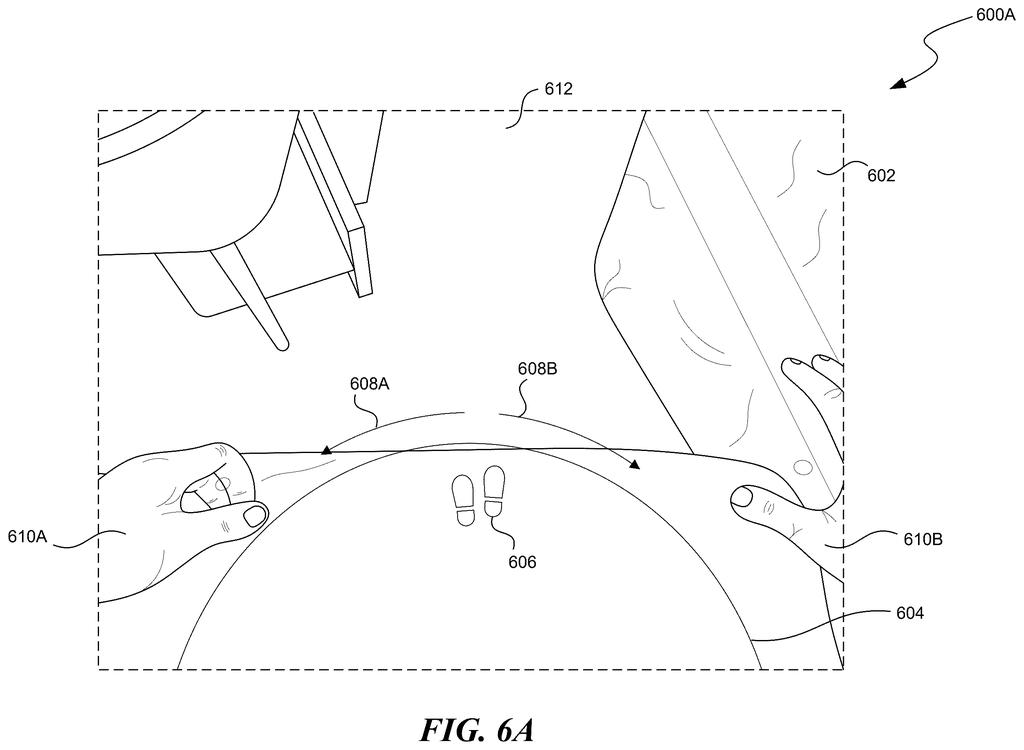
Meta's patent describes another way. When you look down toward your feet in a headset, a ring (a virtual hoop) appears around your avatar, with a movement icon inside and a left and right arrow on the sides. Pinch the icon, drag the hoop across the room, let go, and your avatar is there. Pinch and release an arrow and you turn by a set amount, such as 30 degrees. Hold and drag the arrow, and you turn exactly as far as you want.
Because the ring only shows up when you look down, it stays out of your way the rest of the time. And it works with one hand.
detecting a downward-facing head position and/or gaze of a user of an extra reality system; based on the detected downward-facing head position and/or gaze, rendering a visual affordance relative to a representation of the user in the extra reality environment …
Translation: The system makes a virtual ring appear at your feet when you look down.
How the hoop reads your gaze and hand pinches
The system first watches for a downward head position or gaze. It reads that from headset cameras, motion sensors (an IMU, the small chip that senses tilt and turning), or eye-tracking cameras. The filing gives staring at the floor for about 2 seconds as one example. Only then does the hoop appear near the avatar's feet.
Once the hoop is showing, hand gestures drive everything:
- Move: pinch the movement icon, drag the hoop, and release. The avatar goes where the hoop lands. In one example, moving your hand 0.5 meters carries the hoop 3 meters, so a short reach covers a lot of ground.
- Turn a preset amount: pinch and release a turn arrow to rotate a default angle, such as 30 degrees.
- Turn a custom amount: pinch and drag (or hold) an arrow, and the angle follows how far you go.
The filing also describes hot spots, which are pre-marked places such as the cushions of a virtual couch. Drag the hoop within about 1 meter of one and a preview of your avatar appears there instead. If another avatar already holds that spot, the preview shifts to the nearest open one. Release, and you land there, even reoriented to sit.
The filing also says gestures could come from controllers or wrist sensors, and experienced users could skip the look-down step by bringing a hand close to the body.
… grab, drag, and release the visual affordance (via the icon) to move to that location, B) pinch and release on the left or right arrows to turn a default amount …
Translation: You point and pull yourself around the virtual world using simple hand gestures.
Why this matters for small rooms and no controllers
The practical win is access. The filing points out that many people can't freely walk around a room, whether from lack of space or an injury or disability, and that some headsets are used without controllers. Hand gestures alone could get those users around a virtual world, and the system works with a single hand.
It also tries to keep things tidy. The hoop only appears when you look down, so it doesn't clutter your view, and the filing says that saves battery and processing power. The couch example hints at social spaces: you could drop into an open seat near friends without landing on top of someone's avatar. As with any patent application, nothing here says it will reach a product.
Meta's 188th filing in our Meta coverage since May follows earlier applications like the ad-rebuilding system and the single-light VR tracker.
Source: US 2026/0358894 A1 at the USPTO (PDF). Full patent text and figures are in the official publication.
Get our take in your Top Stories
Liked this breakdown? Add Patentlyze as a preferred source on Google, and our plain-English take shows up more often in your Top Stories the next time Meta patent news breaks.
Add Patentlyze on Google
One click.
There are more where this came from
We read every patent application Big Tech publishes and send you the ones worth knowing. Plain English, free, every week.
The drawings · 15 sheets
15 drawing sheets from US 2026/0358894 A1 · click any drawing to enlarge


Show the other 7 sheets


More from Meta
All 190 Meta patents →
More in AR / VR
All 690 AR / VR patents →
Google
Google's New Patent Uses Rapid Light Switching to Give Smart Glasses Deeper Darks and Finer Shades
Sony
Sony Files Patent for a VR Headset That Blows Wind at Your Face
Meta
Meta Files Patent for a VR Headset Strap That Resizes With a Dial
Sony
No comments yet