
Apple
Apple · Audio · Filed Mar 6, 2026 · USPTO published Nov 12, 2026 · This week's release
Apple Patents a Two-Motor Speaker That Cancels Its Own Vibration
Apple has filed a patent for a speaker with two motors that push against each other on purpose, so the sound comes out but the shaking doesn't. One single wire ties the whole thing together.
- Publication number
- US 2026/0362060 A1(US20260362060A1)
- Applicant
- Apple Inc.
- Filed · Published
- Mar 6, 2026 · Nov 12, 2026
- Inventors
- Claudio NOTARANGELO, Christopher WILK, Marco BARATELLI
- Status when we published
- Waiting for an examiner
- Document
- 20 claims
- US classification
- 381/333
- Parent application
- Claims priority from a provisional application 63802558 (filed May 8, 2025)
What Apple's two-motor speaker actually does
Imagine you're wearing a headset with a speaker right next to your ear, and a deep bass note hits. The speaker pushes air to make that sound, and the push-back can make the whole device tremble against your head.
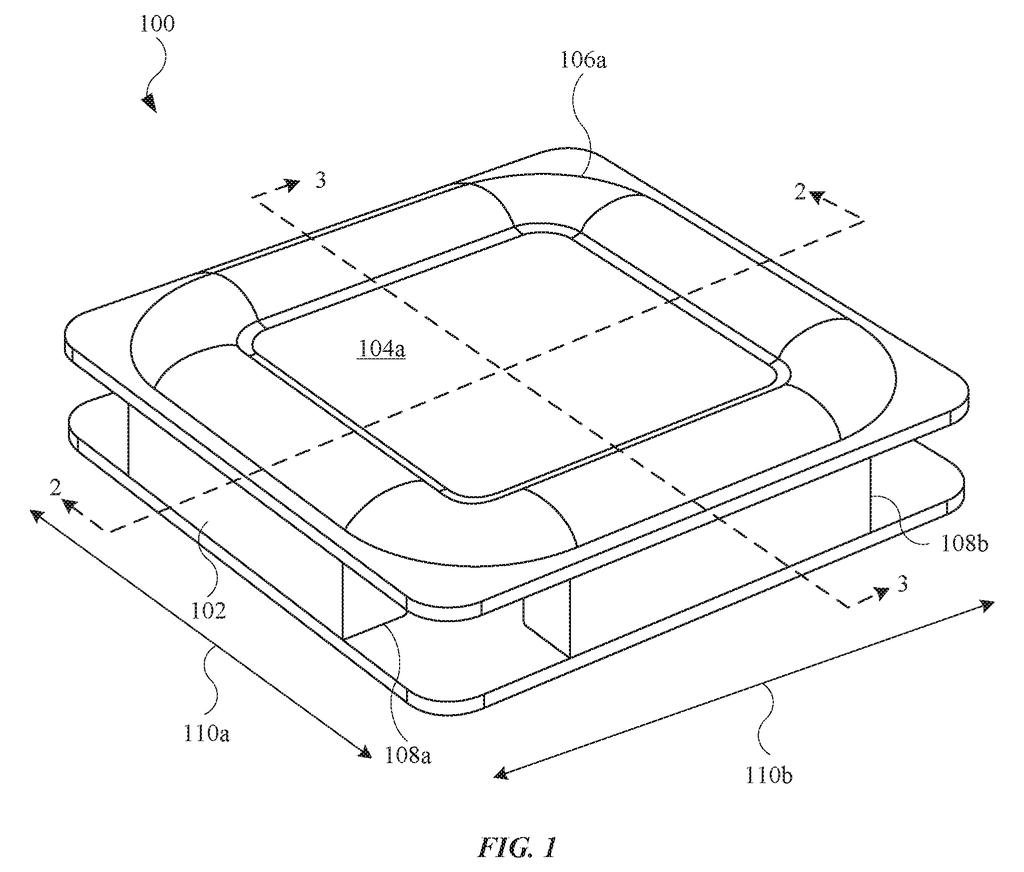
Apple's patent describes a speaker that tackles this with two sound-making parts working as a team. When one is driven forward by its motor, the other is driven in reverse, so the forces they put on the speaker cancel out. The sound still comes out, but the speaker itself stays calmer.
The trick is in the wiring. A single wire loops into several coils around several magnets, and the magnets face opposite ways, so the same electrical signal pulls one part and pushes the other. The filing aims at low notes, roughly 20 to 200 Hertz, and mentions headsets, watches, phones and headphones.
… a wire that forms a first voice coil and a second voice coil, wherein: the first voice coil is configured to drive the first sound-generating component based on the first magnet, and the second voice coil is configured to drive the second sound-generating component based on the second magnet.
Translation: A single continuous wire creates two separate coils that power the two moving parts using their own magnets.
How one wire drives two opposing speaker cones
The speaker has two sound-generating parts, which in the main example are diaphragms (thin membranes that move back and forth to push air and make sound). Each one has its own motor, built from magnets and voice coils (loops of wire that turn into electromagnets when current runs through them).
The key detail in claim 1 is that a single wire forms both voice coils. In the main example, that wire makes four coils around four rare-earth magnets, so the same electrical signal reaches all of them.
The magnets are arranged so one pair faces its coils with a south pole and the other pair with a north pole. With current flowing the same way, one motor's coils are repelled while the other's are attracted. The filing says this makes one part move forward while the other moves in reverse, so the forces they put on the speaker body cancel. Both parts still travel along the same axis, which lets them be stacked to move more air.
The design targets low frequencies and aims to cut distortion. The motor parts sit around the outer edge, under the membrane, to leave room for air movement. A headset version puts one sound outlet facing the wearer and one facing away. The filing also describes magnets turned 90 degrees as a variation.
… the sound-generating components may operate by force cancelling the force from another sound-generating component while providing the acoustic output.
Translation: The dual parts push in opposite directions to cancel out shaking while still producing sound.
What this means for head-worn Apple devices
If you wear a headset or glasses with built-in speakers, deep bass can make the device buzz against your head. By having two moving parts cancel each other's force, a speaker like this could deliver strong low notes with less of that rattle, which the filing says makes for a better user experience.
The filing lists head-mounted mixed reality devices first, then smart watches, smartphones, tablets and headphones. Small gadgets have little room for big speakers, so getting more air movement by stacking two moving parts in the same footprint is a practical win. Claim 16 describes a head-worn device with arms or bands and sound outlets facing both the wearer and the outside. Remember that a patent filing is not a product, so nothing here says when or whether it ships.
Apple's 13th filing in our Audio coverage since May follows work on wired-wireless headphones and faster surround sound delivery, adding another piece to what we've tracked from the company in this space.
Source: US 2026/0362060 A1 at the USPTO (PDF). Full patent text and figures are in the official publication.
Get our take in your Top Stories
Liked this breakdown? Add Patentlyze as a preferred source on Google, and our plain-English take shows up more often in your Top Stories the next time Apple patent news breaks.
Add Patentlyze on Google
One click.
There are more where this came from
We read every patent application Big Tech publishes and send you the ones worth knowing. Plain English, free, every week.
The drawings · 10 sheets
10 drawing sheets from US 2026/0362060 A1 · click any drawing to enlarge


Show the other 2 sheets


More from Apple
All 672 Apple patents →
More in Audio
All 95 Audio patents →
Sony
Sony Files Patent for Headphones That Keep Playing When You Sing Along
Microsoft
Microsoft Patents Game Controller Scroll Wheels Built to Free Up Space Inside
Qualcomm
Qualcomm Files Patent for a Phone That Can Tell When Its Speaker Is Clogged

Sony
No comments yet