
IBM
IBM · Security · Filed May 6, 2025 · USPTO published Nov 12, 2026 · This week's release
IBM Files Patent for Payment Audits That Check One Person Without Exposing Everyone
Privacy and oversight usually pull in opposite directions. IBM's patent application tries to hand an auditor one person's payment history for one time window, and nothing else.
- Publication number
- US 2026/0359900 A1(US20260359900A1)
- Applicant
- INTERNATIONAL BUSINESS MACHINES CORPORATION
- Filed · Published
- May 6, 2025 · Nov 12, 2026
- Inventors
- Elina Van Kempen, Rebekah Mercer, Angelo De Caro, Elli Androulaki, Kaoutar El Khiyaoui
- Status when we published
- Examiner raised objections; the company can respond
- Document
- 20 claims
- US classification
- 705/30
- Examiner
- OBEID, FAHD A (Art Unit 3627)
What IBM's one-person payment audit does
A bank auditor gets a tip that one customer may be moving money improperly. In a payment system built to protect privacy, the auditor faces a bad choice: comb through every record ever made, or get a standing pass to watch that customer indefinitely.
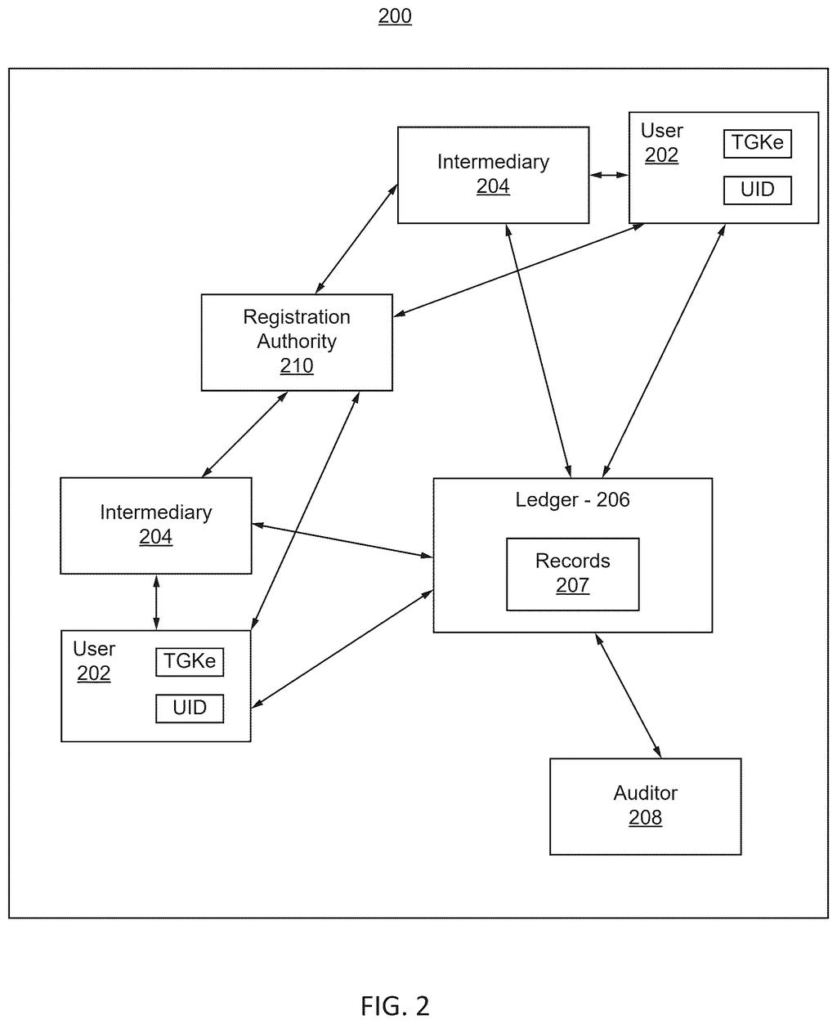
IBM's patent application describes a middle path. Each time you make a payment, your device attaches a hidden tag made from a secret key that changes with each time period. Nobody looking at the public record can tell whose tag it is.
If an audit is approved, the auditor gets only the key for that person and that time period. From it, the auditor works out the possible tags and pulls up just those payments. Everyone else's activity stays hidden, and the access does not carry over to later periods.
… generating a zero-knowledge proof to demonstrate validity of the unique tag without revealing user identity; …
Translation: It creates a cryptographic proof that the payment is valid without exposing who made it.
How the time-limited tags get rebuilt
The filing describes a tagging scheme for anonymous payment systems, where transactions are recorded on a shared, tamper-resistant record book (a ledger) without showing who made them.
Here is the sequence the claims lay out:
- At the start of each time period (the filing calls it an epoch), your device derives a fresh tag generation key from a long-term secret and the period's number.
- For each payment, it mixes in a random number to create a unique tag and attaches it.
- It also attaches a zero-knowledge proof (a math check that shows the tag is valid without revealing who you are).
- The ledger rejects any tag it has seen before, and records the payment only if the proof checks out.
The number of payments per person per period is capped at a public maximum. That cap is what makes audits quick: an auditor never stores anything in advance. When an audit is approved, the auditor asks a go-between (an intermediary, which the filing says could be a bank, broker or government agency) for that person's key for that period, plus a proof it belongs to the right person. The auditor then computes every possible tag, at most the cap's worth, and looks each one up on the ledger.
The filing also covers payments with a sender and a recipient, tagging both sides. An intermediary can create the recipient's tag if the recipient is offline.
The ledger verifies that the unique tag does not match any previous transaction tags.
Translation: The system checks that the payment code has never been used before to stop fraud.
Why private payments still need auditors
If digital payments become more private, the people running them still have to answer to regulators. This design tries to give them an answer that does not strip you of privacy. Your payments stay unlinkable to you unless an audit is approved for you, and an approval covers one time period instead of forever. The filing uses digital central bank currency as one example of where this could apply.
The examiner's first review rejected the claims as filed, which is a routine early step that usually leads to amendments. Nothing here says IBM has a product built on this. It reads as groundwork for systems where privacy and compliance both have to hold.
IBM's 459th filing in our IBM coverage since May follows patents like the VR danger-awareness headset and one-shot photo inspection.
Source: US 2026/0359900 A1 at the USPTO (PDF). Full patent text and figures are in the official publication.
Get our take in your Top Stories
Liked this breakdown? Add Patentlyze as a preferred source on Google, and our plain-English take shows up more often in your Top Stories the next time IBM patent news breaks.
Add Patentlyze on Google
One click.
There are more where this came from
We read every patent application Big Tech publishes and send you the ones worth knowing. Plain English, free, every week.
The drawings · 5 sheets
5 drawing sheets from US 2026/0359900 A1 · click any drawing to enlarge


More from IBM
All 470 IBM patents →
More in Security
All 341 Security patents →
Google
Google Patents a Faster Way to Crunch Private Data Without Exposing It
Salesforce
Salesforce Patents a Background Check on the AI Helpers It Sends to Do Your Work
Microsoft
Microsoft Patents a Readiness Check for Moving Work Logins to the Cloud
Microsoft
No comments yet