
IBM
IBM · AI / ML · Filed May 7, 2025 · USPTO published Nov 12, 2026 · This week's release
IBM Patents Photo Inspection You Set Up With One Example and a Sentence
IBM's new patent application lets you describe a photo-inspection job in a plain sentence, hand over one example picture, and get a defect check without training a new AI from scratch.
- Publication number
- US 2026/0360118 A1(US20260360118A1)
- Applicant
- INTERNATIONAL BUSINESS MACHINES CORPORATION
- Filed · Published
- May 7, 2025 · Nov 12, 2026
- Inventors
- Kun Yan Yin, Wen Wang, Chao Dong, Hanbin Qi, Yi Chen Zhong
- Status when we published
- Waiting for an examiner
- Document
- 20 claims
- US classification
- 382/159
- Examiner
- VAZ, JANICE EZVI (Art Unit 2667)
What IBM's one-example photo checker does
You're looking at photos of wheel hubs coming off a factory line, and your job is to catch any with a missing bolt or a scratch. Getting software to do that usually means collecting thousands of labeled photos and having engineers train a special program for that one part.
IBM's patent application describes a shortcut. You hand the system the photo to check, one example photo, and a plain sentence like "Check the quality of the wheel hub. Pay attention to defects." The system breaks that request into smaller jobs, such as finding the right bolts, the missing bolts and the small scratches, and then hunts for each one.
Because it works from a sentence and a sample, the filing says it can take on a new task without retraining, which could cut a lot of setup time.
… dynamically splitting the visual task into a plurality of sub-tasks by analyzing the text instruction and one or more annotations extracted from the at least one example image; …
Translation: The system breaks down the main job into smaller steps by looking at your written instructions and sample images.
How the request gets split and cross-checked
The request has three parts: the photo to check (the target image), a sentence describing the job, and at least one example image. All three independent claims (a method, a computing device and a software product) describe the same sequence.
First, a large language model (an AI trained to read and write text) studies the sentence and any labels pulled from the example, then splits the job into smaller sub-tasks. In the filing's wheel-hub example, the request "Check the quality of the wheel hub. Pay attention to defects." turns into keywords like "right bolt," "missing bolt," "wrong bolt" and "small scratches."
Then two searches run side by side:
- Keyword search: a detector built to find things named in words (the filing mentions one called Grounding-DINO) looks for each keyword in the target photo.
- Example search: the example image is copied into several altered versions by rotating, cropping, zooming, or using an image generator (Stable Diffusion) to swap backgrounds or logos. A second detector (the filing mentions DE-ViT) compares those versions with the target photo.
Every detection gets a confidence score. The results are then merged, and a step called non-maximum suppression (when several boxes overlap the same thing, keep only the highest-scoring one) removes duplicates. The output is a labeled image.
The target image is then analyzed separately based on the generated keywords and the augmented images to detect the objects or features in the target image.
Translation: It scans the photo using those keywords and modified examples to spot the items you asked it to find.
Why this matters for factory and scan checks
The practical pitch is less setup. The filing points to factory quality checks and medical image review as places where accurate detection matters but labeled training photos are scarce. If a plant manager could describe a new part in a sentence and supply one good photo, a new inspection job might need far less data preparation.
It also lowers the skill bar. The filing says users should not need technical expertise or a special prompt format, and that the system could run in the cloud or on phones and other local devices. Nothing here names a product, so treat it as a design on paper for now, and remember that a patent application is not proof anything will ship.
IBM's 45th filing we've tracked in our AI training and infrastructure coverage since May follows one where an AI quizzes itself and one penalizing gendered resume words.
Source: US 2026/0360118 A1 at the USPTO (PDF). Full patent text and figures are in the official publication.
Get our take in your Top Stories
Liked this breakdown? Add Patentlyze as a preferred source on Google, and our plain-English take shows up more often in your Top Stories the next time IBM patent news breaks.
Add Patentlyze on Google
One click.
There are more where this came from
We read every patent application Big Tech publishes and send you the ones worth knowing. Plain English, free, every week.
The drawings · 8 sheets
8 drawing sheets from US 2026/0360118 A1 · click any drawing to enlarge


More from IBM
All 470 IBM patents →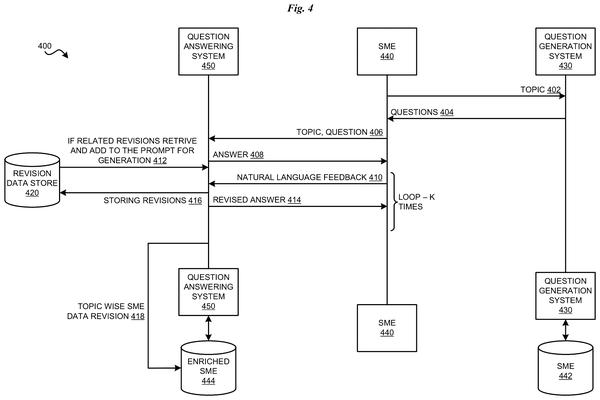
More in AI training & infrastructure
All 316 AI training & infrastructure patents →
Samsung
Samsung Files Patent for Giving AI Services Only as Much Computing Power as They Need
Microsoft
Microsoft Files Patent for AI That Writes the Blueprint for Fake Test Data
Microsoft
Microsoft Wins a Patent for Training AI on Your Gaming PC's Idle Time
Nvidia
No comments yet