
Qualcomm
Qualcomm · Networking · Filed Apr 16, 2026 · USPTO published Nov 12, 2026 · This week's release
Qualcomm Files Patent for Wi-Fi That Can Tell a Game From a Video Call
Your Wi-Fi can't see which app is running, so Qualcomm describes a way for it to guess from the rhythm of the data alone. It even knows when to say it has no idea.
- Publication number
- US 2026/0361656 A1(US20260361656A1)
- Applicant
- QUALCOMM Incorporated
- Filed · Published
- Apr 16, 2026 · Nov 12, 2026
- Inventors
- Gaurang NAIK, Sai Yiu Duncan HO, George CHERIAN, Yanjun SUN, Abhishek Pramod PATIL, Alfred ASTERJADHI, Abdel Karim AJAMI, Xiaolong HUANG, Qiang FAN, Srinivas KATAR, Nitin RAVINDER, Venkata Savitri Pravallika TALLAPRAGADA, Varshini RAJESH, Raamkumar BALAMURTHI
- Status when we published
- Waiting for an examiner
- Document
- 1 claims
- US classification
- 370/235
- Parent application
- Continuation of 18/053,285 (filed Nov 7, 2022)(18053285)
What Qualcomm's Wi-Fi traffic-guessing patent does
Ever tried to guess what your neighbor is doing from the thumps coming through the wall? A steady bass beat means music, and irregular bangs mean someone is rearranging furniture. You are reading the rhythm without ever hearing a word.
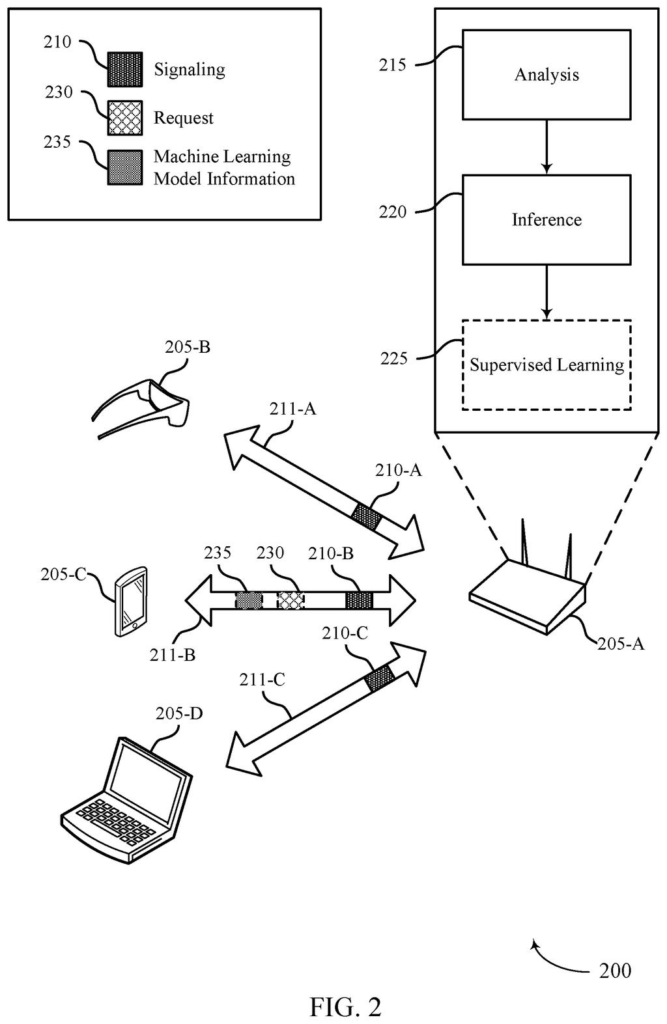
Qualcomm's patent application describes Wi-Fi gear that does the same with your data. A video call sends small bursts on a regular beat. A game or a headset app has its own pulse. Your router, or your phone itself, would time those bursts and guess which kind of app is behind them, even when the app never says.
The twist is that it first checks whether the pattern is one it has actually learned. If the beat looks unfamiliar, it says I don't know instead of forcing a guess. When it is confident, it can save your battery by waking the radio only when data is due, or give your call priority over a download.
… determining that the traffic class associated with the signaling is included in a set of known traffic classes based at least in part on a set of features associated with the signaling; and obtaining a prediction of an application associated with the signaling using a machine learning model …
Translation: The router figures out what kind of data is arriving and uses AI to guess the specific app being used.
How the Wi-Fi radio names an app in three steps
The claims cover a method for a Wi-Fi device (a router or a phone) that receives a stream of data from another device, checks whether that kind of traffic is one it knows, and then uses a machine learning model to predict which application is behind it. The prediction rests on simple features: how many packets arrive, how big they are, and how much time passes between them.
The filing describes three steps:
- Is it periodic? The device samples traffic for about 1.024 seconds, roughly every 2 milliseconds (about 512 samples). It then uses a fast Fourier transform (a math tool that reveals repeating beats) to spot regular pulses, which real-time traffic like gaming shows.
- Is it a known type? An autoencoder (a neural network trained to rebuild its own input) tries to recreate the pattern. A close match means familiar; a poor one means unknown, judged against a cutoff such as the 99th percentile of training data.
- Which app? A multi-class classifier (a model that picks one label from several) names the type, such as extended reality headset apps, gaming or video conferencing.
Several samples vote, and the device computes a confidence level from the share of votes. Mixed votes mean the traffic is treated as unknown. An access point (the router) can also train a model and send a client its layers, neurons and weights, and the client can report back when it gets things wrong.
In response to determining that the traffic class is included in the set of known traffic classes, the first device may use a machine learning model to obtain a prediction of an application associated with the signaling.
Translation: Once the system recognizes the type of network traffic, it runs an AI model to identify the app.
What Wi-Fi traffic guessing means for your battery
If your router or laptop knows a video call is running, it can give that traffic priority over a background download, so your face stops freezing when someone starts a big update. A device that knows traffic arrives on a regular beat can also switch its radio off between beats, which the filing says conserves power. For headset apps, the identified traffic can help predict head and hand movement.
The reason to guess is that, per the filing, apps often don't tell the network what they are sending. Qualcomm's approach needs no help from the app. It is a patent application, so nothing here says it will reach a product.
Qualcomm's 597th filing in our Qualcomm coverage since May continues a thread on chip-aware media, building on the hot-chip video fix and the low-power AR call idea.
Source: US 2026/0361656 A1 at the USPTO (PDF). Full patent text and figures are in the official publication.
Get our take in your Top Stories
Liked this breakdown? Add Patentlyze as a preferred source on Google, and our plain-English take shows up more often in your Top Stories the next time Qualcomm patent news breaks.
Add Patentlyze on Google
One click.
There are more where this came from
We read every patent application Big Tech publishes and send you the ones worth knowing. Plain English, free, every week.
The drawings · 15 sheets
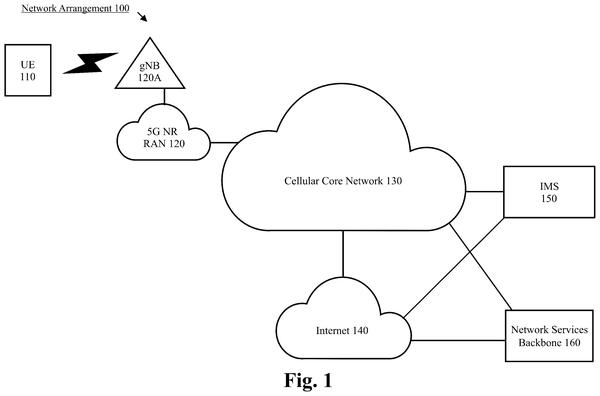
15 drawing sheets from US 2026/0361656 A1 · click any drawing to enlarge


Show the other 7 sheets


More from Qualcomm
All 624 Qualcomm patents →
More in Networking
All 498 Networking patents →
Samsung
Samsung Files Patent for Sending AI Training Jobs to a Second 5G Tower
Apple
Apple Files Patent for Cutting Wireless Lag in VR by Flagging Data to Skip
Google
Google Files Patent for Telling Cell Towers What Your VR Stream Needs
Apple
No comments yet