
Qualcomm
Qualcomm · AR / VR · Filed Apr 20, 2026 · USPTO published Nov 12, 2026 · This week's release
Qualcomm Files Patent to Let Underpowered AR Glasses Join 3D Calls Using Network Power
Your AR glasses may never need to draw the 3D scene. Qualcomm describes a way to have the phone network do the drawing and stream back plain video.
- Publication number
- US 2026/0361776 A1(US20260361776A1)
- Applicant
- QUALCOMM Incorporated
- Filed · Published
- Apr 20, 2026 · Nov 12, 2026
- Inventors
- Imed Bouazizi, Nikolai Konrad Leung, Liangping Ma
- Status when we published
- Waiting for an examiner
- Document
- 24 claims
- US classification
- 709/227
- Parent application
- Continuation of 18/438,992 (filed Feb 12, 2024)(18438992)
What Qualcomm's network-rendered AR call does
Ever tried to run a demanding video game on an old laptop? The fans roar, the picture stutters, and eventually you give up. Smart glasses face a version of that problem with augmented reality (AR) calls, where everyone shares a 3D scene full of avatars, shadows and virtual objects.
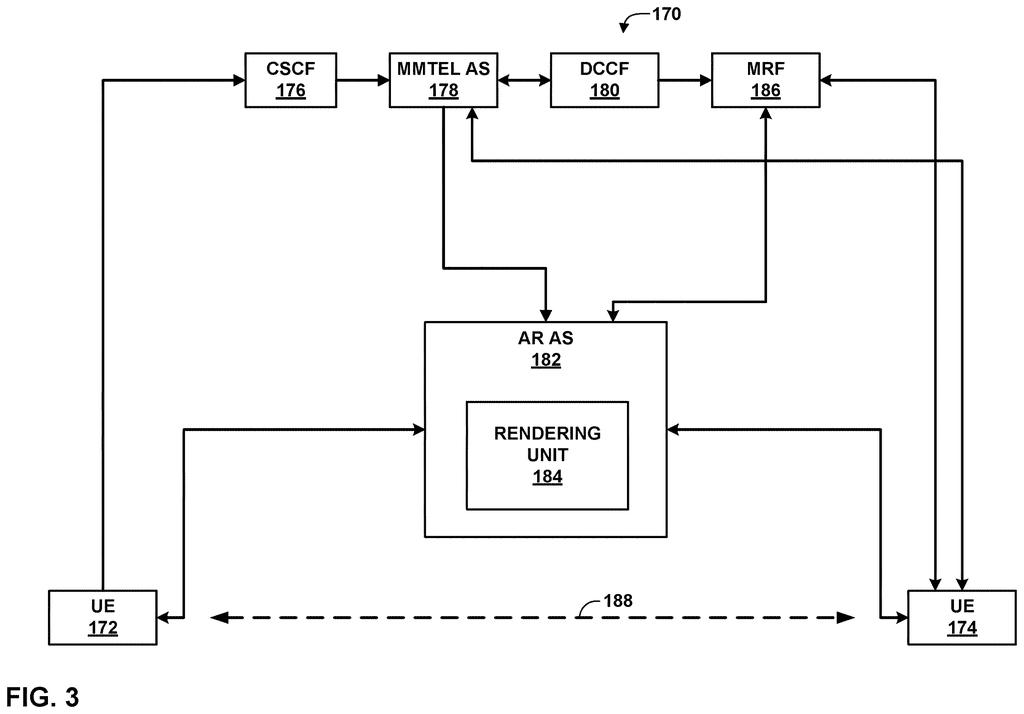
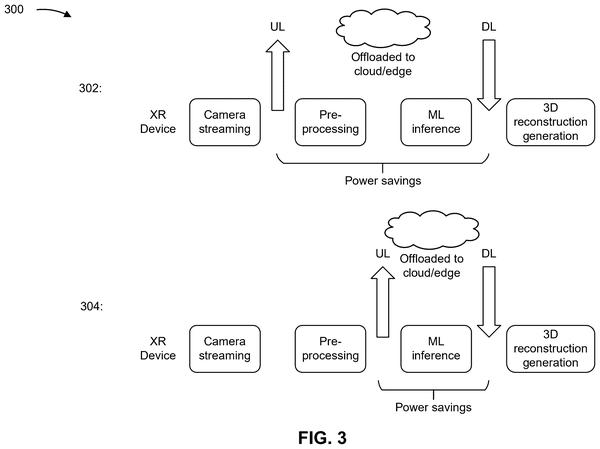
Qualcomm's patent describes a workaround. When your glasses or device start the call, they tell the phone network they can only handle flat, ordinary video. A server sitting between you and the other person then does the heavy drawing, turns the 3D scene into a regular video stream, and sends it to you.
You still get to look around, because your device keeps reporting where you are and which way you're facing. The other person can use a fully equipped headset while you watch the flat version of the same call.
sending, by a first user equipment (UE), a request to start an augmented reality (AR) media call with a second UE to a call session control function (CSCF), the request including a session description protocol (SDP) attribute indicating a request for transcoding of AR media data to two-dimensional video data …
Translation: The lightweight glasses ask the network to convert heavy 3D data into normal 2D video.
How the call setup asks for flat video
The claims cover two sides of one idea. One side is the device, called user equipment (UE), which is telecom-speak for a phone, headset or pair of glasses. The other side is a server in the middle of the call that does the rendering.
On the device side, the UE sends a request to start an AR call to a call session control function (CSCF, the network component that directs call setup). The request carries a session description protocol (SDP) attribute, which is a labeled note inside the setup message, saying it wants AR data converted to two-dimensional video. The UE then connects to a transcoding device, which runs a media function or multimedia resource function (network software that handles audio and video streams), and simply plays what comes back.
On the server side, the transcoding device receives split rendering configuration data telling it to convert AR data to flat video on behalf of the first device. When AR data arrives from the second caller, it renders the scene and sends the 2D result onward.
Several extra details appear in the claims:
- The device can report pose information (where the user is and which way they are looking), which gets passed to the other caller.
- Setup can run through an IMS application server (the network's call-services computer), which sends an updated invitation to the second caller.
The description adds that the server may decode the incoming AR data, render it, and re-encode the result with common video formats such as H.264 or H.265.
… receive transcoded media data from the transcoding device that the transcoding device transcoded from AR media data received from the second UE …
Translation: The glasses display the converted video stream sent from the network processor.
Why lighter AR glasses could join richer calls
If you wear lightweight glasses, battery life and heat are constant limits. The filing says advanced rendering, the kind that recreates realistic lighting, shadows and reflections, may be unavailable on AR glasses and headsets or may drain too much power. Moving that work to network servers could let a modest device join a call that would otherwise be out of reach.
The filing is about call setup signaling on 5G-style phone networks, which fits Qualcomm's position selling chips for phones and wireless gear. It also has a cost: a server must render a separate view for each person who needs one, and that work lands on whoever runs the network.
Qualcomm's 61st filing we've tracked in the AR glasses race since July follows work on blurry edge fixes and phone-to-headset video limits.
Source: US 2026/0361776 A1 at the USPTO (PDF). Full patent text and figures are in the official publication.
Get our take in your Top Stories
Liked this breakdown? Add Patentlyze as a preferred source on Google, and our plain-English take shows up more often in your Top Stories the next time Qualcomm patent news breaks.
Add Patentlyze on Google
One click.
There are more where this came from
We read every patent application Big Tech publishes and send you the ones worth knowing. Plain English, free, every week.
The drawings · 11 sheets
11 drawing sheets from US 2026/0361776 A1 · click any drawing to enlarge


Show the other 3 sheets


More from Qualcomm
All 624 Qualcomm patents →
More in AR / VR
All 690 AR / VR patents →
Samsung
Samsung Patents a Way to Keep AR Glasses Focused on Your Eyes
Samsung
Samsung Files Patent to Fix Washed-Out Colors on See-Through AR Glasses
Samsung
Samsung Files Patent for Glasses That Decide When the Outside World Interrupts You
Sony
No comments yet