
Google
Google · AI / ML · Filed Dec 3, 2025 · USPTO published Nov 12, 2026 · This week's release
Google Files Patent for an Ad Chatbot That Reads Your Photos to Pitch Products
Google has filed a patent application for an ad with a chat button that asks you to upload photos of your stuff, then recommends something to buy based on what it sees. The filing's main example: pictures of your apartment, and a moving truck sized to fit your furniture.
- Publication number
- US 2026/0360138 A1(US20260360138A1)
- Applicant
- Google LLC
- Filed · Published
- Dec 3, 2025 · Nov 12, 2026
- Inventors
- Shahab Kamali, Vardhman Mehta, Shashank Bhushan, Aidan Davis Oldershaw, Alpa Jain, Pallavi Satyan, Satyanarayana Shanmugam, Senthil Kumar Hariramasamy, Bhavika Goyal, Rushil Grover
- Status when we published
- Waiting for an examiner
- Document
- 20 claims
- US classification
- 715/202
- Parent application
- National Stage Entry of PCT/US2024/055727 (filed Nov 13, 2024)(PCTUS2024055727)
What Google's photo-reading ad chatbot does
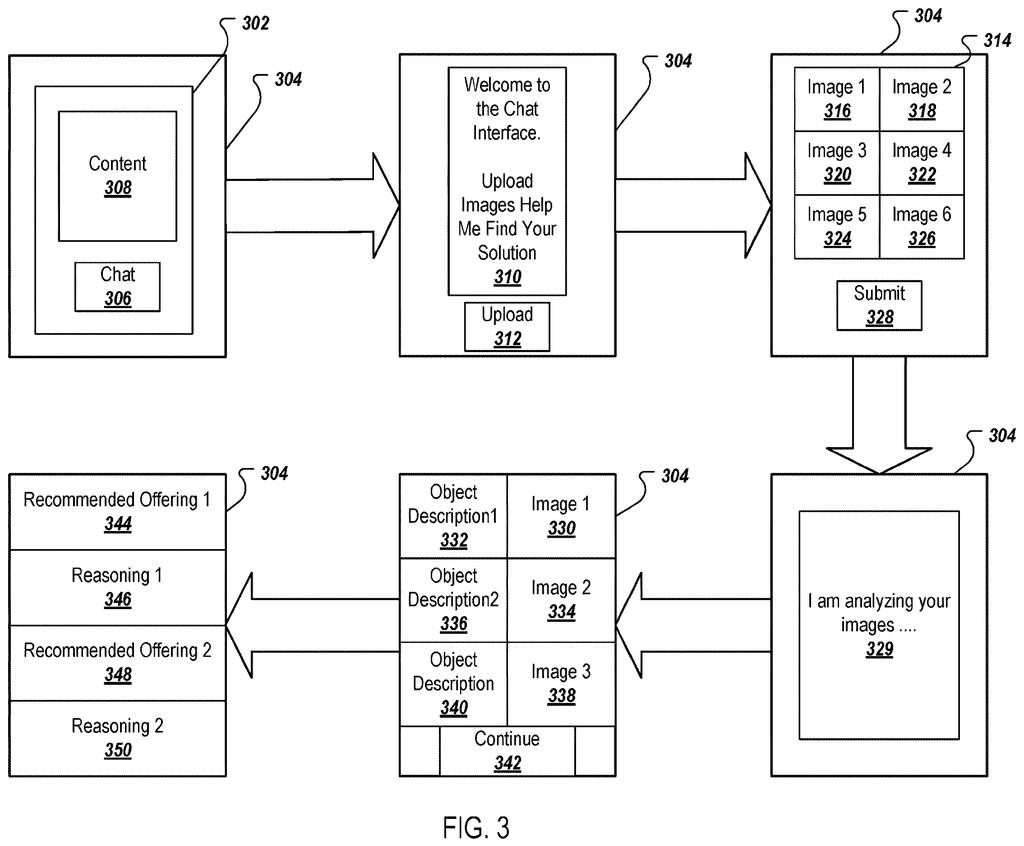
You search move to Atlanta, and an ad from a moving company shows up with a chat button. You tap it, and the chat asks for photos of your apartment. You pick a few pictures of your furniture and send them.
Google's patent describes the system behind that chat. It looks at your photos, reads your earlier search for context, and writes a short description of what it sees, focusing on things you would actually move, like tables and chairs, rather than light fixtures. You get to check that description and tap continue. Then the chat suggests a truck size, with price and availability, plus a few lines explaining why.
The catch is speed. One big AI model could take 20 seconds or more to do all this, which feels painfully slow in a chat. Google's answer is to pair a fast object-spotting model with a smaller, quicker language model, aiming for replies in under 5 seconds.
… receiving, by the artificial intelligence system and through the chat interface, a set of images from the client device; obtaining, from an image classification model, a list of objects depicted by the set of images; …
Translation: The system takes pictures from your device and figures out what objects are inside them.
How two AI models split the photo work
The claims cover a chain of steps. An ad (the filing calls it a digital component) carries a launch button, such as a chat button. Tapping it opens a chat window and sets up a live connection between your device and Google's servers. Through that chat, you upload a set of images.
From there, two models share the work:
- Object spotter: an image classification model (software trained to label what appears in a picture) returns a list of objects, in roughly half a second or less.
- Language model: a smaller model reads your photos plus any text you submitted earlier, such as a search, and writes a summary of what matters in them.
- Merge: the object list and the summary combine into a description, often shown as photo-and-text pairs.
- Recommendation: the system generates an offer from the advertiser, such as a truck size, with reasons for the pick.
The object spotter is built as a small add-on layer (a shallow classifier) sitting on top of a large, frozen image network. That lets engineers teach it new objects with tens of examples, in hours rather than the days or weeks a full retrain can take.
Prices, links, images and text for the offer are pulled from the advertiser's own website domain instead of being invented by the AI. A policy checker screens object lists and offers against blocklists and format rules. The system can also start building the offer while you are still looking at the continue button, hiding some of the wait.
A set of images are received from the client device. A list of objects depicted by the set of images are obtained from an image classification model.
Translation: The system collects your photos and identifies the items shown in them.
Why your next ad might ask for your photos
If this works the way the filing describes, an ad stops being a link and becomes a short conversation. Instead of typing in how many rooms you have and guessing at box counts, you show the chat your photos and get a specific suggestion, with a price, availability, and a few lines on why it fits. The filing's example is a moving truck, and it also mentions interior painting as another case where the system would focus on walls and cabinets.
For Google, the appeal is easy to see: the filing treats ads as one type of digital component, and this turns an ad into a sales conversation. For you, the tradeoff is handing an advertiser's chat photos of your home. The filing builds in a check where you confirm what the AI thought it saw before it suggests anything.
Google's 91st filing in AI assistant & agent patents we've tracked since May builds on earlier applications like training chatbots from phone corrections and reusing past chatbot answers.
Source: US 2026/0360138 A1 at the USPTO (PDF). Full patent text and figures are in the official publication.
Get our take in your Top Stories
Liked this breakdown? Add Patentlyze as a preferred source on Google, and our plain-English take shows up more often in your Top Stories the next time Google patent news breaks.
Add Patentlyze on Google
One click.
There are more where this came from
We read every patent application Big Tech publishes and send you the ones worth knowing. Plain English, free, every week.
The drawings · 5 sheets
5 drawing sheets from US 2026/0360138 A1 · click any drawing to enlarge


More from Google
All 1,079 Google patents →
More in AI assistant & agent
All 413 AI assistant & agent patents →
Nvidia
Nvidia Patents a Memory Shortcut That Lets Small AI Models Draw Sharper Images
Microsoft
Microsoft Patents a Shortcut for the Math That Slows AI Chatbots
Microsoft
Microsoft Files Patent for an AI Assistant That Finds Its Own Helper Apps
Qualcomm
No comments yet