
Qualcomm
Qualcomm · Automotive · Filed Jul 31, 2025 · USPTO published Nov 12, 2026 · This week's release
Qualcomm Patents a Self-Driving Vision System That Spends Less Effort on Parked Cars
Not everything on the road deserves equal attention, and Qualcomm's new patent application builds that idea into how a car sees. It splits the world into things that stay put and things that move, then spends most of its effort on the movers.
- Publication number
- US 2026/0360156 A1(US20260360156A1)
- Applicant
- QUALCOMM Incorporated
- Filed · Published
- Jul 31, 2025 · Nov 12, 2026
- Inventors
- Yunxiao Shi, Yinhao Zhu, Hong Cai, Jisoo Jeong, Shizhong Steve Han, Amin Ansari, Fatih Murat Porikli
- Status when we published
- Waiting for an examiner
- Document
- 20 claims
- US classification
- 382/103
- Parent application
- Claims priority from a provisional application 63803133 (filed May 9, 2025)
What Qualcomm's two-track car vision actually does
A car idles at a red light. A bus rumbles beside it, a van sits parked at the curb, and a cyclist weaves through traffic up ahead. Your own eyes sort all of this in an instant into things that matter right now and things that can wait.
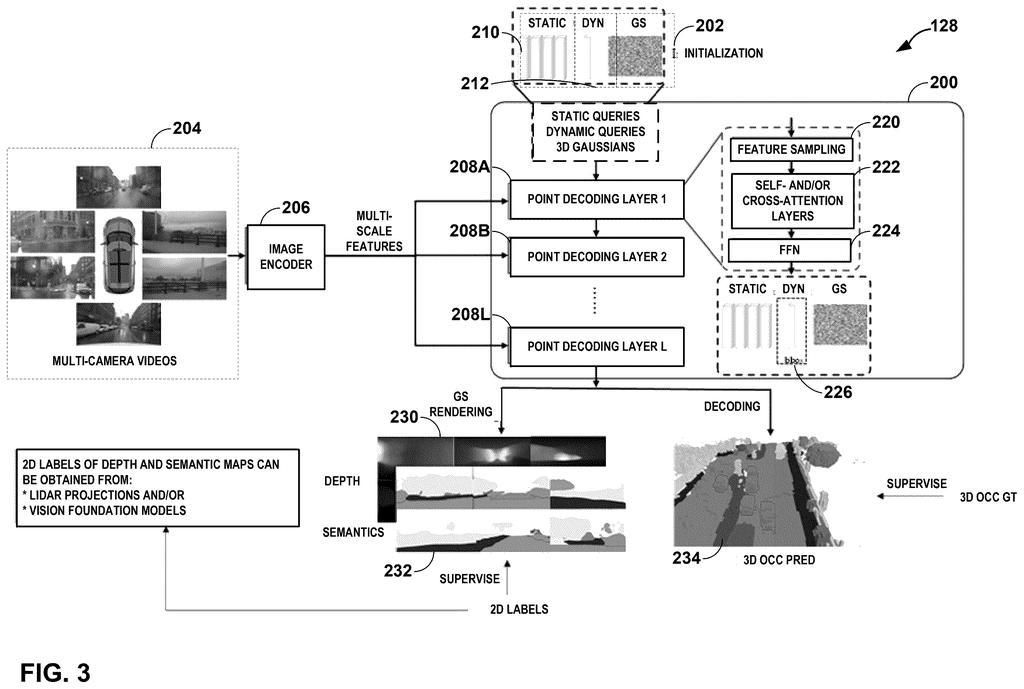
Qualcomm's patent application tries to teach a car's cameras the same trick. The software builds a 3D picture of the space around the vehicle, first in rough strokes, then in finer and finer detail. It then asks two separate sets of questions: one about things that stay put, like buildings and parked cars, and one about things that move, like pedestrians and bicycles.
The moving things get most of the computing effort, including a guess at how fast each one is going. The still things get less. The goal is a car that sees well without needing a giant computer to do it.
… applying hierarchically arranged Gaussian primitives to the one or more images to obtain a representation of the three-dimensional space around the vehicle …
Translation: The system turns camera footage into a 3D digital map using mathematical building blocks.
How Qualcomm's layered Gaussians build a 3D scene
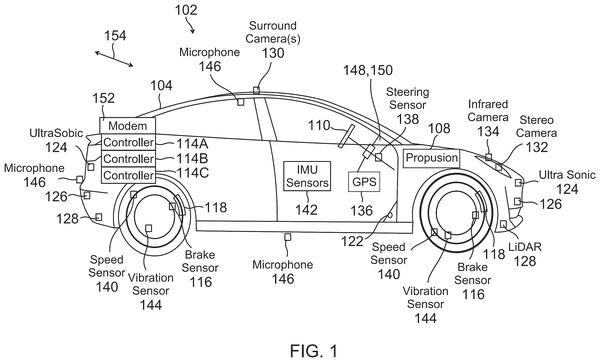
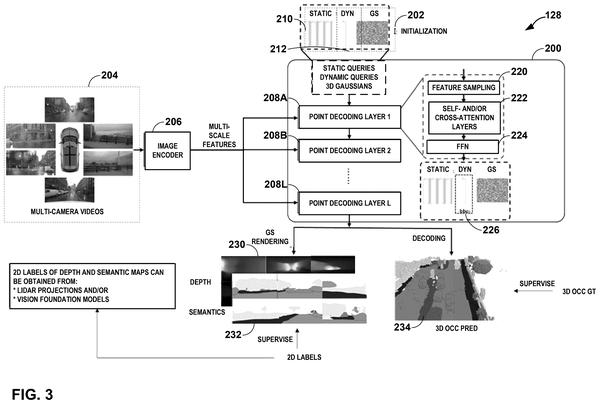
The system starts with images from a multi-camera setup on a vehicle. The filing's example has seven cameras covering 360 degrees, with lidar (a laser scanner that measures distance) as an optional extra. An image encoder first turns the pictures into features at several levels of detail.
Next come the hierarchically arranged Gaussian primitives. A Gaussian primitive is a small fuzzy marker in 3D space with a center point and a spread, and the spread tells the system how unsure it is about that spot. The markers are built in layers, with the filing giving six as an example. Each layer holds more of them than the one before, so the scene sharpens from coarse to fine.
Then the system asks two kinds of questions. A query is a set of numbers the software uses to ask "what is at this spot?" Here:
- Static queries look for things that stay put, like buildings, roads and parked cars.
- Dynamic queries look for moving things, like pedestrians, cyclists and trucks. They also estimate each object's speed and draw a box around it. One variation uses the cameras' exposure time to help estimate that speed.
The two groups can share information through cross-attention (a way for one set of numbers to look at the other). The system is trained against lidar data, and the filing includes a table of scores for buses, cars, construction vehicles, trailers and trucks that it says beat a competing system.
… apply one or more static queries and one or more dynamic queries to the representation of the three-dimensional space around the vehicle to identify one or more static objects and one or more dynamic objects …
Translation: It separately searches the map to tell what is parked and what is moving.
Why spending less effort on parked cars matters
A driver-assist system that treats every part of the scene with equal care needs bigger, hotter and pricier computers. Splitting the work by what is moving lets a car spend its effort where a mistake costs the most: the pedestrian stepping off a curb, the cyclist, the truck changing lanes. The filing says this reduces computing and memory demands compared with the dense grid methods it describes.
For you, the payoff could show up as driver-assist features that react to moving hazards on more affordable hardware. The filing also says the system can pick up obstacles outside its list of known object types, which standard object detection often misses. Keep in mind this is a patent application describing an approach, not a product on the road.
Qualcomm's 56th filing we've tracked since July adds to a run in our self-driving sensing watch that includes one on brake-light detection through fog and one on gaze-based safety alerts.
Source: US 2026/0360156 A1 at the USPTO (PDF). Full patent text and figures are in the official publication.
Get our take in your Top Stories
Liked this breakdown? Add Patentlyze as a preferred source on Google, and our plain-English take shows up more often in your Top Stories the next time Qualcomm patent news breaks.
Add Patentlyze on Google
One click.
There are more where this came from
We read every patent application Big Tech publishes and send you the ones worth knowing. Plain English, free, every week.
The drawings · 6 sheets
6 drawing sheets from US 2026/0360156 A1 · click any drawing to enlarge


More from Qualcomm
All 624 Qualcomm patents →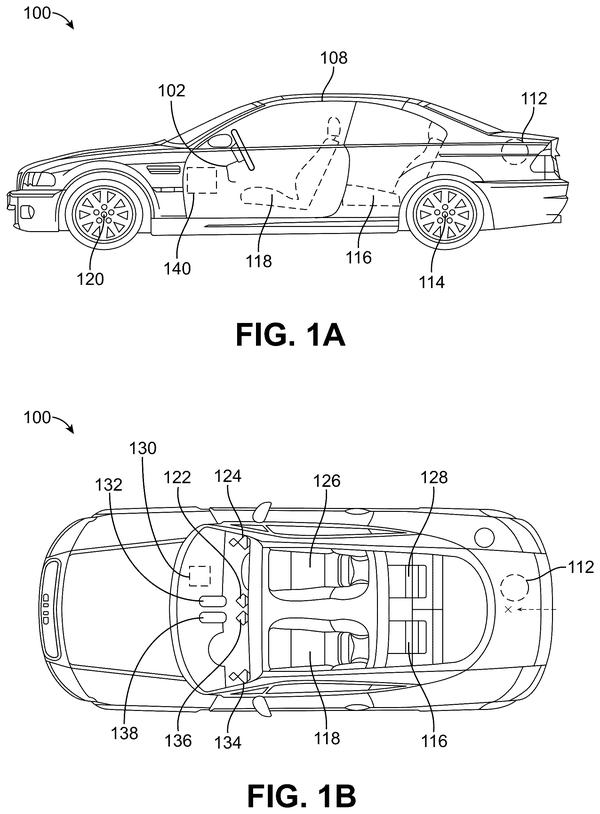
More in Automotive
All 360 Automotive patents →
IBM
IBM Files Patent for Cars That Report the Loud Vehicle Next to Them
Google
Google Files Patent for Cars That Notice When Road Construction Moves the Lane Lines
Waymo (Google)
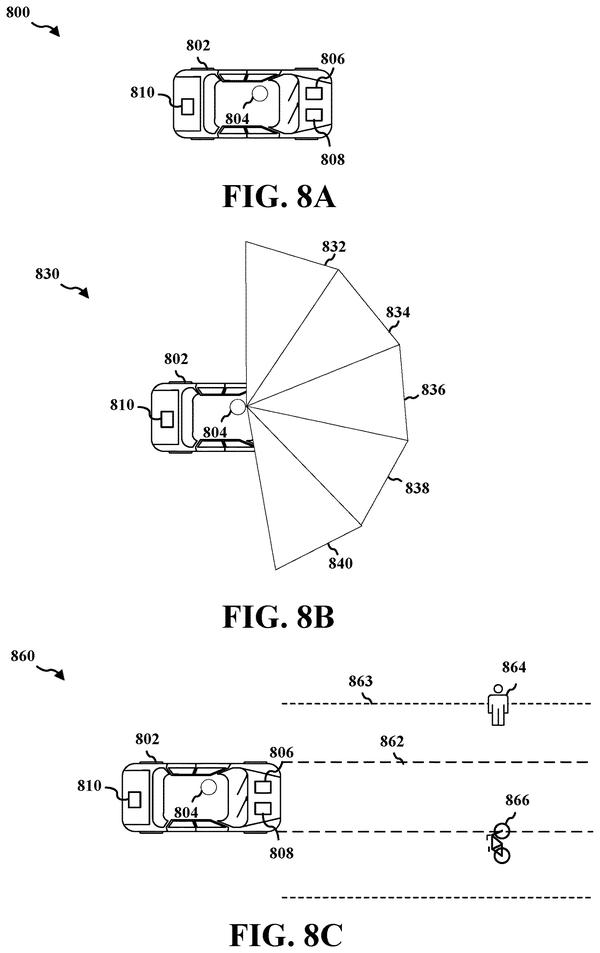
Waymo Files Patent for Cars That Dodge Blind Spots in Double Left Turns
Amazon
No comments yet