
Waymo Files Patent for Cars That Dodge Blind Spots in Double Left Turns
Double left turns are where human drivers cut corners and drift into your lane. Waymo's patent teaches its driverless cars to expect that and to position themselves where neighboring drivers can see them.
What Waymo's multi-lane turn patent does
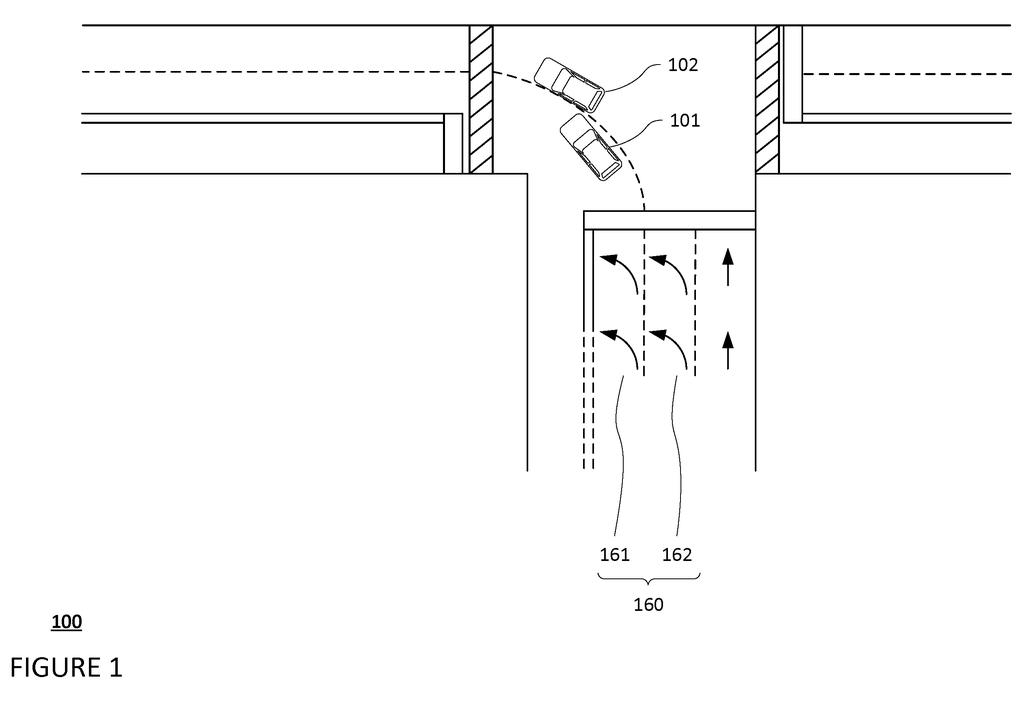
Imagine you're in the inside lane of a double left turn at a big intersection. The car in the outer lane drifts toward you, because drivers on the wider arc tend to cut the corner. You brake hard, everyone in the car lurches, and the ride gets uncomfortable fast.
Waymo's patent describes a driverless car that plans for this ahead of time. If the car is first in line, it nudges its path to match where other cars have usually gone through that turn. If it's behind another car, it follows that car's path. Either way, it stays within a set distance of its normal route.
It also tries to sit between the cars in the next lane, rather than right beside one, so those drivers can actually see it. If that isn't possible, it either speeds up to pass or slows to let someone ahead, whichever feels smoother to passengers.
… adjusting, by the one or more processors, the nominal trajectory of the autonomous vehicle through a multi-lane turn based on the position of the autonomous vehicle relative to each of the at least one other vehicle …
Translation: The car changes its path during a multi-lane turn based on where it is parked next to other vehicles.
How Waymo's car picks its path in a double turn
The core claim is simple. The car drives along a nominal trajectory (its default, centered path through a turn), takes in where it sits relative to other vehicles, adjusts that path for a multi-lane turn, and then drives the adjusted path.
The filing describes several ways to adjust. When the car is first in line, it can compare its default path with historical data, meaning the routes the car or other vehicles previously took through that turn, and shift by the average sideways offset. When it's behind another car, its sensors track that car and the robotaxi follows a similar path. In both cases the shift is capped within a set distance of the original path.
A separate set of claims covers staggering. If the car is in the inner lane and two vehicles are in the outer lane, it keeps adjusting its speed or acceleration to sit in the gap between them. The description gives about one meter of spacing from the cars ahead and behind as an example.
When no gap is available, the claims cover passing or yielding. The description says that choice weighs passenger comfort, looking at things like speed, acceleration, and how close other cars are sideways.
A determination of whether the autonomous vehicle is positioned as a first vehicle in the lane or positioned behind another vehicle in the lane may be made based on a position of the autonomous vehicle in the lane relative to the positions of the objects.
Translation: The system figures out if it is leading the turn or following another car.
Why robotaxi turns need to look more human
If you ride in a robotaxi, the practical payoff is a calmer turn. The filing says the aim is to avoid hard braking and quick swerves, which are the moments when passengers feel uneasy. By staying visible to neighbors, the car also lowers the odds that someone changes lanes into a spot they didn't know was occupied.
The patent also says it wants the car's moves to resemble what human drivers do, so people around it can predict it. That matters on real roads, where a robotaxi shares space with drivers who have no idea it's a robot. The description notes the same ideas could apply to triple-lane turns, right turns, on-ramps and off-ramps. This application continues a family of filings that dates back to 2018.
Google's 77th filing we've tracked since May in our Waymo robotaxi sensing watchlist follows work like zooming in on brake lights and finding a stop without painted lines.
Every choice here costs something. A car that copies the path other drivers take also copies their bad habits, such as drifting into the inner lane. The cap on how far it can stray protects against that, but it also means the car will sometimes pass up a path that would have worked fine.
Staggering has a similar price. Sliding into the gap between two cars in the next lane only works if there is a gap. When there isn't, the car has to pick between speeding up to pass or slowing to yield, and either move brings back the abrupt motion the design is trying to avoid. The comfort check that makes that call carries a lot of weight.
The trade reads as worth it. Human drivers make these adjustments without thinking, and a robotaxi that rigidly hugs the center of its lane will keep getting pinched. The claims are broad, covering any position-based adjustment through a multi-lane turn, so the real test is how well the car handles a crowded turn, and a patent cannot show that.
Get our take in your Top Stories
Liked this breakdown? Add Patentlyze as a preferred source on Google, and our plain-English take shows up more often in your Top Stories the next time Google patent news breaks.
There are more where this came from
We read every patent application Big Tech publishes and send you the ones worth knowing. Plain English, free, every week.
The drawings
13 drawing sheets from US 2026/0349442 A1 · click any drawing to enlarge


Show the other 5 sheets


Want this weekly breakdown for a company we don't cover? Patentlyze Pro →
Be the first to weigh in