
Microsoft
Microsoft · Software · Filed Apr 22, 2025 · USPTO published Nov 12, 2026 · This week's release
Microsoft Wins a Patent for Picking the Best Shortcuts to Search Text and Images Together
Microsoft has been granted a patent on software that decides which lookup shortcuts a database should build when a search compares text, photos and other features all at once.
- Publication number
- US 2026/0359276 A1(US20260359276A1)
- Applicant
- Microsoft Technology Licensing, LLC
- Filed · Published
- Apr 22, 2025 · Nov 12, 2026
- Inventors
- Yue WANG, Bailu DING, Philip A. BERNSTEIN, Vivek Ravindranath NARASAYYA, Surajit CHAUDHURI, Jiongli ZHU
- Status when we published
- Granted
- Document
- 20 claims
- US classification
- 707/715
- Examiner
- HALM, KWEKU WILLIAM (Art Unit 2166)
What Microsoft's search-shortcut tuner does
A shopper types "red running shoes" into a store's search bar and uploads a photo of a pair she likes. The store's computer has to match both at the same time, across millions of products.
Microsoft has now been granted a patent on a tool that handles the behind-the-scenes setup for that kind of search. Databases speed up searches by building lookup shortcuts (called indexes), but building the wrong ones either eats storage or slows everything down. Microsoft's tool studies a sample of real searches, then picks a small set of shortcuts that answers them quickly while staying inside a storage budget and a minimum accuracy target.
If you have ever used a shopping, photo or music app that finds things by meaning instead of exact keywords, this is the sort of plumbing that keeps it quick.
… selecting a configuration of vector indexes that is a subset of potential vector indexes, wherein the configuration of vector indexes is selected based on searching possible vector indexes and identifying the subset of potential vector indexes that minimize latency of the multi-vector workload while meeting the recall constraint and the storage constraint …
Translation: The system finds the fastest combination of search indexes that still fits within memory and accuracy limits.
How the tuner picks shortcuts within a budget
In this kind of database, each item is a row and each feature of that item (its description, its photo) is a column holding a long list of numbers called a vector, which captures meaning. A search compares several vectors at once and returns the closest matches.
The filing says the two common setups both have a cost. Building one shortcut per search takes a lot of storage and build time. Building one shortcut per column is slower, because it has to pull in many more candidates before sorting out the best ones.
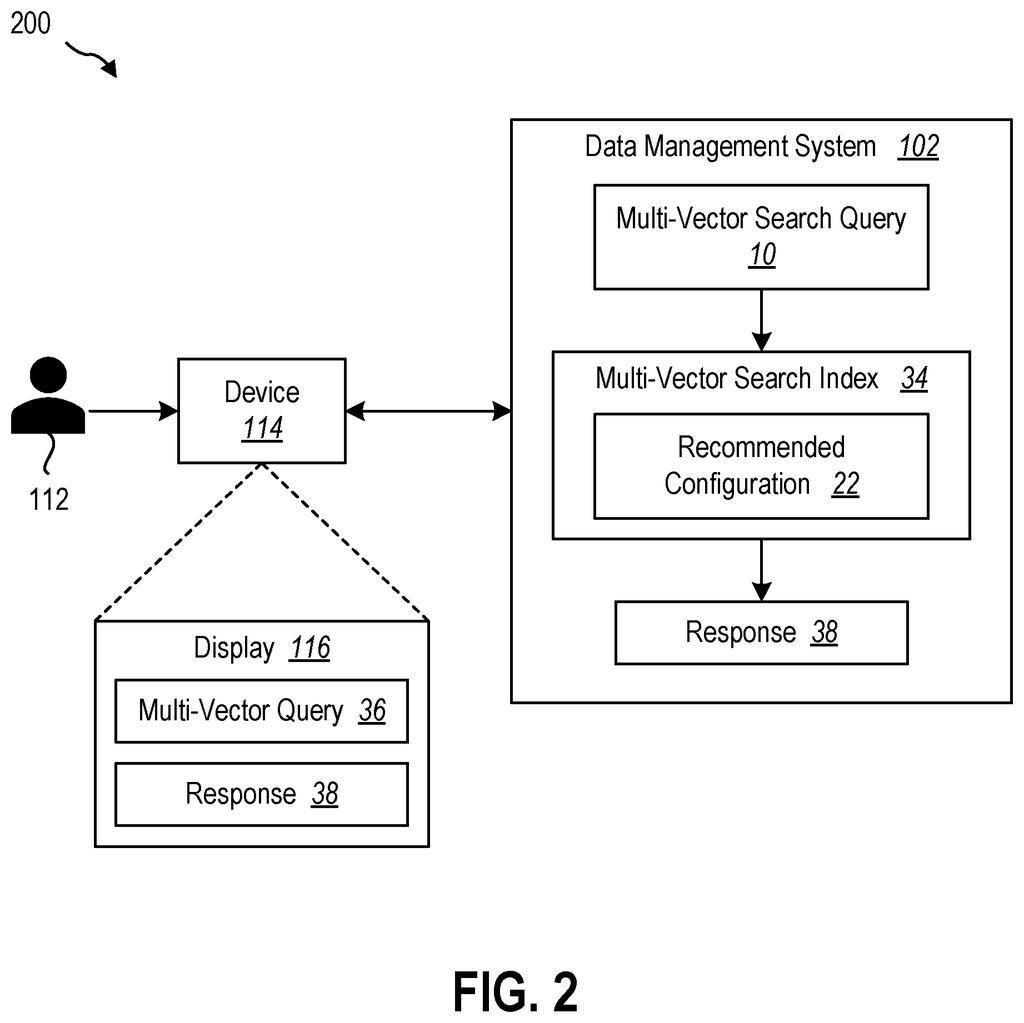
Microsoft's index tuner takes three inputs: a sample of typical searches, a storage limit, and a recall threshold (the minimum share of the truly closest matches a search must return). It then hunts through possible shortcut sets, sometimes using cheap stand-in shortcuts built from samples, for the set with the lowest delay that still meets both limits. For each search it produces a plan:
- Which shortcuts to use and how many items to pull from each
- An estimated cost (scanning the shortcuts plus re-ranking the candidates)
- An estimated recall, checked against the true closest matches
The claims highlight multi-column indexes, single shortcuts covering a sequence of columns that can also answer searches on just the first few of them. The tuner only outputs a recommendation after confirming the storage and recall limits hold. The description adds that machine learning models can do the searching and estimating.
The present disclosure relates to systems and methods for multi-vector search index tuning. The systems and methods select a recommended configuration of vector indexes for a given set of multi-vector queries while maintaining storage constraints and recall constraints for the vector indexes.
Translation: Microsoft patented a method to automatically tune search tools for text and images without breaking storage limits.
Why faster text-and-image search matters
If you run an app that searches by meaning across text, photos and more, the shortcut setup decides how fast results appear and how large your storage bill gets. Microsoft's tool tries to settle that automatically instead of leaving it to a database engineer's guesswork. Faster, leaner search could matter for shopping, photo libraries and AI assistants that look things up before answering (the filing names retrieval-augmented generation, a common way chatbots fetch facts).
The patent describes a general tuning tool and names no specific Microsoft product. It is already a granted patent, though the final granted claims may read a little differently from the published application described here.
Microsoft's 636th filing in our Microsoft coverage since May follows work on smarter job-search ranking and context-aware memory chips.
Source: US 2026/0359276 A1 at the USPTO (PDF). Full patent text and figures are in the official publication.
Get our take in your Top Stories
Liked this breakdown? Add Patentlyze as a preferred source on Google, and our plain-English take shows up more often in your Top Stories the next time Microsoft patent news breaks.
Add Patentlyze on Google
One click.
There are more where this came from
We read every patent application Big Tech publishes and send you the ones worth knowing. Plain English, free, every week.
The drawings · 4 sheets
4 drawing sheets from US 2026/0359276 A1 · click any drawing to enlarge


More from Microsoft
All 646 Microsoft patents →
More in Software
All 753 Software patents →
Google
Google Files Patent for Swapping Your Search for a Stand-In Phrase Advertisers See
Adobe
Adobe Files Patent for Turning Flat AI Images Into Layered, Editable Artwork
Sony
Sony Files Patent for Turning Gameplay Video Into a Single Image to Catch Bugs
Adobe
No comments yet