
Microsoft
Microsoft · AI / ML · Filed May 31, 2025 · USPTO published Nov 12, 2026 · This week's release
Microsoft Files Patent for an AI That Suggests Your Next Move in Work Apps
Microsoft's patent application describes an AI that notices which work record you open, then suggests the next step, like approving a claim, before you have to work it out yourself.
- Publication number
- US 2026/0359188 A1(US20260359188A1)
- Applicant
- Microsoft Technology Licensing, LLC
- Filed · Published
- May 31, 2025 · Nov 12, 2026
- Inventors
- Conrad WONG GONZALEZ, Rachel KINGDON, Kavishi AGARWAL, Esin SAKA, Anthony Ronald UITZ, Alexander Thien TRAN, Antonio RUIZ FERNANDEZ, Vandana JAIN
- Status when we published
- Waiting for an examiner
- Document
- 20 claims
- US classification
- 715/704
- Parent application
- Claims priority from a provisional application 63804454 (filed May 12, 2025)
What Microsoft's suggested-actions patent does
Every time you open a customer claim or a support case at work, you stop and ask the same question: what am I supposed to do with this one? Multiply that by dozens of records a day and the clicking adds up.
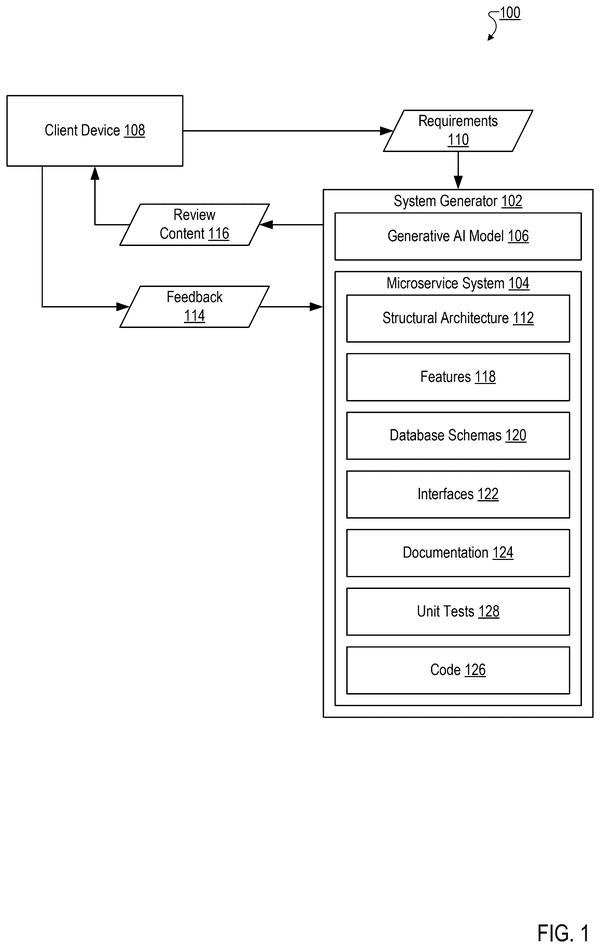
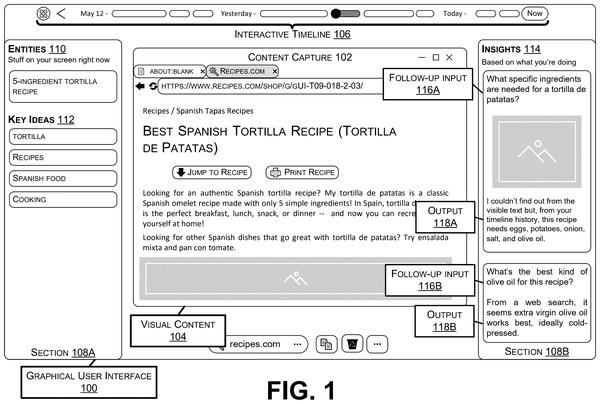
Microsoft's patent application describes an AI helper that answers that question for you. The person who builds the app writes down, in ordinary sentences, what actions exist, like approve a claim when it follows company policy. The AI studies sample records and turns that loose note into firm rules. Then, when you open a record, it checks the record against those rules and offers a suggestion, such as Approve claim 1029.
Before anything reaches you, the system checks that the suggestion is allowed for your account and that the AI is confident enough. It can simply suggest, offer an assistant to do the work, or do it in the background.
determining that a data record is in a navigation path of a user account; submitting the data record and a formal workflow rule to a language model with an action generation prompt to determine whether any formal workflow rule applies to the data record …
Translation: The system watches what you are looking at and feeds that data into an AI along with company rules.
How Microsoft's two-step AI picks an action
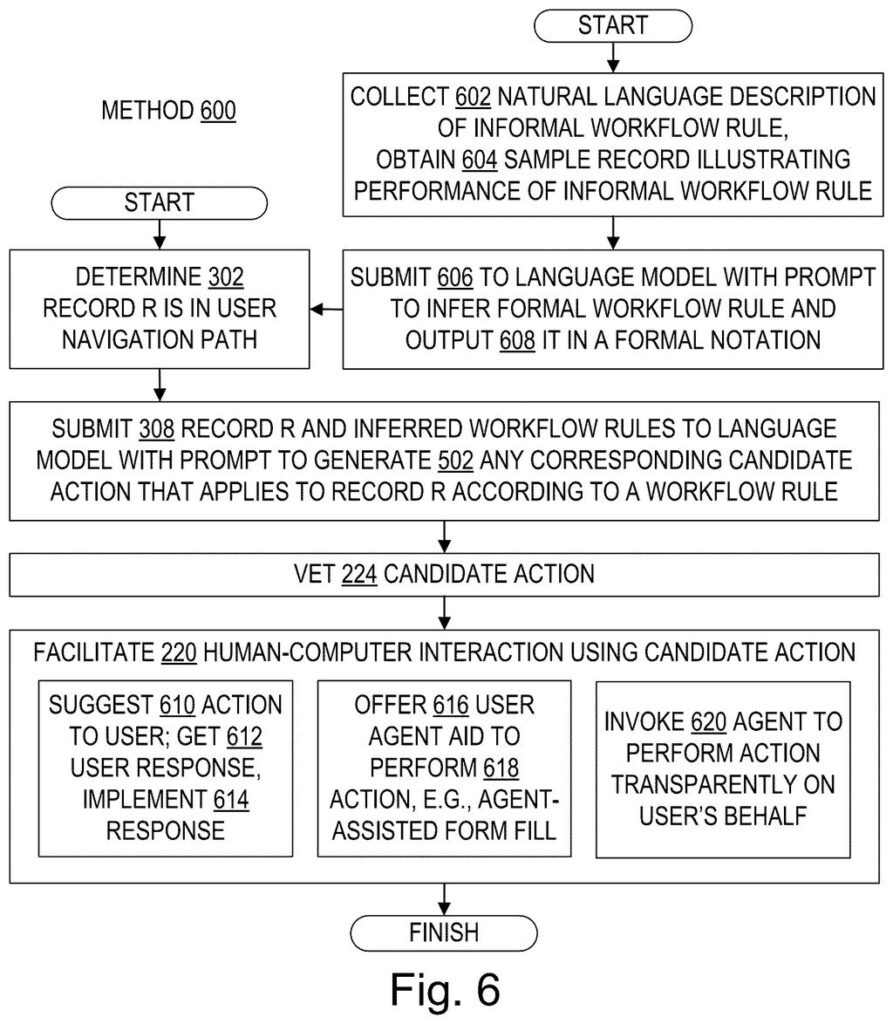
The patent has two stages. The first is rule inference: an app builder describes an action in plain language, and the system sends that note plus sample records to a language model (an AI trained on text). It asks the model to write a formal workflow rule, a precise, machine-readable version, in a format like JSON. In the filing's example, the AI works out that claims in the right category between 50 and 1,000 dollars can be approved.
The second stage is action generation. When a record lands in your navigation path (you open it, hover over it, or it sits in your recent or most-used list), the system sends that record and the rules to the model. The model returns candidate actions, each with a confidence score from 0 to 100 and a short reason.
Then comes vetting. The filing lists checks like these:
- Does your account have the permission or role to do this?
- Would the action leak confidential data from one record to another?
- Is confidence above a cutoff? One example drops a 0.35 against a 0.7 threshold.
- Is the priority high enough, and does it meet responsible-AI criteria?
The costly rule-writing happens once and is shared across accounts, while the per-record check is a lighter prompt.
Some vet candidate actions according to a confidence they apply to a record, compliance with user account security permissions, or other criteria.
Translation: Before making a suggestion, the software checks how certain it is and whether you have permission to do it.
Why Microsoft's patent matters for Dynamics users
If you work through queues of claims, cases or requests, this could turn a pile of records into a short to-do list with a suggested action on each. The filing describes showing up to 5, 10 or 20 active suggestions at a time, jumping you to the right record, and keeping suggestions around for a set period such as 7 days.
For companies building these apps, the pitch is that the builder writes plain sentences instead of code, and the AI does the rest. The filing names Microsoft's Power Platform model apps and Dynamics as the setting, and says an internal prototype used GPT-4.1 mini. As with any patent application, it shows an idea Microsoft wants to protect, not a product on its way.
Microsoft's 32nd filing we've tracked since July in our AI agents that act for you watchlist follows its work on two small AIs teaming up and an AI building apps from text.
Source: US 2026/0359188 A1 at the USPTO (PDF). Full patent text and figures are in the official publication.
Get our take in your Top Stories
Liked this breakdown? Add Patentlyze as a preferred source on Google, and our plain-English take shows up more often in your Top Stories the next time Microsoft patent news breaks.
Add Patentlyze on Google
One click.
There are more where this came from
We read every patent application Big Tech publishes and send you the ones worth knowing. Plain English, free, every week.
The drawings · 4 sheets
4 drawing sheets from US 2026/0359188 A1 · click any drawing to enlarge


More from Microsoft
All 646 Microsoft patents →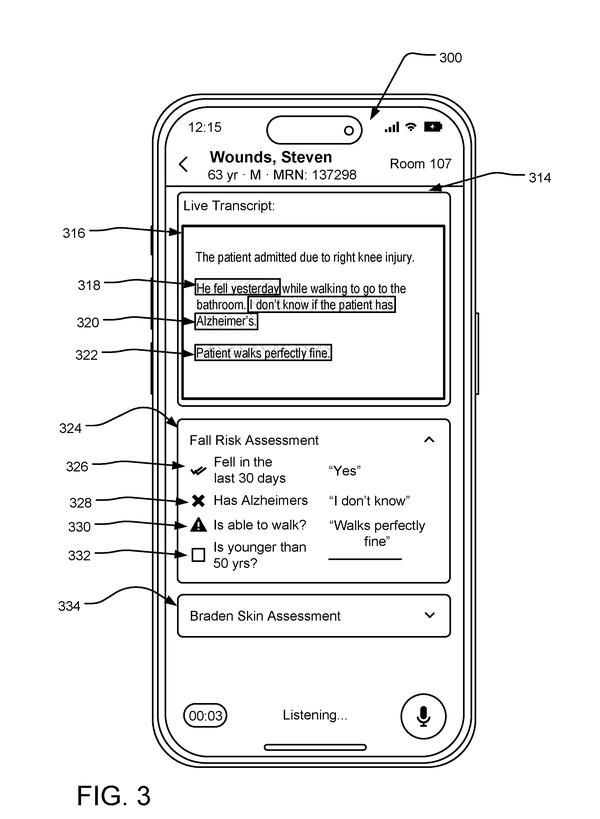
More in AI / ML
All 2,637 AI / ML patents →
Google
Google Patents a System That Turns Smart Home Sensor Data Into Suggested Actions
Sony
Sony Patents an AI That Picks Your Game Settings From a Plain-English Request
Google
Google Patents a System That Acts on Your Messages the Moment You Hit Send
Samsung
No comments yet