

Samsung
Samsung · Battery & power · Filed Mar 27, 2026 · USPTO published Nov 12, 2026 · This week's release
Samsung Patents a Leg-Assist Wearable That Won't Power Up Until It's Strapped On Right
Samsung's walking-assist wearable has a motor that pushes on your legs, so this patent has the device confirm the straps are snug before the motor is allowed to move. It treats a loose strap as a safety problem.
- Publication number
- US 2026/0355042 A1(US20260355042A1)
- Applicant
- Samsung Electronics Co., Ltd.
- Filed · Published
- Mar 27, 2026 · Nov 12, 2026
- Inventors
- Taehyun LEE
- Status when we published
- Waiting for an examiner
- Document
- 20 claims
- US classification
- 601/5
- Parent application
- Continuation of PCT/KR2024/014714 (filed Sep 27, 2024)(PCTKR2024014714)
What Samsung's strap-checking wearable does
Every time you strap on a walking-assist wearable, a few belts are all that stand between a motor's push and your thighs. If a strap is loose, some of that push gets lost instead of moving your leg.
Samsung's patent application adds pressure sensors to the inside of the thigh straps. Until those sensors feel firm contact, the device stays in an idle mode where the motor is not allowed to produce force. If the contact is too light, it buzzes or speaks a prompt asking you to re-fit it.
The filing also describes checking while you exercise, since straps loosen as you move. Some versions even tighten the straps on their own.
… changing the operating mode of the wearable device to an active mode in response to a determination that the wearable device is properly worn by the user.
Translation: The motor only turns on after the system confirms it is strapped on right.
How the thigh straps tell the motor to start
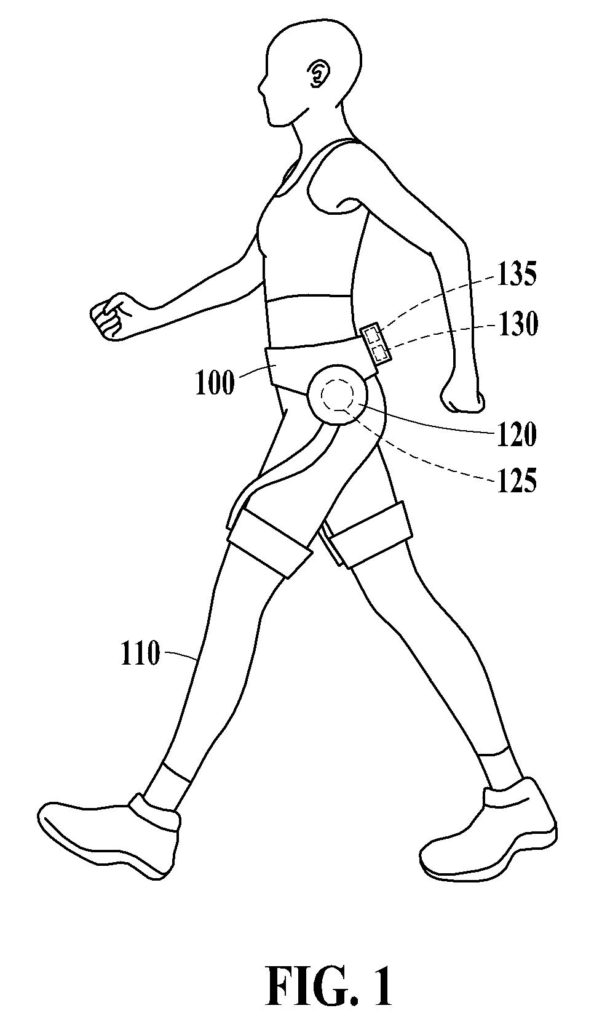
Claim 1 describes a motorized wearable that pushes or pulls on your legs. It has a driving module (the motor), a torque transmission frame (a rigid arm that carries the motor's twisting force to your leg), and a thigh fastener (the strap that holds that arm to your thigh).
The new piece is a pressure sensor on the side of the thigh fastener that faces your body. A processor reads it and decides whether the device is worn properly. In the described version, a reading above a reference value counts as snug and a reading at or below it counts as loose. Until the check passes, the device sits in an idle mode, where the motor can't produce force. Once it passes, it switches to an active mode, where an exercise program or a user command can start the motor.
If the fit fails, the device can vibrate or play a voice prompt asking you to re-fit it. During use it keeps watching, using the pressure sensor and, optionally, a torque sensor (which measures the motor's twisting force), because a gap under a strap changes both readings.
The filing also describes some extras:
- A second pressure sensor in the lower-back base to check the waist side.
- Optional self-tightening adjusters, using air pressure or a motor-and-wire dial, that tighten the thigh and waist straps until the pressure reads right.
- Detecting when you take the device off, then returning it to idle.
Why a loose strap is a safety problem here
Anything that pushes on your body needs to be strapped on correctly, and most people won't notice a slightly loose strap. This filing moves that check from your judgment to the device. In practice that could mean less fiddling before each session and less of the motor's effort leaking away through a gap.
The description is plain about the motive: proper fit matters for safety and ease of use. It also ties the idea into a wider setup, with prompts through earphones, a smartwatch or a phone, and automatic exercise suggestions once the fit is right. As a patent application, it describes an idea, not a product you can buy.
Samsung's 46th entry in our battery & power coverage since May joins earlier applications like the crooked phone wireless charging fix and the side-agnostic health ring.
Source: US 2026/0355042 A1 at the USPTO (PDF). Full patent text and figures are in the official publication.
Get our take in your Top Stories
Liked this breakdown? Add Patentlyze as a preferred source on Google, and our plain-English take shows up more often in your Top Stories the next time Samsung patent news breaks.
Add Patentlyze on Google
One click.
There are more where this came from
We read every patent application Big Tech publishes and send you the ones worth knowing. Plain English, free, every week.
The drawings · 12 sheets
12 drawing sheets from US 2026/0355042 A1 · click any drawing to enlarge


Show the other 4 sheets


More from Samsung
All 1,629 Samsung patents →
More in Battery & power
All 116 Battery & power patents →
IBM
IBM Patents a Wearable That Charges Itself from Sunlight, Body Heat, or Motion
Amazon
Amazon Patents a Fix for Gesture-Sensing Antennas That Lose Accuracy at Variable Power

Disney
Disney Patents a Way to Wirelessly Power Objects Inside Water
Sony
No comments yet